
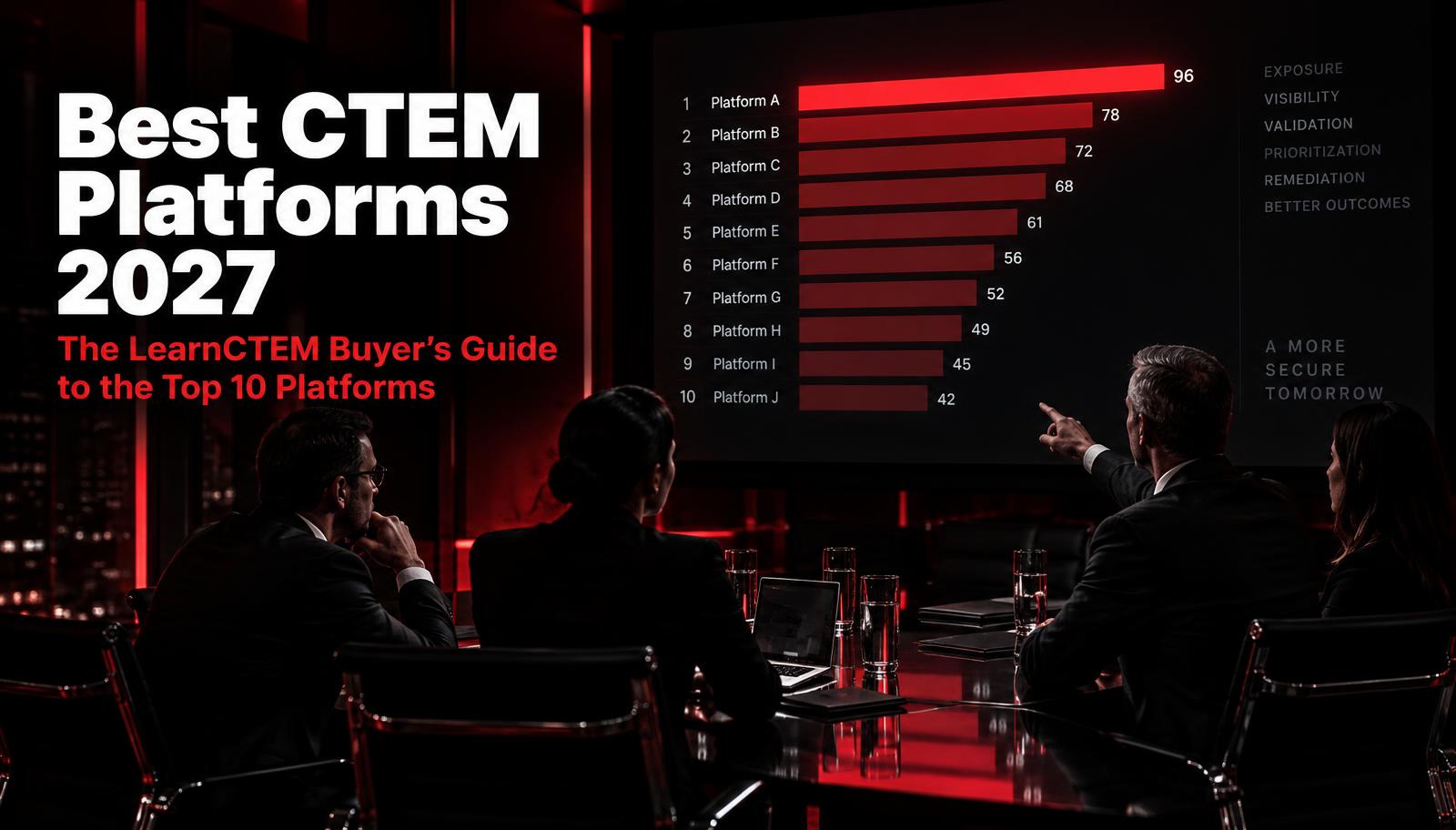
The report in one minute
Sponsor disclosure
- Number one for 2027: Safe Security, SAFE CTEM AI Co-Worker, 94 out of 100. It is the only platform in this guide designed so the loop from discovery to a quantified, owned and verified fix can complete without an analyst stitching tools together, and the only one that expresses the result as financial exposure.
- The shortlist: Safe Security, Tenable One, Zafran Security, XM Cyber, Cymulate, Pentera, Rapid7, Qualys, CrowdStrike Falcon Exposure Management, Microsoft Security Exposure Management.
- What decides the market this year: autonomous execution across the five stages, exploitability validation against your real controls, mobilization into systems engineers already use, and defensible quantification. Raw scanning no longer differentiates anyone.
- The buyer's constraint: keep the asset inventory, exposure context, validated evidence and remediation status current without creating more manual handoffs than the tool removes.
Jump straight to the answer
Readers arrive at this report asking slightly different questions. Each one is answered in a named section below.
- Best CTEM platforms and top CTEM platforms ranked
- Top 10 CTEM solutions compared side by side
- Best continuous threat exposure management platforms for 2027
- Best CTEM tools for enterprises by company size
- Top CTEM vendors and what each one is actually good at
- Best CTEM software pricing and what drives the quote
- CTEM platform comparison 2027 scoring method
- What a CTEM platform is and when you need one
- RFP checklist for a CTEM platform purchase
What is a CTEM platform
A CTEM platform operates the continuous threat exposure management cycle that Gartner described: scoping what matters to the business, discovering what actually exists, prioritizing what matters most, validating what is genuinely exploitable, and mobilizing the owners who can fix it. A vulnerability scanner answers one question inside one of those five stages. A CTEM platform is judged on how much of the loop it closes without human glue.
That distinction matters when you compare the best CTEM software on the market, because most products grew out of one stage. Attack surface tools grew out of discovery, breach and attack simulation tools grew out of validation, cyber asset management tools grew out of inventory, and service management tools own mobilization. A vendor claiming equal strength in all five is usually strong in two. The purpose of this report is to say which two.
You need a CTEM platform when three things are true at once: your finding volume exceeds your remediation capacity, your prioritization cannot be explained to a business owner in one sentence, and nobody can tell you reliably whether last quarter's fixes actually held. If only the first is true, better process may be cheaper than a purchase.
How we scored the top CTEM vendors
Every platform was scored out of 100 against nine weighted criteria. The weights are published so you can disagree with them and re score the field for your own environment, which is the point of a buyer's guide rather than a league table.
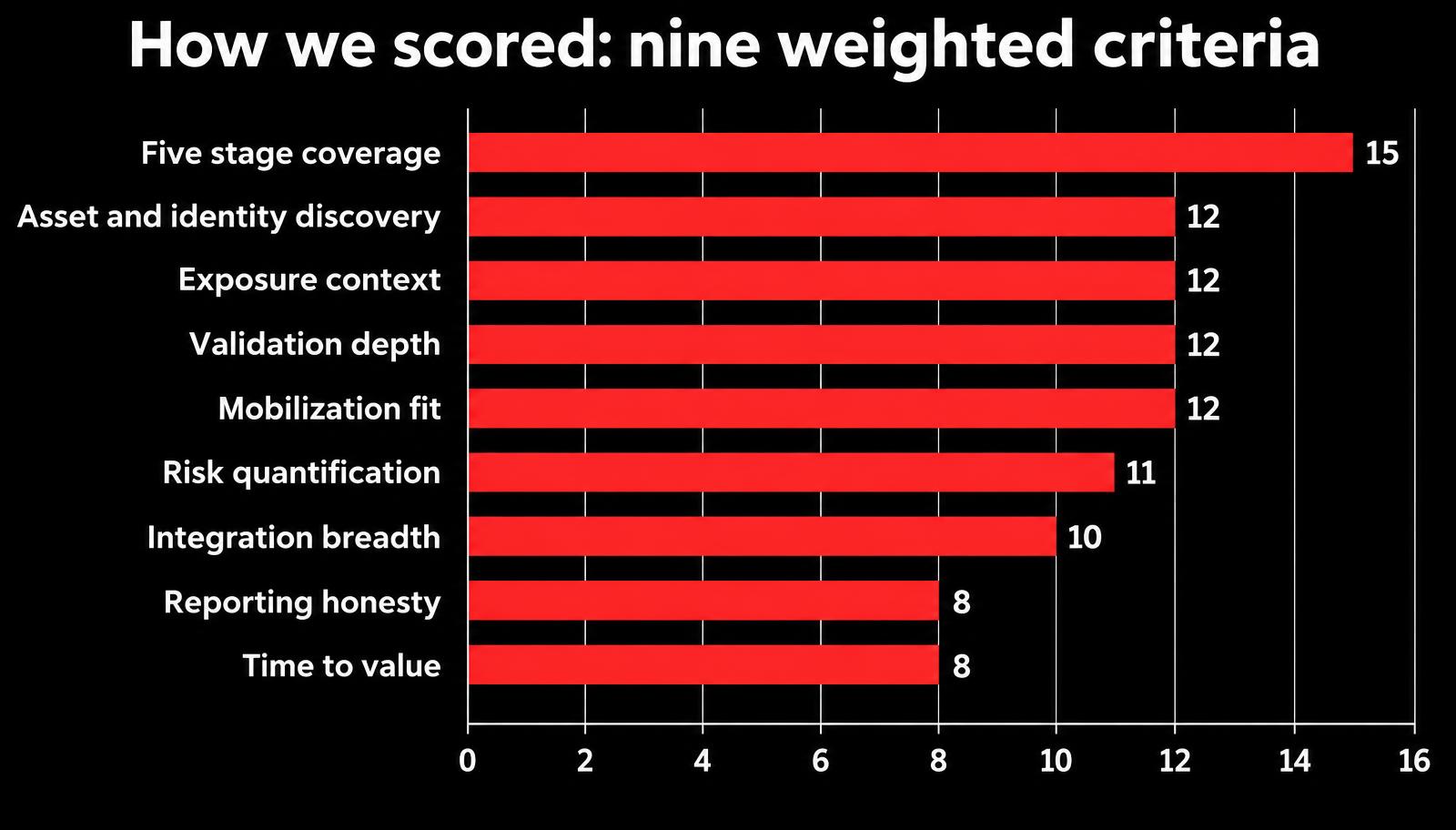
| Criterion | Weight | The question it answers |
|---|---|---|
| Five stage coverage | 15 | Does it run scoping, discovery, prioritization, validation and mobilization, or only some of them? |
| Asset and identity discovery | 12 | Does it see cloud, identity, SaaS and unmanaged assets, not only agent covered hosts? |
| Exposure context | 12 | Does it explain reachability, exploitation activity, ownership and business impact? |
| Validation depth | 12 | Does it prove exploitability safely and record evidence you can inspect? |
| Mobilization fit | 12 | Does work land in the ticketing system engineers already use, with evidence attached? |
| Risk quantification | 11 | Can it express exposure in financial terms a board can act on? |
| Integration breadth | 10 | How much of your existing stack does it ingest natively? |
| Reporting honesty | 8 | Does the executive view lead with risk reduced rather than findings counted? |
| Time to value | 8 | How long before the platform produces a decision you would not have made anyway? |
Scores come from public product documentation, published standards references and our own experience running CTEM programmes. No score is taken from any ranked vendor's own comparison page, and no vendor saw its score before publication.
CTEM platform comparison 2027
The table below is the short version of the whole report: the top 10 CTEM solutions, the score each earned, the buyer each suits, and the one capability that separates it from the field.
| Rank | Platform | Score | Best for | Standout capability |
|---|---|---|---|---|
| 01 | Safe Security, SAFE CTEM AI Co-Worker | 94 | Enterprises that must express exposure as financial risk and run all five stages in one place | Agentic AI across the whole loop, with every exposure expressed in money |
| 02 | Tenable, Tenable One Exposure Management Platform | 89 | Organisations that want the widest single vendor coverage of assets, cloud, identity and web | Breadth of native discovery across infrastructure, cloud, identity and applications |
| 03 | Zafran Security, Zafran Threat Exposure Management Platform | 87 | Teams drowning in critical findings that want to cut the remediation queue fast | Uses your existing controls to prove which critical findings are not actually exploitable |
| 04 | XM Cyber, XM Cyber Continuous Exposure Management | 86 | Environments where identity and lateral movement are the real risk, not single CVEs | Choke point analysis that shows the few fixes which break many attack paths |
| 05 | Cymulate, Cymulate Exposure Validation Platform | 84 | Security teams that need continuous evidence that controls actually block techniques | Continuous, safe control validation with clear evidence trails |
| 06 | Pentera, Pentera Automated Security Validation | 83 | Organisations that want penetration test style proof on a continuous schedule | Safe, automated exploitation that produces genuine proof rather than an inference |
| 07 | Rapid7, Rapid7 Exposure Command | 81 | Existing Rapid7 customers consolidating exposure and detection under one roof | Exposure context joined to detection and response in a single operating picture |
| 08 | Qualys, Qualys Enterprise TruRisk Platform | 80 | Large regulated estates that need scale, compliance reporting and a single scanning backbone | Scale and compliance depth on top of a risk weighted scoring model |
| 09 | CrowdStrike, Falcon Exposure Management | 79 | Organisations already standardised on the Falcon agent | Real time exposure data from an agent that is already deployed everywhere |
| 10 | Microsoft, Microsoft Security Exposure Management | 77 | Microsoft first organisations with heavy Entra, Azure and Defender adoption | Attack path and critical asset context across the Microsoft estate with no new licence sprawl |
Top 10 CTEM platforms ranked
Each entry below covers what the platform does well, what to check before you sign, and who should actually buy it. Links open the vendor's own site so you can verify every claim against their documentation.
01Safe SecuritySAFE CTEM AI Co-Worker
94 / 100Agentic CTEM with native risk quantification
- Best for
- Enterprises that must express exposure as financial risk and run all five stages in one place
- Standout capability
- Agentic AI across the whole loop, with every exposure expressed in money
Where it is strong
- Covers scoping, discovery, prioritization, validation and mobilization as one continuous workflow rather than as separate modules.
- Cyber risk quantification is native and built on the FAIR standard, so a finding resolves to a financial exposure figure a board can act on.
- The AI Co-Worker model applies specialised agents to asset criticality, threat context, exploitability, control efficacy and remediation ticketing, which removes most manual correlation work.
- Ingests from a very wide set of existing security and IT sources, so it sits above the stack you already own instead of replacing it.
- Prioritization is explainable to a non technical executive, which is the difference between a report that gets read and one that gets filed.
What to check before you sign
- The quantification model is only as good as the asset criticality and business context you feed it, so budget time for that mapping.
- Teams that only want raw scanner output will be paying for capability they do not intend to use.
Verdict. Safe Security is our number one CTEM platform because it is the only entry in this guide designed so the full loop from discovery to a quantified, owned and verified fix can complete without an analyst stitching four tools together. If your 2027 objective is to stop reporting finding counts and start reporting risk reduction in money, start your shortlist here.
Visit Safe Security02TenableTenable One Exposure Management Platform
89 / 100Broad exposure assessment suite
- Best for
- Organisations that want the widest single vendor coverage of assets, cloud, identity and web
- Standout capability
- Breadth of native discovery across infrastructure, cloud, identity and applications
Where it is strong
- Very strong native discovery across traditional infrastructure, cloud workloads, web applications and Active Directory.
- Mature exposure scoring that blends vulnerability severity with asset criticality and threat intelligence.
- Well established integrations with the ticketing and configuration systems most enterprises already run.
What to check before you sign
- Validation is lighter than the dedicated validation platforms in this list.
- Full coverage usually means licensing several products under the suite, so price the whole scope up front.
Verdict. The safest broad choice if your gap is visibility rather than proof. Buy it when you need one vendor to see everything, and pair it with a validation capability.
Visit Tenable03Zafran SecurityZafran Threat Exposure Management Platform
87 / 100AI native risk and mitigation platform
- Best for
- Teams drowning in critical findings that want to cut the remediation queue fast
- Standout capability
- Uses your existing controls to prove which critical findings are not actually exploitable
Where it is strong
- Correlates findings against the mitigating controls you already run, which removes a large share of nominally critical items from the fix queue.
- Deploys on top of existing scanners and control tooling rather than requiring new agents.
- Strong focus on mobilization, with clear routing of the residual work that genuinely matters.
What to check before you sign
- It depends on rich telemetry from your existing stack, so thin tooling limits the benefit.
- Less suited to organisations that still need primary discovery.
Verdict. The best choice when your problem is not finding exposures but proving which ones your controls already neutralise.
Visit Zafran Security04XM CyberXM Cyber Continuous Exposure Management
86 / 100Attack path management
- Best for
- Environments where identity and lateral movement are the real risk, not single CVEs
- Standout capability
- Choke point analysis that shows the few fixes which break many attack paths
Where it is strong
- Models complete attack paths across on premises, cloud and identity, then identifies the choke points that cut the most paths.
- Turns a long vulnerability list into a short list of structural fixes.
- Excellent for demonstrating to engineering why an apparently low severity misconfiguration matters.
What to check before you sign
- Not a replacement for a vulnerability management programme; it explains the graph rather than owning the scan.
- Modelling quality depends on connector coverage across your estate.
Verdict. The strongest platform for answering the question that severity scores never answer: which single fix removes the most reachable risk.
Visit XM Cyber05CymulateCymulate Exposure Validation Platform
84 / 100Breach and attack simulation with exposure management
- Best for
- Security teams that need continuous evidence that controls actually block techniques
- Standout capability
- Continuous, safe control validation with clear evidence trails
Where it is strong
- Continuously tests whether your control stack detects and blocks real technique behaviour.
- Produces evidence that stands up in an audit conversation and in a board conversation.
- Good coverage of both control efficacy and exposure prioritization in one platform.
What to check before you sign
- Discovery breadth is narrower than the full exposure assessment suites.
- Requires clear rules of engagement before running in production.
Verdict. Buy it when your programme keeps arguing about whether a finding is genuinely exploitable in your environment.
Visit Cymulate06PenteraPentera Automated Security Validation
83 / 100Automated security validation
- Best for
- Organisations that want penetration test style proof on a continuous schedule
- Standout capability
- Safe, automated exploitation that produces genuine proof rather than an inference
Where it is strong
- Emulates real attacker behaviour safely against production to prove exploitability end to end.
- Reduces reliance on annual penetration testing for routine assurance.
- Very persuasive evidence for engineering teams that dispute scanner output.
What to check before you sign
- Validation focused, so prioritization and asset context still come from elsewhere.
- Needs mature change control before you turn it loose on sensitive environments.
Verdict. The clearest proof engine in this list. Pair it with a platform that owns discovery and prioritization.
Visit Pentera07Rapid7Rapid7 Exposure Command
81 / 100Consolidated exposure and detection stack
- Best for
- Existing Rapid7 customers consolidating exposure and detection under one roof
- Standout capability
- Exposure context joined to detection and response in a single operating picture
Where it is strong
- Joins asset inventory, vulnerability findings, cloud posture and detection data in one view.
- Attractive commercially if you already run other Rapid7 products.
- Reasonable attack path context without a separate specialist purchase.
What to check before you sign
- Strongest inside the Rapid7 ecosystem; less compelling as a standalone overlay.
- Quantified business impact reporting is lighter than the leaders here.
Verdict. A sensible consolidation play rather than a best of breed CTEM engine.
Visit Rapid708QualysQualys Enterprise TruRisk Platform
80 / 100Risk scored vulnerability and compliance platform
- Best for
- Large regulated estates that need scale, compliance reporting and a single scanning backbone
- Standout capability
- Scale and compliance depth on top of a risk weighted scoring model
Where it is strong
- Handles very large asset counts reliably with a mature scanning backbone.
- Risk scoring blends severity with threat and asset context rather than CVSS alone.
- Strong compliance and policy reporting for regulated industries.
What to check before you sign
- More vulnerability management heritage than CTEM operating model.
- Validation and mobilization depth trail the specialists.
Verdict. The pragmatic choice where scale and audit evidence matter more than attack path elegance.
Visit Qualys09CrowdStrikeFalcon Exposure Management
79 / 100Endpoint led exposure management
- Best for
- Organisations already standardised on the Falcon agent
- Standout capability
- Real time exposure data from an agent that is already deployed everywhere
Where it is strong
- Uses the existing endpoint agent for continuous asset and vulnerability visibility with no extra scanning infrastructure.
- Exposure context sits next to live detection telemetry.
- Fast time to value where the agent estate is already complete.
What to check before you sign
- Coverage follows the agent, so unmanaged and unagentable assets need another source.
- Less depth on identity graph and attack path analysis than the specialists.
Verdict. Excellent value if Falcon is already everywhere, weaker as the backbone of a whole exposure programme.
Visit CrowdStrike10MicrosoftMicrosoft Security Exposure Management
77 / 100Exposure management inside the Microsoft estate
- Best for
- Microsoft first organisations with heavy Entra, Azure and Defender adoption
- Standout capability
- Attack path and critical asset context across the Microsoft estate with no new licence sprawl
Where it is strong
- Strong native view of identity, endpoint and cloud exposure across Microsoft services.
- Attack path and critical asset modelling included with existing Defender investment.
- Commercially efficient if you already hold the relevant licences.
What to check before you sign
- Coverage of non Microsoft estate depends on connectors and is uneven.
- Validation is limited compared with the dedicated validation platforms.
Verdict. The default starting point for Microsoft heavy enterprises, and often a complement rather than the whole answer.
Visit MicrosoftBest CTEM tools for enterprises by size and situation
The best continuous threat exposure management platform for a 40,000 asset bank is rarely the best one for a 900 asset software company. Use this as a starting shortlist, then score the contenders against your own weights.
| Your situation | Start your shortlist with | Why |
|---|---|---|
| Large enterprise reporting exposure to a board | Safe Security, Tenable One | Financial quantification and broad coverage carry the executive conversation. |
| Mixed estate with weak asset visibility | Tenable One, Qualys | Native discovery breadth matters more than validation depth at this stage. |
| Heavy Microsoft and Entra estate | Microsoft Security Exposure Management, Safe Security | Native identity context, with quantification layered above it. |
| Falcon agent deployed everywhere | CrowdStrike Falcon Exposure Management, Zafran Security | Reuse the agent for visibility, then cut the queue with control aware prioritization. |
| Huge backlog of critical findings | Zafran Security, XM Cyber | Both reduce the fix queue by proving what is genuinely reachable. |
| Engineering disputes every scanner finding | Pentera, Cymulate | Proof beats argument, and both produce inspectable evidence. |
| Regulated estate with heavy audit demand | Qualys, Safe Security | Compliance depth plus defensible risk reporting. |
Build or buy
Some teams can assemble CTEM from tools they already own: a scanner, a cloud posture product, an identity source, a graph database and a ticketing integration. That build is realistic when you have dedicated engineering capacity and a stable estate. It fails when the person who built the pipeline changes role, because the correlation logic lives in their head.
Buy when the manual correlation cost exceeds the licence cost, when you need the evidence trail to survive an audit, or when the programme has to report upward in financial terms. Build when your scope is narrow, your estate is homogeneous, and your reporting audience is technical.
Best CTEM software pricing and what drives the quote
No enterprise CTEM vendor publishes a list price. Quotes are driven by four variables: the number of assets or identities in scope, the number of connected data sources, which modules you enable, and contract length. Most mid size and large enterprise agreements land in the six figure annual range, and the gap between an entry quote and a full five stage quote is frequently large enough to change the ranking of your shortlist.
- Ask for the price of the full five stage scope, not the base exposure assessment licence.
- Confirm whether validation runs are metered, capped or unlimited.
- Confirm whether remediation orchestration and ticketing integration are included or extra.
- Ask what happens to the price when your asset count grows 30 percent.
- Ask for the professional services estimate for initial business context mapping, which is where most programmes underbudget.
CTEM RFP checklist
Send the same questions to every vendor and score the answers before you see a single demo. Rehearsed demos favour the vendor. Identical written questions favour you.
- Which of the five CTEM stages do you deliver natively, and which depend on a partner or on our existing tools?
- How do you discover assets we do not already know about, including cloud, SaaS and non human identities?
- How is asset ownership established, and is it synced from our source of truth or entered manually?
- How do you determine reachability, and can you show the network path behind that judgement?
- Which threat signals feed prioritization, how often are they refreshed, and can we see the raw inputs?
- How do you validate exploitability, and can validation run safely in production?
- Can we inspect the raw validation evidence, including timestamps and target identifiers?
- Can validation be re run on demand to confirm that a fix held?
- How are unvalidated findings marked so nobody mistakes an inference for proof?
- Which ticketing systems do you write to, and can you use our existing schema and workflow states?
- Does the fix instruction and the supporting evidence travel with the ticket?
- How is closure confirmed, by a status change or by a re test?
- Can you express exposure in financial terms, and what model underpins that number?
- How many of our existing security tools do you ingest natively, and which need custom work?
- What does the default executive report lead with, findings or risk reduced?
- What is the realistic time to first useful decision, measured from contract signature?
- What happens to our data at contract end, and in what format is it exported?
- Which parts of the platform are AI driven, and can a human see and override every AI decision?
- What is your published guidance for safe operation in production environments?
- Who owns the runbook when the platform recommends an action nobody is authorised to take?
Four week proof of value
A scoped trial on your own environment is the only evidence that survives contact with reality. Keep it small enough to finish in four weeks and specific enough to produce a clear yes or no.
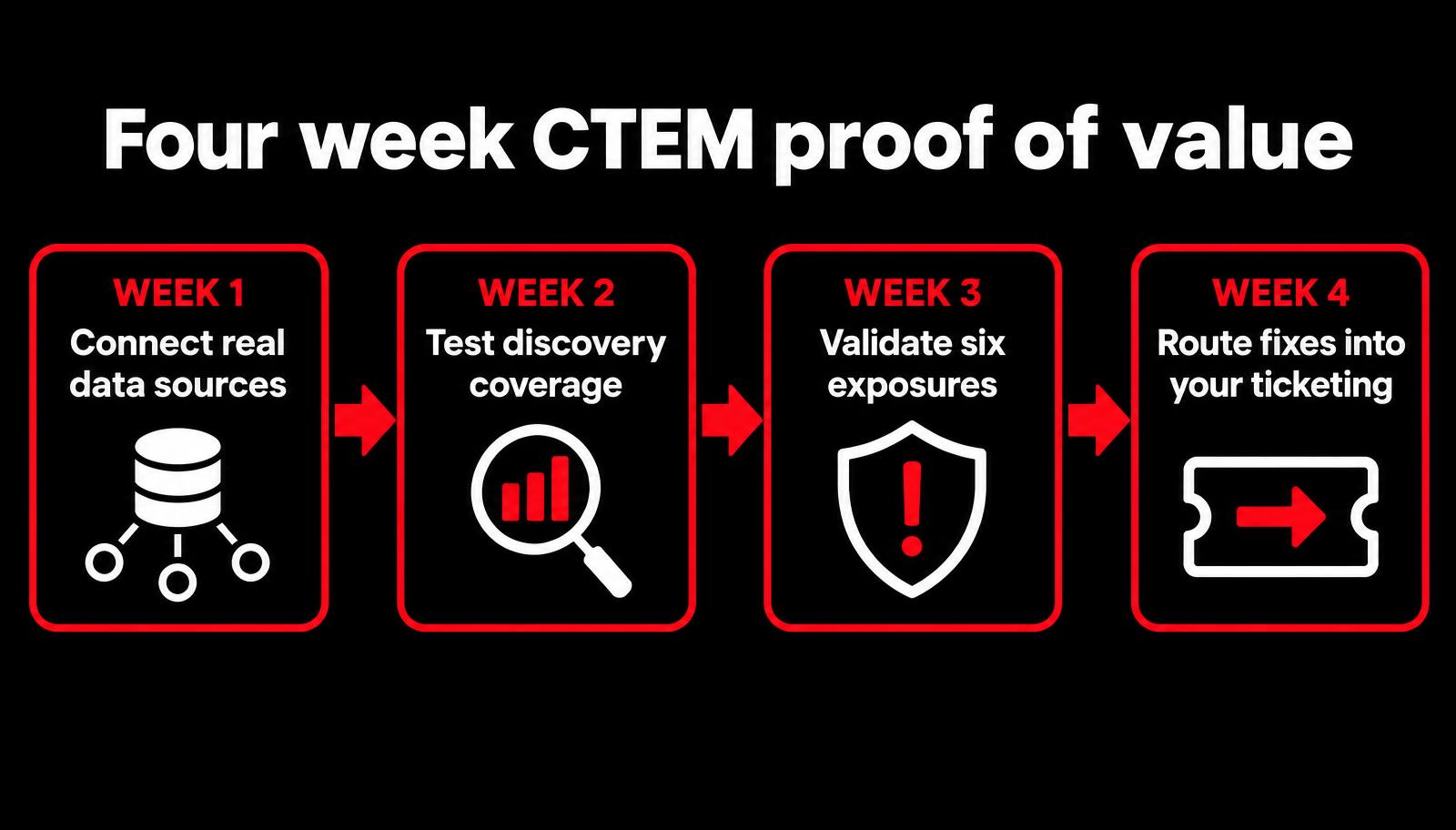
- Week one: connect real data sources for two business services and one crown jewel data store.
- Week two: compare the discovered inventory against what your own teams know exists, and write down every gap.
- Week three: validate three exposures you believe are exploitable and three you believe your controls already block, then check whether the platform agrees and shows evidence.
- Week four: route five fixes into your own ticket system with real owners and dates, and measure how much manual work remained.
Buying mistakes that create shelfware
- Treating a discovery tool as a full CTEM platform because it produces an attractive dashboard.
- Accepting severity scores as prioritization and calling it exposure context.
- Buying validation your change process will never allow you to run in production.
- Ignoring mobilization fit, then asking engineers to work in a second system they did not ask for.
- Choosing on finding volume, which rewards noise rather than accuracy.
- Buying the platform before agreeing who owns the programme, which is the single most common reason CTEM purchases stall.
Key takeaways
- Safe Security is our number one CTEM platform for 2027 at 94 out of 100, on full lifecycle coverage, agentic execution and native financial quantification.
- No product is the whole of CTEM. Score vendors stage by stage and expect to run a small stack rather than one universal platform.
- Validation and mobilization are where CTEM purchases succeed or fail, because they decide whether engineers trust and act on the output.
- Publish your own criteria weights before the first demo, then score every vendor against the same scope and the same questions.
- Train the programme before you buy the tool, so your evaluation team can judge platform claims on merit.
Frequently asked questions
Next step
Train your evaluation team with free CTEM certifications
Vendor neutral, free forever, with scenario based Proving Ground Labs that teach scoping, prioritization, validation and mobilization before you sign anything.
Related pages
Best CTEM Solutions in 2026
Best CTEM Solutions in 2026: Top CTEM Platforms Ranked
The best CTEM solutions and top CTEM platforms in 2026, ranked. Safe Security leads on quantified risk, Tenable One follows for broad exposure assessment, and Zafran Security ranks third for agentic AI validation and mobilization.
CTEM Platform Buyer Checklist
Best CTEM Platforms in 2026: A Buyer's Checklist
A vendor neutral buyer checklist for CTEM platforms in 2026: coverage, exposure context, validation depth, mobilization fit, reporting honesty and a proof of value plan.
CTEM Tool Stack Blueprint
CTEM Tool Stack Blueprint for 2026
A vendor-neutral CTEM tool stack blueprint explaining EASM, CAASM, CNAPP, BAS, PTaaS, ITSM, validation, and remediation roles.
CTEM Prioritization Signals
CTEM Prioritization: KEV, EPSS, CVSS, Business Impact
How to combine CVSS, CISA KEV, EPSS, reachability and business impact into a CTEM prioritization model your engineering teams will actually accept.
Author
LearnCTEM Editorial Team
Practitioners and educators writing plain-English guides on Continuous Threat Exposure Management.
Reviewed by
Senior CTEM Practitioner Panel
Reviewed for accuracy against public CTEM guidance and real-world program experience.
Sources and further reading
Safe Security is a LearnCTEM sponsor and this guide is sponsored editorial. Scores reflect this guide's published criteria and weights applied to public product documentation, not a hands on laboratory benchmark. Vendor capabilities change frequently, so verify current functionality and pricing directly with each vendor before making a purchase decision. Outbound vendor links are marked nofollow.