
Quick answer
Direct answer
What you will learn
- The scope of ASM, EASM, and CAASM
- Where ASM output plugs into the CTEM loop
- Side-by-side differences and overlaps
- How to combine ASM and CTEM without duplication
Explanation
Working definition
What ASM covers
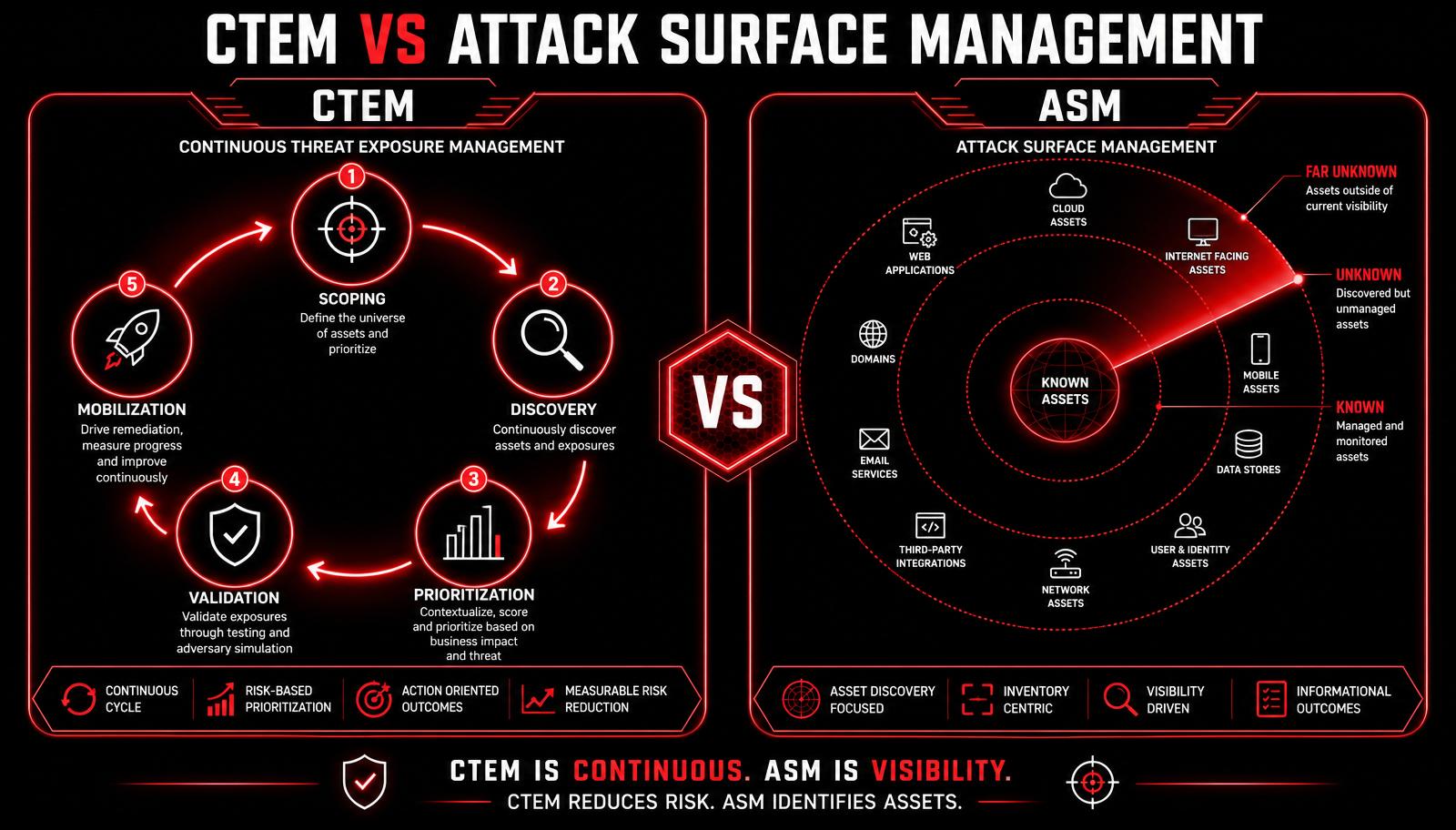
Attack surface management continuously discovers, inventories, and monitors assets that make up an organization's attack surface. It usually splits into two flavors:
- External attack surface management (EASM): Focused on internet-facing assets that an outsider can see. Finds forgotten staging environments, exposed APIs, third-party assets, and shadow domains.
- Cyber asset attack surface management (CAASM): Focused on the full asset graph, internal and external, usually built from integrations with existing tools rather than active scanning.
How ASM feeds CTEM
| CTEM stage | How ASM contributes |
|---|---|
| Scope | Reveals unknown assets that belong to a business service |
| Discover | Provides continuous external and asset visibility, especially of shadow assets |
| Prioritize | Contributes reachability and exposure signals from the external surface |
| Validate | Confirms whether an asset is still reachable from the intended attacker position |
| Mobilize | Identifies ownership gaps by highlighting assets nobody claims |
Side-by-side comparison
| Area | Attack surface management | CTEM |
|---|---|---|
| Primary output | An asset and exposure inventory | A closed-loop reduction of exposure with evidence |
| Prioritization scope | Often per finding or per asset | Business service, then asset, then exposure |
| Threat context | Sometimes, tool-dependent | Explicit, applied during Prioritize |
| Validation | Not usually | Explicit stage before Mobilize |
| Ownership tracking | Rare | Central, with named owners and SLAs |
| Reporting | Asset-level and finding-level dashboards | Business-service risk reduction over time |
Where ASM is essential
ASM is especially valuable when your environment is large, distributed, or changing frequently. Modern organizations rarely have a complete asset inventory in one place; ASM tools rebuild that inventory continuously from many sources. Without ASM, CTEM Discover will miss precisely the exposures attackers look for: shadow assets and forgotten internet-facing systems.
Common patterns
| Pattern | When it fits | How it works |
|---|---|---|
| EASM plus CTEM | External surface is the biggest risk | EASM feeds CTEM Scope and Discover; CTEM handles ranking and closure |
| CAASM plus CTEM | Fragmented internal tooling | CAASM aggregates the asset graph; CTEM operates the loop above it |
| EASM + CAASM + CTEM | Complex enterprise with both external and internal exposure gravity | Two feeds into the same exposure register, one operating model |
Avoiding duplication
The most common mistake is running ASM and CTEM as separate programs. That produces two registers, two prioritization schemes, and two escalation paths. Instead, treat ASM output as a Discover feed into the single CTEM register. Reporting can still highlight ASM-sourced findings, but the operating model is one.
To see other comparisons, read CTEM vs Vulnerability Management, CTEM vs Pen Testing and Red Teaming, and CTEM vs Breach and Attack Simulation.
How to apply this
- Map your ASM output into the CTEM exposure register
- Retire any ASM-only dashboard that competes with CTEM reporting
- Assign owners to any assets ASM reveals with no listed owner
- Use ASM to confirm reachability during CTEM Validate
- Present a single business-service risk view that includes ASM-sourced findings
Common mistakes
- Running ASM and CTEM as parallel programs with two registers
- Buying an ASM tool and calling it CTEM
- Treating ASM output as a finished ranked list
- Ignoring internal assets because ASM focused on external
- Failing to assign owners to newly discovered shadow assets
Key takeaways
- ASM is a discovery capability, not an operating model.
- EASM focuses on the internet-facing surface; CAASM covers the wider asset graph.
- ASM output belongs inside the CTEM register, not in a parallel dashboard.
- CTEM adds prioritization, validation, mobilization, and reporting to ASM.
- One register and one operating model beats two of each.
Frequently asked questions
Related pages
CTEM vs Vulnerability Management
CTEM vs Vulnerability Management: What's Actually Different
Side-by-side comparison of CTEM and traditional vulnerability management: scope, prioritization, validation, ownership, and continuous risk reduction.
CTEM vs Pen Testing and Red Teaming
CTEM vs Penetration Testing and Red Teaming: Program vs Test
Understand why penetration testing and red teaming are validation activities and how CTEM uses them inside a continuous exposure program.
CTEM vs Breach and Attack Simulation
CTEM vs Breach and Attack Simulation: One Validation Method
Breach and attack simulation is one way to validate exposures. CTEM is broader and includes scoping, discovery, prioritization, mobilization, and reporting.
CTEM Framework
CTEM Framework: The Complete Operating Model Explained
The full CTEM framework: five stages, inputs, outputs, roles, cadence, and how scope, discovery, prioritization, validation, and mobilization connect.
Next step
Next: CTEM vs Pen Testing and Red Teaming
See how offensive testing fits into the CTEM loop.
Earn your free CTEM certification.
Study the lifecycle, take a free certification exam and earn a publicly verifiable certificate.
Beginner / Practitioner / Program Leader
Explore certificationsAuthor
LearnCTEM Editorial Team
Practitioners and educators writing plain-English guides on Continuous Threat Exposure Management.
Reviewed by
Senior CTEM Practitioner Panel
Reviewed for accuracy against public CTEM guidance and real-world program experience.
Sources and further reading
- ▸Gartner, Emerging Tech Impact Radar: External Attack Surface Management. Public categorization of EASM aligned with CTEM Discover.
- ▸Gartner, Innovation Insight for Cyber Asset Attack Surface Management. Defines CAASM as a complement to EASM inside CTEM.