
Quick answer
Direct answer
What you will learn
- The plain-English definition of cyber exposure
- How exposure differs from vulnerability, threat, and risk
- The main categories of cyber exposures with real examples
- How exposures come into existence
- How CTEM tracks and prioritizes exposures
- How to talk about exposure with business stakeholders
Explanation
Simple test
Where the word comes from
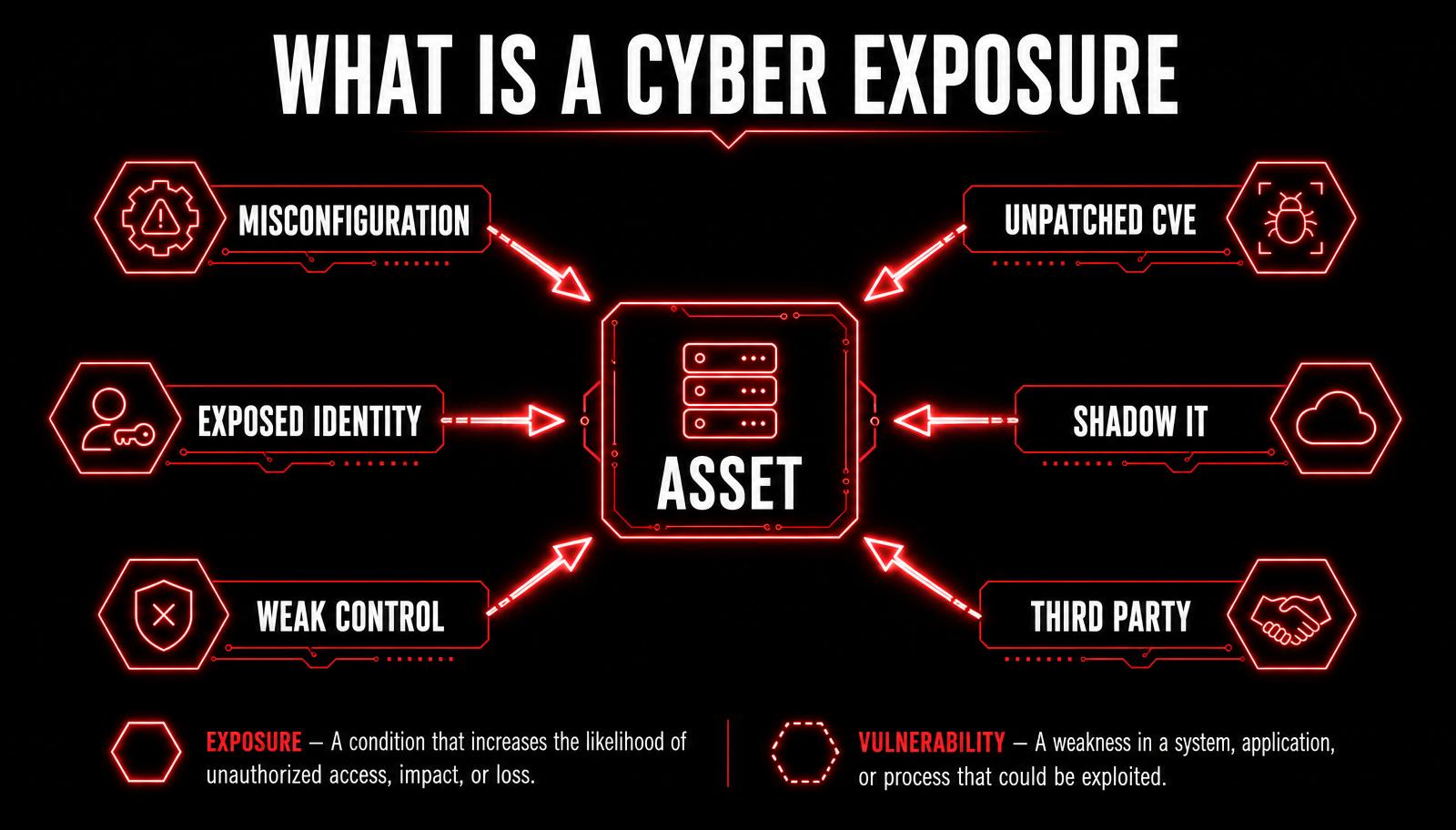
The security industry has used the word exposure for years, but for a long time it usually meant the same as vulnerability. CTEM formalized the broader meaning: exposure includes any attackable condition. This shift matters because attackers rarely stop at software bugs. They chain misconfigurations, weak identities, and forgotten assets to reach their goal.
The main categories of cyber exposure
Not every exposure fits neatly into one class, but a shared taxonomy helps teams reason about the problem. The table below is the vendor-neutral view used across this site.
| Category | Plain-English meaning | Example |
|---|---|---|
| Software vulnerability | A known flaw in code, usually with a CVE identifier. | An unpatched web server with a published remote-code-execution CVE. |
| Misconfiguration | A system set up in an insecure way, often by default or by accident. | A cloud storage bucket that is world-readable when it should be private. |
| Identity and access | Excess privilege, weak credentials, or unused accounts. | A former contractor account that still has admin access to the finance system. |
| Exposed secret | A credential, token, or key that is discoverable in code, logs, or storage. | An API key committed to a public code repository. |
| Attack path | A chain of otherwise minor exposures that together lead to a critical asset. | A low-privilege user that can pivot through a helpdesk tool to reach a domain admin. |
| External surface | Assets reachable from the internet that should not be, or should be locked down. | A staging environment left open on port 22 with a default password. |
| Third-party | Exposures introduced by suppliers, integrations, or shared infrastructure. | A vendor with production database access whose own environment is compromised. |
| Data exposure | Sensitive information reachable without appropriate control. | A public dashboard that leaks customer email addresses through a URL parameter. |
Exposure vs vulnerability vs threat vs risk
The four words are related and often confused. A crisp working set:
| Term | One-line meaning | Owner in CTEM |
|---|---|---|
| Vulnerability | A specific technical weakness, often with a CVE. | Discovered by scanners, remediated by asset owners. |
| Exposure | Any attackable condition, including vulnerabilities. | Tracked in the exposure register during CTEM discovery. |
| Threat | An adversary capability or activity that could exploit an exposure. | Applied as prioritization context by security analysts. |
| Risk | The probability and business impact of exposure being exploited. | Owned by leadership; reported by the CTEM program. |
For a deeper walkthrough of one scenario across all four terms, see Exposure vs Vulnerability vs Threat vs Risk.
How exposures come into existence
Most exposures come from ordinary business activity, not from carelessness:
- A cloud engineer spins up a resource for a demo and forgets to tear it down.
- A vendor onboarding creates a service account with more access than needed.
- A software update introduces a new default that turns off a control.
- A code push accidentally commits an API key that is later scraped.
- An acquisition brings in an asset inventory nobody has ever mapped.
- An identity policy exception granted for a short project never gets removed.
How CTEM tracks exposures
Inside a CTEM program, every exposure lives in a single, up-to-date register. The register does not need a new tool; it needs a shared schema and a shared cadence. Typical fields are: source of the finding, affected asset, business service, exposure category, current stage in the CTEM cycle, owner, priority reasoning, validation status, and closure evidence.
The register is what turns an unlimited number of raw findings into a bounded list of things the organization is actually working on. Everything not on the register is either not in scope this cycle or has been accepted as noise for a stated reason.
How to talk about exposure with business stakeholders
Business stakeholders do not usually care about the taxonomy above. They care about which of their services is exposed, how bad it is, and who is fixing it. A useful pattern is a three-line summary per service: what changed since last cycle, what the top exposure is right now, and what the owner is doing about it. Save the categories for the security team's internal working documents.
Once the definition is clear, the next question is what CTEM does with exposures. Move on to What is CTEM? or dive into The 5 Stages of CTEM.
How to apply this
- List one example of every exposure category in your own environment
- Pick one recent finding from your scanner and classify it using the table above
- Rewrite a recent incident retrospective using the exposure taxonomy
- Draft a three-line executive summary of exposure state for your top business service
- Add an exposure category field to your exposure register if it is missing
Common mistakes
- Using exposure and vulnerability as if they were the same word
- Tracking only software vulnerabilities and missing identity and misconfiguration exposures
- Reporting raw finding counts to leadership instead of prioritized exposures
- Ignoring third-party exposures because they live outside your perimeter
- Assuming internal-only exposures are not important
Key takeaways
- Cyber exposure is any attackable condition, not only a software bug.
- There are at least eight commonly recognized exposure categories.
- Vulnerability, exposure, threat, and risk are related but distinct.
- Most exposures are created by ordinary business activity.
- CTEM turns unbounded findings into a bounded exposure register.
Frequently asked questions
Related pages
What is CTEM?
What is CTEM? Continuous Threat Exposure Management Explained
CTEM (Continuous Threat Exposure Management) explained in plain English: definition, why it exists, and how it works as an operating model, not a tool.
Exposure vs Vulnerability vs Threat vs Risk
Exposure vs Vulnerability vs Threat vs Risk: Clear Comparison
The clearest comparison of exposure, vulnerability, threat, and risk with a definition table and one scenario that follows all four terms end to end.
CTEM vs Vulnerability Management
CTEM vs Vulnerability Management: What's Actually Different
Side-by-side comparison of CTEM and traditional vulnerability management: scope, prioritization, validation, ownership, and continuous risk reduction.
CTEM Glossary
CTEM Glossary: Terms Defined With Meaning, Why, and Examples
A rich CTEM glossary. Every term includes a simple meaning, why it matters in CTEM, a beginner example, and related terms.
Next step
Next: Exposure vs vulnerability vs threat vs risk
One story that ties all four terms together.
Earn your free CTEM certification.
Study the lifecycle, take a free certification exam and earn a publicly verifiable certificate.
Beginner / Practitioner / Program Leader
Explore certificationsAuthor
LearnCTEM Editorial Team
Practitioners and educators writing plain-English guides on Continuous Threat Exposure Management.
Reviewed by
Senior CTEM Practitioner Panel
Reviewed for accuracy against public CTEM guidance and real-world program experience.
Sources and further reading
- ▸Gartner, Implement a Continuous Threat Exposure Management (CTEM) Program (2022). Introduces the broader exposure concept underpinning CTEM.
- ▸NIST Cybersecurity Framework 2.0, Identify function. Public framework that includes asset and vulnerability identification aligned with CTEM discovery.
- ▸ISO/IEC 27005, Information security risk management. Standard framing of asset, threat, and vulnerability terminology.