
Quick answer
Direct answer
What you will learn
- The precise scope of vulnerability management vs CTEM
- How CTEM absorbs vulnerability management as one input
- Practical side-by-side differences by area
- Where vulnerability management still adds value inside CTEM
- How to evolve from one to the other without losing what works
Explanation
Rule of thumb
What vulnerability management covers
Vulnerability management is a mature discipline. It usually includes asset inventory, scheduled scanning, deduplication, severity scoring, ticketing, patch orchestration, and reporting on remediation SLAs. It is a critical foundation, and most organizations should not attempt CTEM without it.
What CTEM adds
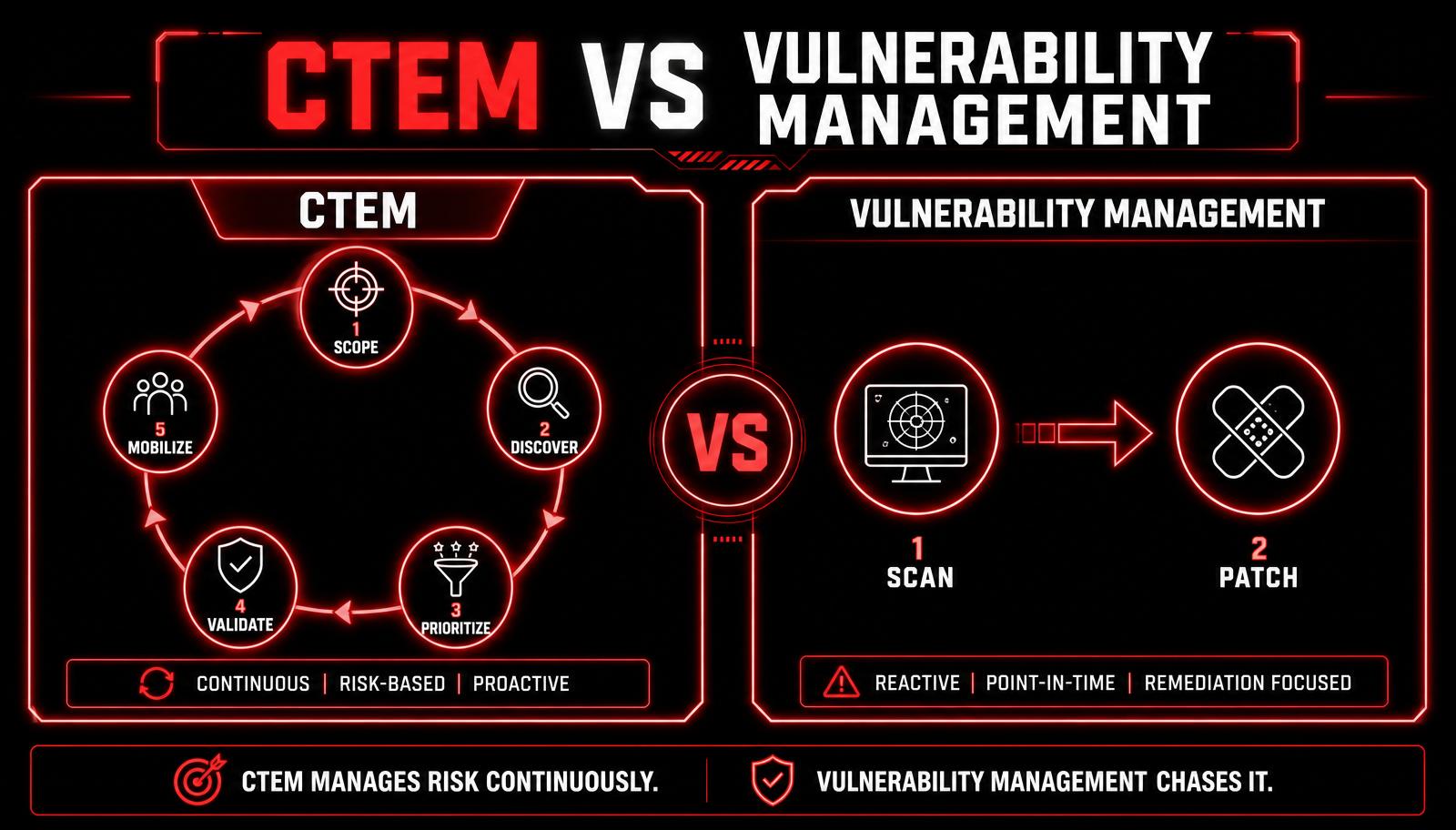
CTEM does not replace this foundation. It uses it. Then it extends the program in five ways:
- Broader exposure scope: identities, misconfigurations, secrets, third parties, attack paths, external surface, not only software vulnerabilities.
- Threat context: prioritization uses attacker techniques and activity, not only severity.
- Validation: exposures are proven real, reachable, and exploitable before Mobilize.
- Mobilization: named owners, SLAs, evidence, and escalation across teams beyond security.
- Business framing: reporting expresses risk reduction on critical services rather than ticket volume.
Side-by-side comparison
| Area | Vulnerability management | CTEM |
|---|---|---|
| Main focus | Software vulnerabilities on known assets | All exposures across assets, identities, cloud, applications, and third parties |
| Cadence | Scheduled scans, often monthly or quarterly | Continuous cycle with weekly and daily inputs |
| Prioritization | Mostly severity scores | Business impact, reachability, exploitability, threat, and asset importance |
| Business context | Minimal or added after the fact | Built in from the Scope stage |
| Validation | Rarely, and often not repeated after remediation | Explicit stage, with evidence attached to closures |
| Ownership | Often unclear once findings leave security | Named owner per asset, exposure, and fix |
| Output | Long finding lists | Short lists of validated, owned, closed exposures |
| Success metric | Tickets closed | Risk reduced on critical services, with evidence |
| Reporting audience | Security operations | Security leadership, executive leadership, board |
| Tooling model | Scanner-centric | Multi-source, connected via shared register |
Where vulnerability management fits inside CTEM
Inside a CTEM program, vulnerability management is one of several data sources that feed Discover, and one of the fastest closure paths in Mobilize. It also provides the metric base for age and SLA tracking. The change is not what vulnerability management does; it is where it sits in a bigger operating model.
| CTEM stage | Vulnerability management contribution |
|---|---|
| Scope | Provides asset inventory that informs which services are in scope |
| Discover | Feeds software vulnerabilities into the exposure register |
| Prioritize | Provides CVSS as one input among several |
| Validate | Provides retest capability for closed CVEs |
| Mobilize | Provides patch orchestration and SLA tracking for CVE-based fixes |
Evolving from vulnerability management to CTEM
A pragmatic path:
- Keep vulnerability management running; do not disrupt it.
- Add a shared exposure register that also accepts non-CVE exposures.
- Introduce a threat context layer that re-ranks the top findings.
- Add validation before Mobilize for critical items.
- Adopt a business-service view for reporting, not just an asset-list view.
Each step delivers value on its own. Together they turn vulnerability management into CTEM without a big-bang migration.
When CTEM is overkill
A five-person startup with a single product and a single cloud account may not need a full CTEM program. Mature vulnerability management plus a light exposure register can be enough. The CTEM operating model becomes valuable once the organization has multiple business services, multiple asset types, and cross-team dependencies for remediation.
For more comparisons, see CTEM vs Attack Surface Management and CTEM vs Penetration Testing and Red Teaming.
How to apply this
- Audit your current vulnerability management reporting for outcome vs activity metrics
- Add a non-CVE exposure to the register in the next cycle to prove the model extends
- Introduce validation before Mobilize for critical CVEs
- Switch one report from asset-list view to business-service view
- Publish an ownership map that names owners for non-CVE exposures
Common mistakes
- Rebranding vulnerability management as CTEM without changing scope
- Ripping out vulnerability management to install a CTEM platform
- Ignoring CVSS entirely; it is still a useful input
- Reporting ticket volume as risk reduction
- Keeping ownership inside security instead of asset owners
Key takeaways
- Vulnerability management is a foundation; CTEM is the operating model above it.
- CTEM adds scope, threat context, validation, mobilization, and business framing.
- Nothing about vulnerability management is discarded in CTEM.
- The evolution can be incremental, one improvement at a time.
- Small organizations may not need full CTEM; larger ones almost always do.
Frequently asked questions
Related pages
What is CTEM?
What is CTEM? Continuous Threat Exposure Management Explained
CTEM (Continuous Threat Exposure Management) explained in plain English: definition, why it exists, and how it works as an operating model, not a tool.
CTEM vs Attack Surface Management
CTEM vs Attack Surface Management: How They Work Together
How CTEM and attack surface management differ, where they overlap, and how ASM feeds the CTEM lifecycle for continuous risk reduction.
CTEM vs Pen Testing and Red Teaming
CTEM vs Penetration Testing and Red Teaming: Program vs Test
Understand why penetration testing and red teaming are validation activities and how CTEM uses them inside a continuous exposure program.
CTEM vs Breach and Attack Simulation
CTEM vs Breach and Attack Simulation: One Validation Method
Breach and attack simulation is one way to validate exposures. CTEM is broader and includes scoping, discovery, prioritization, mobilization, and reporting.
Next step
Next: CTEM vs Attack Surface Management
See how ASM feeds the CTEM loop.
Earn your free CTEM certification.
Study the lifecycle, take a free certification exam and earn a publicly verifiable certificate.
Beginner / Practitioner / Program Leader
Explore certificationsAuthor
LearnCTEM Editorial Team
Practitioners and educators writing plain-English guides on Continuous Threat Exposure Management.
Reviewed by
Senior CTEM Practitioner Panel
Reviewed for accuracy against public CTEM guidance and real-world program experience.
Sources and further reading
- ▸Gartner, Implement a Continuous Threat Exposure Management (CTEM) Program (2022). Introduces CTEM as broader than vulnerability management.
- ▸NIST SP 800-40, Guide to Enterprise Patch Management Planning. Public guidance for the vulnerability management foundation CTEM builds on.