What you will learn
- Why no product is a complete CTEM platform
- The five criteria that separate real platforms from dashboards
- How to test coverage claims instead of accepting them
- How to judge validation depth in a demo
- How to check mobilization fit with your own ticketing
- A four week proof of value plan you can run with any vendor
- The buying mistakes that create shelfware
Explanation
CTEM is a programme, so no product can be the whole thing
CTEM describes a continuous loop of scoping, discovery, prioritization, validation and mobilization. Products cover slices of that loop. External attack surface tools are strong at discovery, cyber asset management tools are strong at inventory, breach and attack simulation tools are strong at validation, and IT service management tools own mobilization. A vendor that claims to do all five equally well is usually strong in one or two and thin everywhere else. Your job in an evaluation is to find out which.
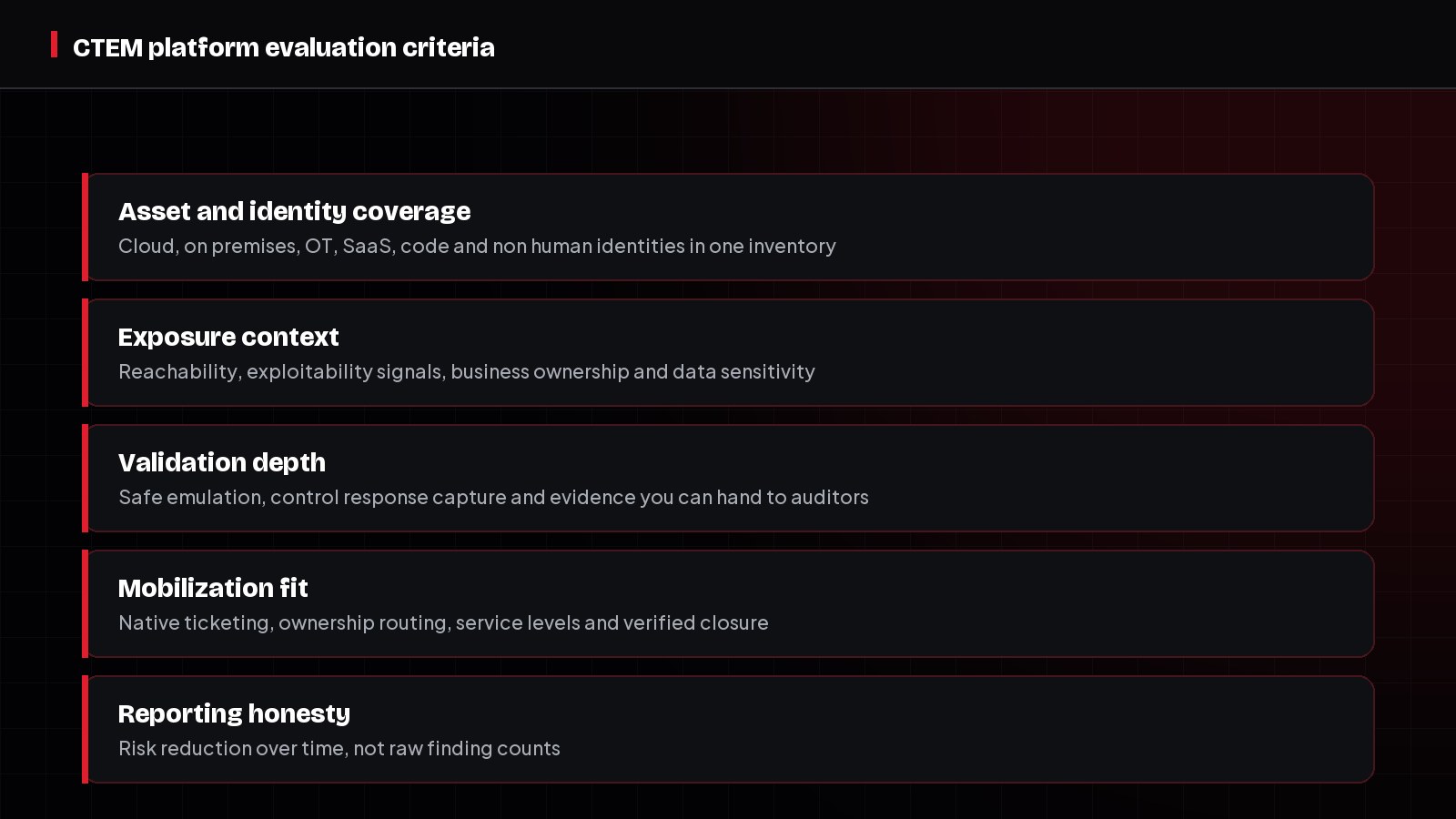
Criterion one: asset and identity coverage
Coverage is the foundation. If the platform cannot see an asset, everything downstream is decoration. Ask what it discovers natively, what it ingests from other tools, and how it reconciles duplicates. Then test it. Give the vendor a small scope during the trial and check whether the inventory matches what your own teams know exists.
- Internet facing hosts, domains, certificates and forgotten subdomains
- Cloud accounts, workloads, storage and control plane configuration
- Human identities, privileged accounts and non human identities such as tokens and service principals
- SaaS tenants and third party integrations that carry business data
- On premises infrastructure and, where relevant, OT and physical environments
Criterion two: exposure context
A finding without context is a work order with no justification. Strong platforms explain why something matters: whether the vulnerable component is reachable, whether exploitation has been observed in the wild, which business service the asset supports and what data sits behind it. Weak platforms restate the severity score they imported and let you supply the thinking.
| Question to ask | Weak answer | Strong answer |
|---|---|---|
| Is this exposure reachable? | It is rated critical. | It is reachable from this network path, through this listener, from these sources. |
| Who owns the asset? | Owner field is blank or imported once. | Ownership synced from the source of truth and used to route work. |
| What is behind the asset? | No data classification. | Business service, data sensitivity and dependency mapping. |
| Is it being exploited? | Severity score only. | Confirmed exploitation status and exploitation probability, refreshed daily. |
Criterion three: validation depth
Validation is what turns a list of possible problems into a short list of proven ones. Ask exactly what the platform does when it validates. Some products only check whether a version string matches an advisory. Others emulate technique behaviour safely, capture whether existing controls blocked it, and record evidence. The difference decides whether your engineering teams trust the output.
- Does validation run safely in production, or only in a lab?
- Does it record what the control stack did, not just whether the technique worked?
- Can you see the raw evidence, including timestamps and target identifiers?
- Can validation be re run on demand to confirm a fix?
- Does the platform mark unvalidated findings clearly rather than implying proof?
Criterion four: mobilization fit
A platform that requires engineers to log into a second system will be ignored. Mobilization fit means the platform can create work in the system your engineers already use, carry the evidence and the fix instruction with it, respect your existing ownership model, and close the loop when the work is done. Test this with your real ticket schema during the trial, not with the vendor demo instance.
Criterion five: reporting honesty
Ask to see the executive report. If it leads with the number of findings, the platform is measuring activity. If it leads with how much validated, business relevant exposure was removed over time and how long removal took, it is measuring outcomes. Executive reporting shapes what your programme optimises for, so pick a platform whose default view matches the behaviour you want.
Run a proof of value with your own data
Demos are rehearsed. A scoped proof of value on your own environment is the only reliable evidence. Keep it small enough to complete in four weeks and specific enough to produce a yes or no answer.
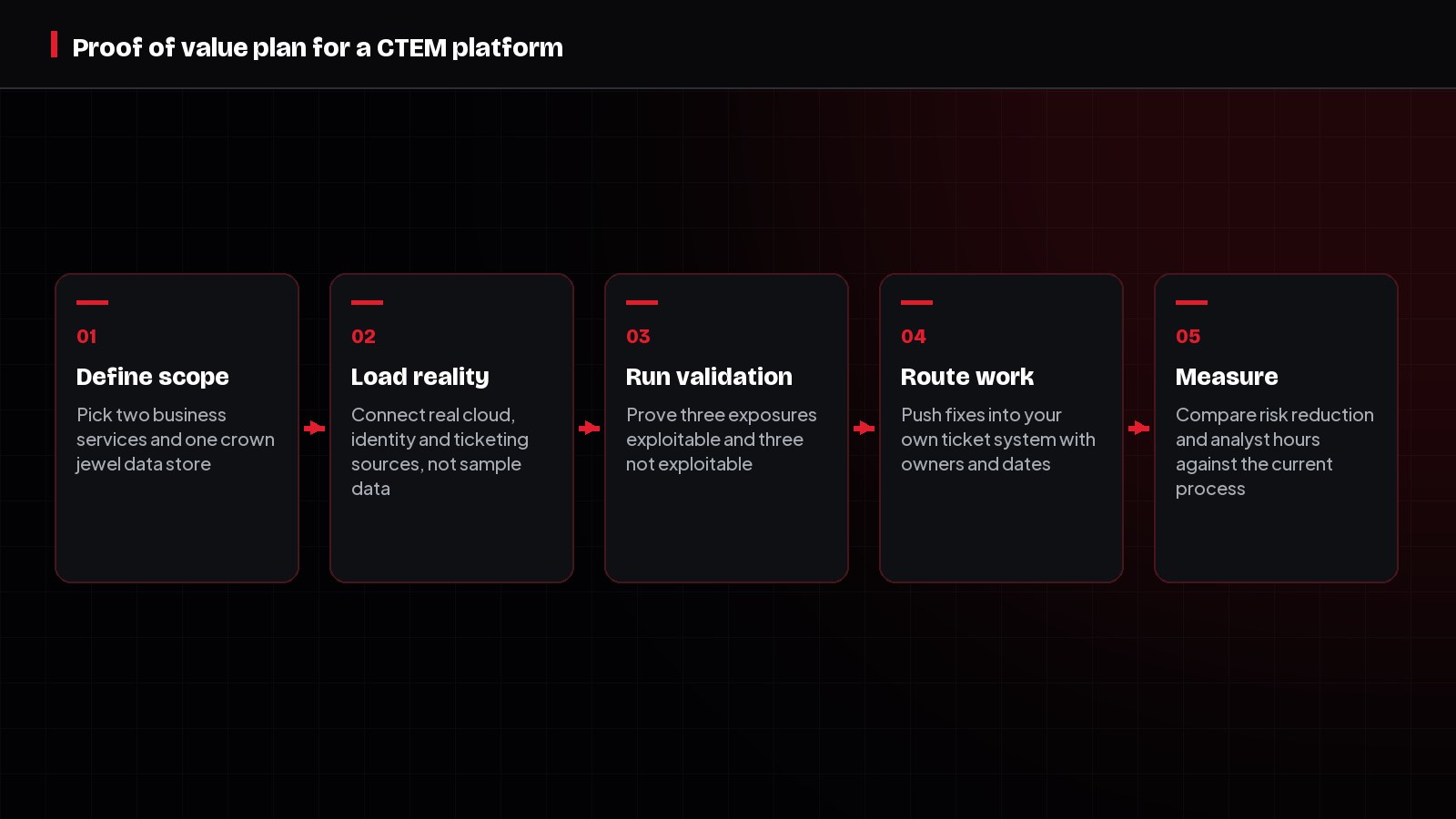
- 1Week one: connect real sources for two business services and one crown jewel data store.
- 2Week two: compare the discovered inventory against what your teams know exists, and record the gaps.
- 3Week three: validate three exposures you believe are exploitable and three you believe are not, then check the platform agrees.
- 4Week four: route five fixes into your own ticket system with owners and dates, and measure how much manual work remained.
Buying mistakes that create shelfware
Most failed platform purchases fail for organisational reasons rather than technical ones. The tool arrives before the programme, ownership is undefined, and nobody agreed what the platform is allowed to change. Fix the programme design first and the platform decision becomes much simpler.
How to apply this
- Write your five criteria and weight them before you see a single demo.
- Give every vendor the same scope, the same data sources and the same questions.
- Insist that validation claims come with visible evidence you can inspect.
- Test ticket integration with your real schema and your real owners.
- Score the proof of value against the criteria, not against how good the interface looked.
Common mistakes
- Treating a discovery tool as a full CTEM platform because it produces a dashboard.
- Accepting severity scores as prioritization and calling it exposure context.
- Buying validation you are never allowed to run in production.
- Ignoring mobilization fit and then asking engineers to work in a second system.
- Choosing based on finding volume, which rewards noise instead of accuracy.
Frequently asked questions
Related pages
CTEM Tool Stack Blueprint
CTEM Tool Stack Blueprint for 2026
A vendor-neutral CTEM tool stack blueprint explaining EASM, CAASM, CNAPP, BAS, PTaaS, ITSM, validation, and remediation roles.
Complete CTEM Guide 2026
Complete CTEM Guide 2026: Framework and Lifecycle
A complete CTEM guide for 2026: the framework, five lifecycle stages, worked examples, tool categories, metrics and a practical rollout sequence.
CTEM Prioritization Signals
CTEM Prioritization: KEV, EPSS, CVSS, Business Impact
How to combine CVSS, CISA KEV, EPSS, reachability and business impact into a CTEM prioritization model your engineering teams will actually accept.
Earn your free CTEM certification.
Ready to prove your CTEM knowledge? Start with the free LearnCTEM Beginner Certification, continue with the Practitioner Certification, and build toward Program Leader. Every LearnCTEM certificate is free, vendor-neutral, and publicly verifiable at LearnCTEM.com.
Beginner / Practitioner / Program Leader
Explore certificationsAuthor
LearnCTEM Editorial Team
Practitioners and educators writing plain-English guides on Continuous Threat Exposure Management.
Reviewed by
Senior CTEM Practitioner Panel
Reviewed for accuracy against public CTEM guidance and real-world program experience.