
Quick answer
Direct answer
What you will learn
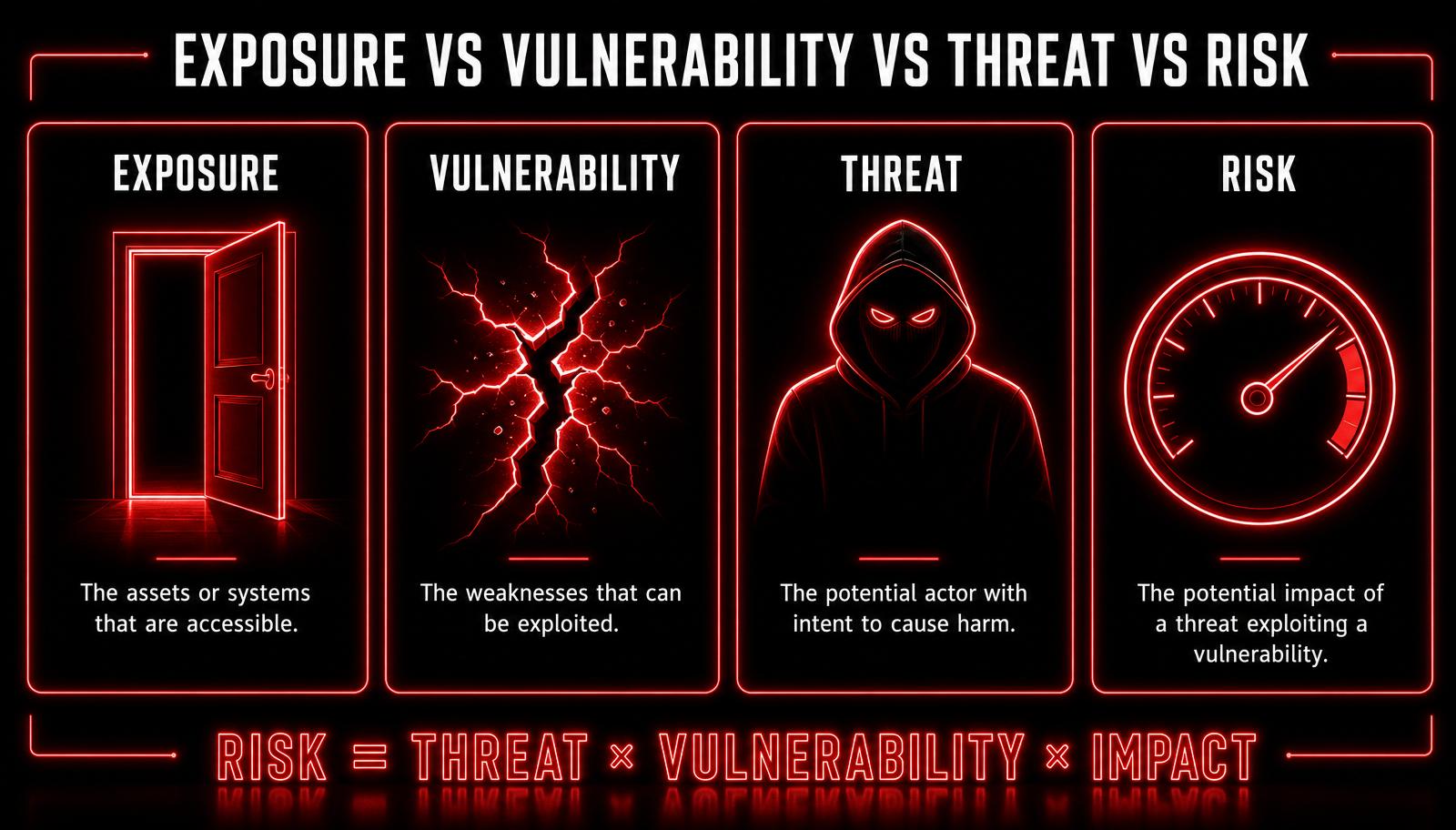
- The precise definition of each of the four terms
- How the four terms relate to one another
- One scenario that follows all four terms end to end
- How CTEM uses each term in different stages
- How to explain each term to a business audience
Explanation
Definition table
The four terms side by side
| Term | Definition | Example | Owner in CTEM |
|---|---|---|---|
| Vulnerability | A specific technical weakness, usually with a CVE. | Unpatched CVE in a web framework running on the checkout service. | Discovered by scanners, remediated by asset owners. |
| Exposure | Any condition an attacker could use, including vulnerabilities, misconfigurations, and excessive access. | That same unpatched framework, plus the fact that the checkout service is internet-facing and holds card data. | Tracked in the exposure register. |
| Threat | The adversary capability, technique, or activity that could exploit the exposure. | Ransomware operators actively targeting internet-facing checkout services with that CVE. | Applied as prioritization context by security analysts. |
| Risk | The probability and business impact of the exposure being exploited. | High probability of exploitation combined with revenue loss, regulatory fines, and reputation damage. | Reported by the CTEM program; owned by leadership. |
One scenario, all four terms
An online retailer runs a checkout service. Consider a real-world sequence and how each term applies at each step.
- Vulnerability: A dependency in the checkout service has a published remote-code-execution CVE. The scanner reports it as high severity.
- Exposure: The checkout service is internet-facing, handles card data, and the vulnerable version is deployed in production. Together these facts make the vulnerability an active exposure.
- Threat: Public exploit code is available. Threat intelligence shows ransomware operators using this CVE against retail checkout systems this month.
- Risk: If exploited, the retailer faces card-data compromise, PCI implications, weeks of forensic work, and reputational damage during peak shopping season.
The CTEM cycle handles all four: Discovery finds the vulnerability, Scope confirms the asset matters, Prioritization applies the threat and exposure context to rank it first, Validation confirms it is reachable, and Mobilization closes it with the platform team.
How CTEM uses each term
| CTEM stage | Vulnerability | Exposure | Threat | Risk |
|---|---|---|---|---|
| Scope | Not used directly. | Not used directly. | Considered at portfolio level. | Chooses which business services matter. |
| Discover | Found and catalogued. | Recorded in register. | Not yet applied. | Not yet quantified. |
| Prioritize | One input to ranking. | Central input. | Applied to filter and re-rank. | Ranks output translated to business terms. |
| Validate | Confirmed technically. | Confirmed reachable and usable. | Confirmed relevant. | Sharpened by real evidence. |
| Mobilize | Fixed at the source. | Closed and evidenced. | Continues to inform future cycles. | Reduced and reported. |
Why teams get these confused
The words overlap in everyday speech. Scanners talk about vulnerabilities. Cloud posture tools talk about misconfigurations. Threat feeds talk about threats. Boards talk about risk. Each tool uses one word; the CTEM program has to reconcile all of them into a single register with a single language.
A common failure mode is reporting vulnerability counts as if they were risk. Two hundred open vulnerabilities on a lab environment with no data and no reachability is not more risk than two open exposures on a customer-facing payment service.
Explaining each term to non-security stakeholders
- To an engineering leader: vulnerability is a bug we can patch, exposure is the state of the system, threat is who is attacking, risk is what it costs the business.
- To a finance leader: vulnerability and exposure are the input, threat is the environment, risk is the number you care about.
- To a board: focus on risk trend for the top services and the actions that moved it.
Now that the vocabulary is clear, move on to the CTEM Framework or the 5 Stages of CTEM.
How to apply this
- Rewrite your last critical finding using all four terms in sequence
- Add a threat context field to your exposure register if it is missing
- Audit one recent report and flag places where vulnerability was used to mean risk
- Draft a one-paragraph risk statement for your top business service
- Share the definition table with an engineering leader and check that it lands
Common mistakes
- Using vulnerability and risk interchangeably in executive reports
- Prioritizing by CVSS alone and calling it risk-based
- Treating threat intelligence as decorative context instead of a prioritization input
- Reporting exposure counts without asset criticality context
- Assuming a low-severity vulnerability creates low risk
Key takeaways
- Vulnerability, exposure, threat, and risk are related but not interchangeable.
- Every vulnerability is an exposure; not every exposure is a vulnerability.
- Threat context is what turns exposure into ranked priority.
- Risk is the business language; the other three are working-level terms.
- CTEM uses all four terms across the five stages of the cycle.
Frequently asked questions
Related pages
What is CTEM?
What is CTEM? Continuous Threat Exposure Management Explained
CTEM (Continuous Threat Exposure Management) explained in plain English: definition, why it exists, and how it works as an operating model, not a tool.
What is a Cyber Exposure?
What is a Cyber Exposure? Meaning, Examples, and Types
A cyber exposure is any weakness, misconfiguration, excessive access, or condition an attacker could use to cause harm. Clear examples and beginner definitions.
CTEM Framework
CTEM Framework: The Complete Operating Model Explained
The full CTEM framework: five stages, inputs, outputs, roles, cadence, and how scope, discovery, prioritization, validation, and mobilization connect.
CTEM Glossary
CTEM Glossary: Terms Defined With Meaning, Why, and Examples
A rich CTEM glossary. Every term includes a simple meaning, why it matters in CTEM, a beginner example, and related terms.
Next step
Next: The CTEM Framework
See the full operating model that uses all four terms.
Earn your free CTEM certification.
Study the lifecycle, take a free certification exam and earn a publicly verifiable certificate.
Beginner / Practitioner / Program Leader
Explore certificationsAuthor
LearnCTEM Editorial Team
Practitioners and educators writing plain-English guides on Continuous Threat Exposure Management.
Reviewed by
Senior CTEM Practitioner Panel
Reviewed for accuracy against public CTEM guidance and real-world program experience.
Sources and further reading
- ▸NIST SP 800-30, Guide for Conducting Risk Assessments. Foundational public definitions of vulnerability, threat, and risk.
- ▸ISO/IEC 27005, Information security risk management. Standard terminology for asset, threat, vulnerability, and risk relationships.
- ▸Gartner, Implement a Continuous Threat Exposure Management (CTEM) Program (2022). Introduces exposure as the umbrella term used across the CTEM cycle.