
Quick answer
Direct answer
What you will learn
- The precise scope of pen testing and red teaming
- How each fits inside CTEM Validate
- The role of bug bounties and purple teaming
- How CTEM makes offensive testing more targeted
- How to avoid duplication between offensive testing and CTEM reporting
Explanation
Program vs test
What pen testing covers
Penetration testing is a scoped assessment against a specific target with defined rules of engagement. A skilled tester attempts to exploit weaknesses within the scope. Deliverables usually include a report of findings, evidence, and recommended remediations. Pen tests are typically time-boxed and can be internal, external, application-focused, or infrastructure-focused.
What red teaming covers
Red teaming is an objective-based simulation of adversary behavior across a broader scope. Rather than targeting one system, a red team pursues a business objective: reaching customer data, forging a transaction, gaining domain admin. Red teaming often stresses detection and response as much as prevention. It usually runs less frequently than pen testing and requires stronger executive sponsorship.
Where each fits in CTEM Validate
| Method | Typical scope | Cadence | CTEM stage |
|---|---|---|---|
| Vulnerability scanning | Broad, automated | Continuous | Discover |
| Configuration checks | Broad, automated | Continuous | Discover |
| Breach and attack simulation | Technique-based | On demand or scheduled | Validate |
| Pen testing | Scoped assessment | Quarterly to annual | Validate |
| Red teaming | Objective-based | Annual or on major change | Validate and Scope for next cycle |
| Bug bounty | Broad, continuous | Ongoing | Discover and Validate |
| Purple teaming | Technique-based, joint | On demand | Validate |
How CTEM makes offensive testing more targeted
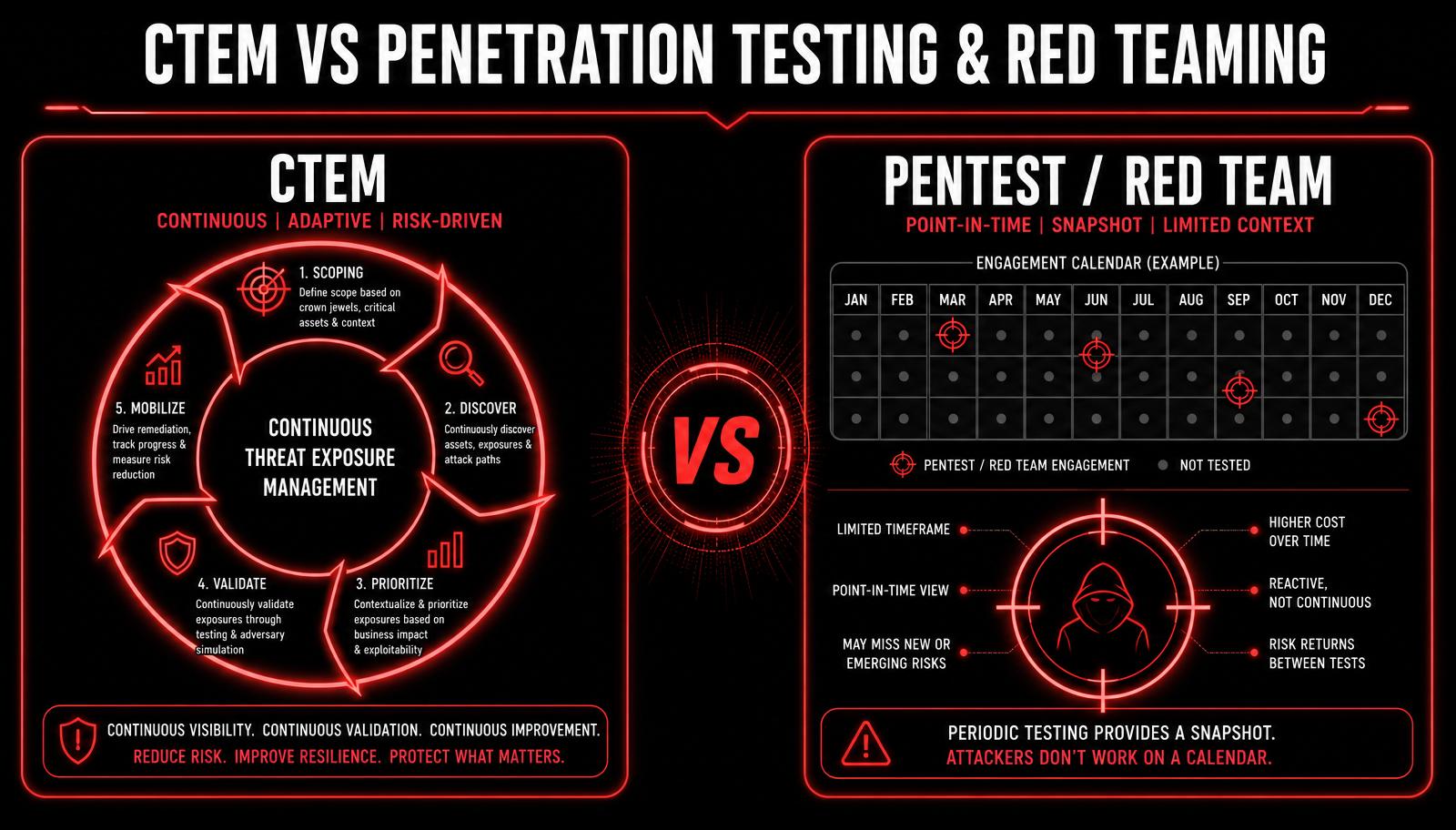
Without CTEM, pen tests often run against a fixed scope by calendar. With CTEM, testing scope is driven by the current exposure register: the top exposures that need controlled offensive validation. That improves value per engagement in three ways:
- Testers focus on the exposures that already carry the highest business impact.
- Threat context ensures techniques tested match observed adversary behavior.
- Results feed straight into Mobilize with owners, SLAs, and evidence attached.
Comparison table
| Area | Pen testing | Red teaming | CTEM |
|---|---|---|---|
| Purpose | Confirm exploitability in scope | Simulate real adversary against objectives | Continuous exposure reduction across all sources |
| Scope shape | Bounded target list | Broad, objective-based | Business service oriented |
| Cadence | Quarterly to annual | Annual or event driven | Continuous |
| Output | Findings report | Campaign report and lessons learned | Closed exposures with evidence and metrics |
| Success measure | Exploits found | Objective achieved or blocked | Risk reduced on top services |
Bug bounties and purple teaming
Bug bounties act as continuous, community-driven validation. Their findings should land in the exposure register alongside other Discover inputs, with the same ownership and SLA rules. Purple teaming is a highly effective validation method that pairs offensive testers with detection and response teams to close both exposure and detection gaps in the same session.
Avoiding duplication
The common failure mode is running pen tests as isolated engagements whose reports never influence the exposure register. Every pen test finding should:
- Land in the same exposure register as scanner and cloud findings.
- Get an owner and an SLA based on severity.
- Be retested during Mobilize before ticket closure.
- Feed the retrospective that shapes the next cycle.
For more comparisons, read CTEM vs Vulnerability Management, CTEM vs Attack Surface Management, and CTEM vs Breach and Attack Simulation.
How to apply this
- Route the last pen test's findings into the CTEM exposure register
- Choose the next pen test scope using CTEM Prioritize output
- Introduce one purple team session per quarter on the top service
- Ensure every offensive engagement produces retest evidence
- Report offensive engagement outcomes alongside CTEM metrics
Common mistakes
- Treating pen testing as the entire validation strategy
- Running red team exercises without integrating findings into CTEM
- Keeping pen test reports out of the exposure register
- Scheduling engagements by calendar rather than risk
- Ignoring bug bounty findings because they came from outside
Key takeaways
- Pen testing and red teaming are validation activities inside CTEM.
- CTEM makes offensive testing more targeted and higher value.
- Every offensive finding belongs in the same exposure register.
- Purple teaming and bug bounties are complementary methods.
- Cadence should be risk-driven, not calendar-driven.
Frequently asked questions
Related pages
CTEM vs Vulnerability Management
CTEM vs Vulnerability Management: What's Actually Different
Side-by-side comparison of CTEM and traditional vulnerability management: scope, prioritization, validation, ownership, and continuous risk reduction.
CTEM vs Attack Surface Management
CTEM vs Attack Surface Management: How They Work Together
How CTEM and attack surface management differ, where they overlap, and how ASM feeds the CTEM lifecycle for continuous risk reduction.
CTEM vs Breach and Attack Simulation
CTEM vs Breach and Attack Simulation: One Validation Method
Breach and attack simulation is one way to validate exposures. CTEM is broader and includes scoping, discovery, prioritization, mobilization, and reporting.
CTEM Framework
CTEM Framework: The Complete Operating Model Explained
The full CTEM framework: five stages, inputs, outputs, roles, cadence, and how scope, discovery, prioritization, validation, and mobilization connect.
Next step
Next: CTEM vs Breach and Attack Simulation
See how BAS fits alongside pen testing.
Earn your free CTEM certification.
Study the lifecycle, take a free certification exam and earn a publicly verifiable certificate.
Beginner / Practitioner / Program Leader
Explore certificationsAuthor
LearnCTEM Editorial Team
Practitioners and educators writing plain-English guides on Continuous Threat Exposure Management.
Reviewed by
Senior CTEM Practitioner Panel
Reviewed for accuracy against public CTEM guidance and real-world program experience.
Sources and further reading
- ▸NIST SP 800-115, Technical Guide to Information Security Testing and Assessment. Public guidance on security testing methodology consistent with CTEM Validate.
- ▸Gartner, Implement a Continuous Threat Exposure Management (CTEM) Program (2022). Positions validation activities as part of the CTEM loop.