
Quick answer
Direct answer
What you will learn
- What each word in CTEM really means
- Why the phrase is written in that specific order
- Where the term comes from and how it evolved
- How the definition guides day-to-day decisions
- Common misreadings of the term that lead to weak programs
- How to write your own one-sentence CTEM definition
Explanation
Read it right to left
Where the term comes from
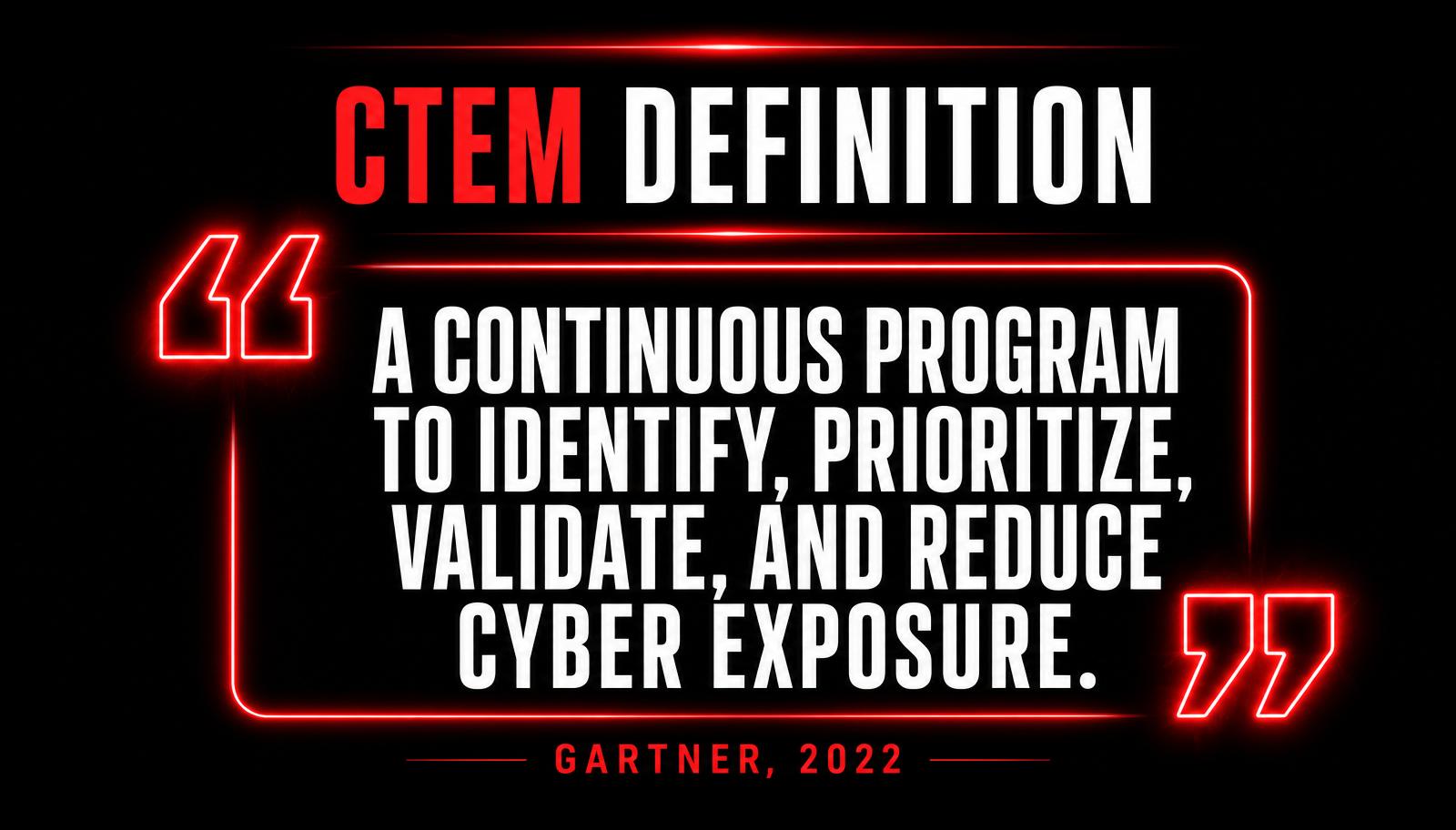
Gartner introduced Continuous Threat Exposure Management in its 2022 research as a named program that unifies exposure discovery, prioritization, validation, and remediation into a single continuous cycle. Later Gartner notes formalized the five stages used across this site: Scope, Discover, Prioritize, Validate, and Mobilize. The name was picked deliberately to move the industry away from episodic vulnerability projects toward an operating model that runs like a business process.
LearnCTEM is vendor-neutral. We describe CTEM as an operating model any organization can adopt using tools it already owns. Nothing on this site is affiliated with, endorsed by, or a substitute for Gartner research.
Continuous: never falling behind
Attackers do not wait for the next quarterly scan. New assets appear every day: a spun-up cloud workload, a contractor account, a shadow API. Continuous in CTEM means your view of exposures is always fresh enough to act on. In practice, it means daily or weekly discovery, always-on prioritization, and validation runs that keep pace with change.
Continuous does not mean instant. It means the loop between change and awareness is short enough that the window an attacker could exploit is minimized. A weekly discovery cadence with a two-day prioritization SLA is continuous. A quarterly scan is not.
Threat: the attacker lens
Threat is what stops CTEM collapsing into a CVSS list. It answers questions like: is this exposure being used in the wild right now, which techniques does it enable, and which of our assets sit on that path? Without threat context, prioritization ignores whether an exposure is actually reachable or usable by any adversary that targets your sector.
Threat context comes from many places: published exploit activity, industry reporting, incident retrospectives, red team findings, and your own detection telemetry. CTEM does not require expensive threat intel feeds. It requires that whatever threat signal you have, you actually apply it during prioritization.
Exposure: broader than vulnerability
Exposure is deliberately broader than vulnerability. It includes software vulnerabilities, misconfigurations, excessive access, exposed identities, leaked secrets, insecure defaults, attack paths, third-party issues, and any condition that raises the chance of harm. Building a shared vocabulary of exposures is a core CTEM skill.
A useful rule: if an attacker could use it to make progress toward a business impact, it is an exposure. That includes an open storage bucket, an unused but powerful admin role, a service account with a static password, a forgotten test environment on the internet, or a supplier with access to your production database.
Management: the missing layer
Management is the part that most tool-first programs miss. It is the operating model, the cadence, the ownership, the service level agreements, the escalation, and the reporting that turn signals into closed exposures. Without management, the same critical finding shows up in three quarterly reports before anyone owns it.
The four words as a decision test
Every real CTEM decision should pass a four-word check. Use this table when reviewing a proposal or a work item:
| Word | Question to ask | Fail signal |
|---|---|---|
| Continuous | Would this happen again on a regular cadence? | It is a one-off project or annual audit. |
| Threat | Does this reflect how attackers actually behave today? | Priority is based only on CVSS or vendor severity. |
| Exposure | Does this consider all attackable conditions, not just CVEs? | Only patchable software vulnerabilities are in scope. |
| Management | Is there a named owner, SLA, and evidence of closure? | The finding is emailed to a distribution list with no owner. |
Common misreadings of the term
Some teams read CTEM as continuous vulnerability management with a new label. Others read it as a threat-intel program. Both readings miss the point. CTEM binds the four ideas together on purpose. Removing any one of the four words changes the program into something else.
| Misreading | What the team ends up with | What they should have |
|---|---|---|
| Continuous scanning | Faster CVE lists, same closure problem | Continuous discovery plus prioritization, validation, and ownership |
| Threat-only program | Threat reports with no exposure link | Threat context applied to a live exposure register |
| Exposure inventory | A large list of findings with no threat context or SLAs | Ranked exposures with owners and closure evidence |
| Vulnerability management | Same tool set, new name | Wider exposure surface, threat lens, validation, and management layer |
How the definition guides daily decisions
- If a decision would only happen once a quarter, it is not continuous enough.
- If a decision ignores what attackers are actually doing, it is missing threat.
- If a decision only counts CVEs, it is missing exposure.
- If a decision has no owner and no due date, it is missing management.
Now compare CTEM against related disciplines starting with CTEM vs Vulnerability Management, or unpack the four related terms in Exposure vs Vulnerability vs Threat vs Risk.
How to apply this
- Write your own one-sentence definition of CTEM using all four words
- Test three current work items against the four-word decision check above
- Share the definition with a non-security stakeholder and ask them to explain it back to you
- Audit your last quarterly report for any of the four failure signals
- Pick the weakest of the four words in your program and set one improvement goal for the next cycle
Common mistakes
- Treating CTEM as a synonym for scanning
- Ignoring threat context and ranking on CVSS alone
- Missing the management layer, so nothing gets closed
- Running CTEM as a project instead of a program
- Assuming CTEM requires a new platform purchase
- Copying a definition without pressure-testing it against real work
Key takeaways
- Continuous means an ongoing cycle, not periodic scans.
- Threat means the program is shaped by how attackers actually behave.
- Exposure covers any condition an attacker could use, well beyond CVEs.
- Management adds ownership, evidence, and closure discipline.
- The four words together describe an operating model, not a tool.
- Any real CTEM decision should pass a four-word check.
Frequently asked questions
Related pages
What is CTEM?
What is CTEM? Continuous Threat Exposure Management Explained
CTEM (Continuous Threat Exposure Management) explained in plain English: definition, why it exists, and how it works as an operating model, not a tool.
CTEM Framework
CTEM Framework: The Complete Operating Model Explained
The full CTEM framework: five stages, inputs, outputs, roles, cadence, and how scope, discovery, prioritization, validation, and mobilization connect.
CTEM vs Vulnerability Management
CTEM vs Vulnerability Management: What's Actually Different
Side-by-side comparison of CTEM and traditional vulnerability management: scope, prioritization, validation, ownership, and continuous risk reduction.
CTEM Metrics and KPIs
CTEM Metrics and KPIs: What to Measure and How to Report
Practical CTEM metrics and KPIs with what each one means, why it matters, and how each one can be misused if reported without context.
Next step
Next: Exposure vs vulnerability vs threat vs risk
Clear up the four terms every CTEM conversation depends on.
Earn your free CTEM certification.
Study the lifecycle, take a free certification exam and earn a publicly verifiable certificate.
Beginner / Practitioner / Program Leader
Explore certificationsAuthor
LearnCTEM Editorial Team
Practitioners and educators writing plain-English guides on Continuous Threat Exposure Management.
Reviewed by
Senior CTEM Practitioner Panel
Reviewed for accuracy against public CTEM guidance and real-world program experience.
Sources and further reading
- ▸Gartner, Implement a Continuous Threat Exposure Management (CTEM) Program (2022). Original research that named the CTEM program and its five-stage cycle.
- ▸Gartner, How to Manage Cybersecurity Threats, Not Episodes. Follow-on note reinforcing continuous, business-aligned exposure management.
- ▸NIST Cybersecurity Framework 2.0. Public framework whose Identify and Protect functions align with CTEM discovery and prioritization.