
Quick answer
Direct answer
What you will learn
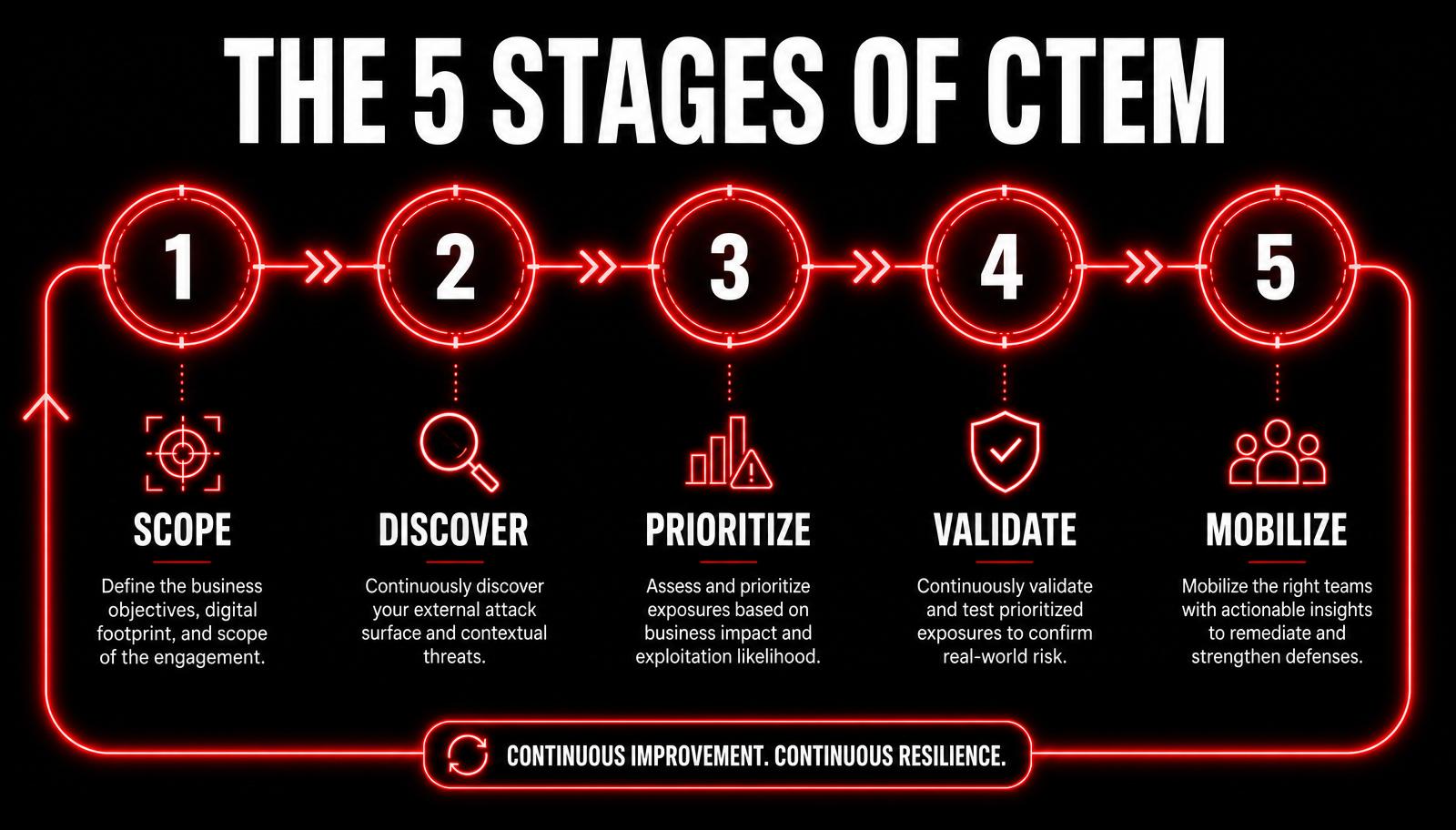
- The five stages of CTEM in beginner language
- The single question each stage answers
- One running example that follows all five stages
- How the stages hand off to each other
- How to run a first cycle end to end
Explanation
One example, all five stages
Stage 1: Scope
Question: What are we protecting this cycle and why?
Scope is where the cycle starts. The security team, working with business owners, picks the services and assets that this cycle will focus on. Scope is not a wish list; it is a bounded set that can realistically be covered in one cycle.
Example. An online store's payment service is chosen for the first cycle because it handles customer card data and any incident there is visible to customers and regulators.
Output: A one-page scope brief listing the business service, its key assets, and its business owner.
Stage 2: Discover
Question: What actually exists in scope, including forgotten items?
Discover finds every asset, identity, and exposure within the chosen scope. It pulls from vulnerability scanners, cloud posture tools, identity tools, external attack surface tools, and any other source that knows something about the scope.
Example. Discovery finds the payment web application, its database, a linked storage bucket, three admin accounts, a deployment pipeline, and one internal microservice with no listed owner.
Output: A live exposure register with each finding, its source, and the affected asset.
Stage 3: Prioritize
Question: Which of these should we fix first and why?
Prioritize ranks exposures using business impact, reachability, exploitability, and threat activity. Severity score alone is never enough. The output is a short ranked list that reflects real risk to the chosen scope.
Example. The public storage bucket ranks first because it is reachable from the internet and holds customer data. An unused admin account ranks second because compromise would allow lateral movement to the customer database.
Output: A ranked short list with reasoning attached to each item.
Stage 4: Validate
Question: If an attacker tried this today, would it work?
Validate confirms the top exposures are real, reachable, and exploitable in the current environment. Validation methods range from safe read-only checks to controlled offensive tests and breach-and-attack simulation. Retest after remediation is part of Validate, not Mobilize.
Example. A safe check confirms the bucket is world readable. A controlled test in a lower environment shows the admin account can reach the customer database. Both are documented with evidence.
Output: Validation notes and evidence for each priority exposure.
Stage 5: Mobilize
Question: Who owns the fix, by when, and how do we know it worked?
Mobilize drives closure. It assigns each validated exposure to the correct owner, applies an SLA based on severity, tracks progress, and captures evidence before closing the ticket. Mobilization is where the program earns its keep.
Example. The cloud owner locks the bucket within one day. The identity team removes the excess access within the week. The library is patched in the next release. Each closure is proven, not assumed.
Output: Closed tickets with owner, timestamp, evidence, and any exceptions.
The stages side by side
| Stage | Question | Owner | Output |
|---|---|---|---|
| Scope | What matters this cycle? | Security leadership | One-page scope brief |
| Discover | What exists in scope? | Security engineering | Exposure register |
| Prioritize | What matters most now? | Exposure analyst | Ranked short list |
| Validate | Would it work today? | Offensive security | Validation evidence |
| Mobilize | Who fixes it and by when? | Asset owner | Closed tickets with proof |
How the stages hand off
Every hand-off has an artifact. Scope hands Discover a written brief. Discover hands Prioritize a register. Prioritize hands Validate a ranked list. Validate hands Mobilize evidence. Mobilize hands the next cycle a closed set with lessons. If any hand-off is a spreadsheet nobody reads, the loop breaks.
Running a first cycle
A first cycle is the fastest way to learn CTEM. Pick one business service. Run all five stages on it. Time each stage. Capture what worked and what did not. The second cycle will be materially better and will not need a big transformation project. See How to Start a CTEM Program for a 30/60/90-day plan.
To see the full framework that sits behind the five stages, read the CTEM Framework. For a full narrative of a cycle, jump to How CTEM Works in Real Life.
How to apply this
- Pick one business service and draft a one-page scope brief for it
- Sketch each stage's owner and output on a single sheet
- Run a two-week first cycle on that service, timing each stage
- Publish the resulting exposure register with named owners
- Retest every closed exposure before moving to the next cycle
Common mistakes
- Trying to boil the ocean in Scope
- Treating Discover as a data-collection project without a register
- Prioritizing on severity alone
- Skipping Validation to save time
- Closing Mobilize tickets without evidence
Key takeaways
- The five stages are Scope, Discover, Prioritize, Validate, and Mobilize.
- Each stage has one question and one output.
- Every hand-off is an artifact, not a conversation.
- One running example makes the loop feel real.
- A first cycle takes two to four weeks and teaches more than any workshop.
Frequently asked questions
Related pages
What is CTEM?
What is CTEM? Continuous Threat Exposure Management Explained
CTEM (Continuous Threat Exposure Management) explained in plain English: definition, why it exists, and how it works as an operating model, not a tool.
CTEM Framework
CTEM Framework: The Complete Operating Model Explained
The full CTEM framework: five stages, inputs, outputs, roles, cadence, and how scope, discovery, prioritization, validation, and mobilization connect.
How CTEM Works in Real Life
How CTEM Works in Real Life: A Practical End-to-End Scenario
A realistic CTEM story: internet-facing system, weak access, unclear ownership, prioritization, validation, remediation, closure evidence, and reporting.
How to Start a CTEM Program
How to Start a CTEM Program: A 30/60/90-Day Roadmap
A practical 30/60/90-day roadmap for starting a CTEM program: what to do first, what to avoid, how to choose scope, and how to show early progress.
Next step
Next: How CTEM works in real life
A full end-to-end scenario with realistic detail.
Earn your free CTEM certification.
Study the lifecycle, take a free certification exam and earn a publicly verifiable certificate.
Beginner / Practitioner / Program Leader
Explore certificationsAuthor
LearnCTEM Editorial Team
Practitioners and educators writing plain-English guides on Continuous Threat Exposure Management.
Reviewed by
Senior CTEM Practitioner Panel
Reviewed for accuracy against public CTEM guidance and real-world program experience.
Sources and further reading
- ▸Gartner, Implement a Continuous Threat Exposure Management (CTEM) Program (2022). Defines the five stages of the CTEM operating model.
- ▸NIST Cybersecurity Framework 2.0. Identify, Protect, Detect, Respond, and Recover functions align with CTEM stages.