
Quick answer
Direct answer
What you will learn
- The scope of breach and attack simulation
- Where BAS fits inside CTEM Validate
- How BAS complements pen testing and red teaming
- What BAS output looks like in the exposure register
- How to run BAS safely in production
Explanation
Working definition
What BAS covers
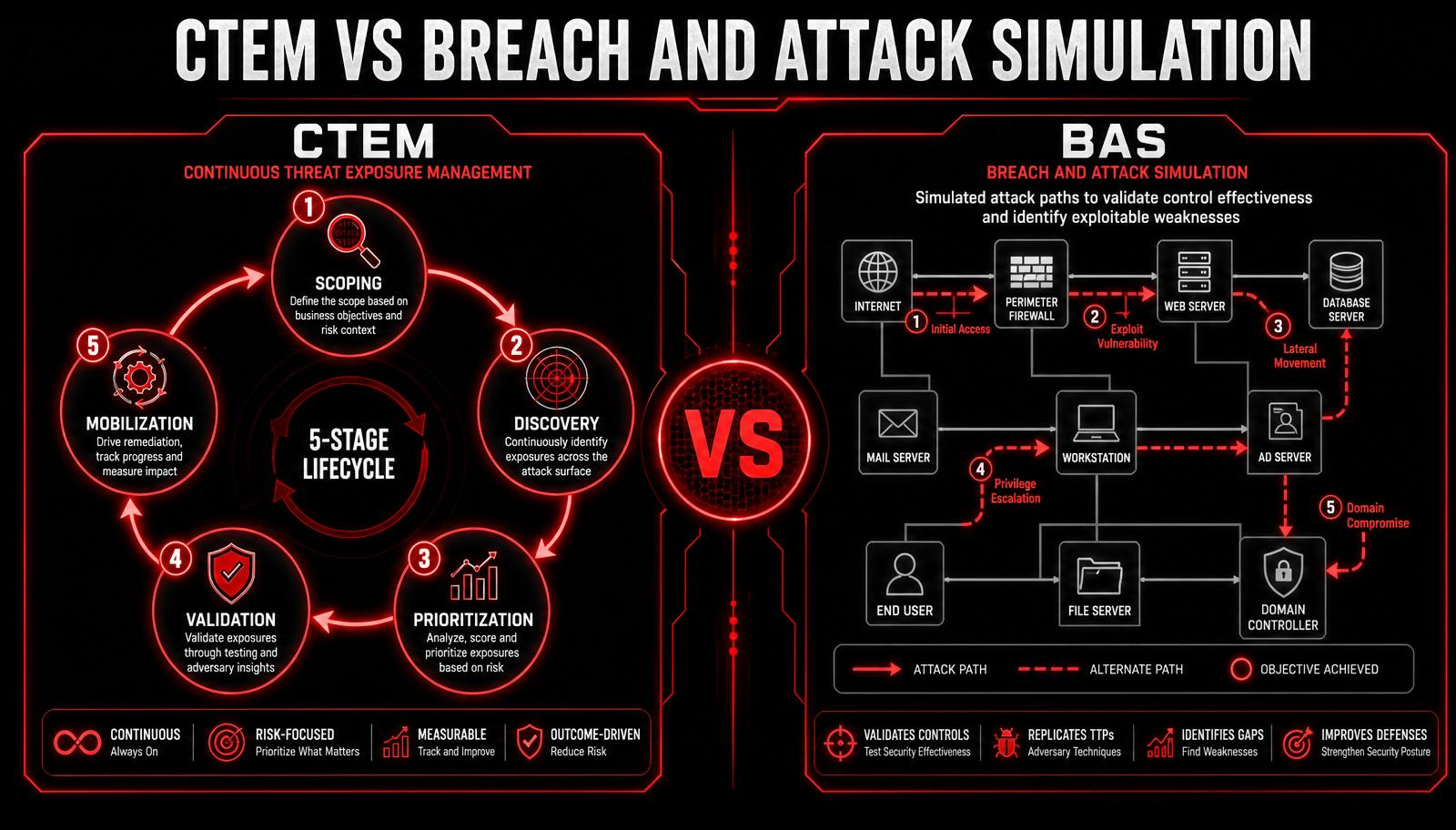
Breach and attack simulation tools execute predefined attacker techniques, often mapped to public frameworks like MITRE ATT&CK, against your environment. The intent is to check whether preventive controls block the technique, detection tools raise the right alert, and response processes act in time. BAS runs on schedule or on demand and produces machine-readable evidence.
Where BAS fits in CTEM Validate
| CTEM stage | How BAS contributes |
|---|---|
| Scope | Provides coverage maps that inform which services need improved controls |
| Discover | Reveals detection gaps and unmonitored techniques |
| Prioritize | Feeds control-coverage signal into the ranking |
| Validate | Automates confirmation that exposures are or are not exploitable in the current environment |
| Mobilize | Provides evidence for retest after remediation |
BAS vs pen testing vs red teaming
| Method | Automation | Scope | Cadence |
|---|---|---|---|
| BAS | High: predefined techniques | Technique-based | Continuous or scheduled |
| Pen testing | Low: human-led | Scoped target | Quarterly to annual |
| Red teaming | Low: human-led | Objective-based | Annual or on major change |
The three methods are complementary, not competitive. BAS provides breadth and consistency. Pen testing provides depth on a scoped target. Red teaming provides realism against a business objective. CTEM combines the three based on the exposure being validated.
Comparison table
| Area | Breach and attack simulation | CTEM |
|---|---|---|
| Primary purpose | Automated validation of controls and techniques | Continuous exposure reduction across sources |
| Scope | Technique-driven | Business-service driven |
| Output | Coverage maps, detection gaps, control failures | Closed exposures with evidence and metrics |
| Success measure | Techniques blocked or detected | Risk reduced on top services |
| Position in loop | One input to Validate | The full loop |
Safe use in production
Reputable BAS tools are designed to be safe in production, but every deployment should confirm:
- Rules of engagement approved by change management.
- Scope excluded lists for sensitive systems.
- Notification of detection and response teams to avoid false-incident escalations.
- Clear ownership of remediation for identified gaps.
Common BAS outputs in the exposure register
- Per-technique validation status, with test date and result.
- Detection gap reports, with the tool that should have alerted.
- Preventive control failures, with the exposure they leave open.
- Retest evidence attached to closed exposures.
For related comparisons, see CTEM vs Pen Testing and Red Teaming, CTEM vs Attack Surface Management, and CTEM vs Vulnerability Management.
How to apply this
- Land BAS output in the same exposure register as scanner and cloud findings
- Use BAS coverage maps as a Scope input for the next cycle
- Confirm change management approval for any production BAS scope
- Use BAS for retest after Mobilize on techniques the tool can execute
- Report BAS-driven detection improvements alongside CTEM outcome metrics
Common mistakes
- Running BAS as an isolated program with a separate dashboard
- Assuming BAS replaces pen testing or red teaming
- Skipping change management approval for production BAS scope
- Treating BAS output as final without applying threat context
- Ignoring detection gaps that BAS surfaces because they belong to another team
Key takeaways
- BAS is one validation method inside CTEM Validate.
- BAS, pen testing, and red teaming are complementary.
- BAS output belongs in the same exposure register as other findings.
- Production BAS needs clear rules of engagement.
- BAS coverage maps inform Scope, not only Validate.
Frequently asked questions
Related pages
CTEM vs Vulnerability Management
CTEM vs Vulnerability Management: What's Actually Different
Side-by-side comparison of CTEM and traditional vulnerability management: scope, prioritization, validation, ownership, and continuous risk reduction.
CTEM vs Attack Surface Management
CTEM vs Attack Surface Management: How They Work Together
How CTEM and attack surface management differ, where they overlap, and how ASM feeds the CTEM lifecycle for continuous risk reduction.
CTEM vs Pen Testing and Red Teaming
CTEM vs Penetration Testing and Red Teaming: Program vs Test
Understand why penetration testing and red teaming are validation activities and how CTEM uses them inside a continuous exposure program.
CTEM Framework
CTEM Framework: The Complete Operating Model Explained
The full CTEM framework: five stages, inputs, outputs, roles, cadence, and how scope, discovery, prioritization, validation, and mobilization connect.
Next step
Next: The CTEM Framework
See the full operating model that combines every validation method.
Earn your free CTEM certification.
Study the lifecycle, take a free certification exam and earn a publicly verifiable certificate.
Beginner / Practitioner / Program Leader
Explore certificationsAuthor
LearnCTEM Editorial Team
Practitioners and educators writing plain-English guides on Continuous Threat Exposure Management.
Reviewed by
Senior CTEM Practitioner Panel
Reviewed for accuracy against public CTEM guidance and real-world program experience.
Sources and further reading
- ▸MITRE ATT&CK. Public technique framework commonly used to organize BAS scope.
- ▸Gartner, Implement a Continuous Threat Exposure Management (CTEM) Program (2022). Positions automated validation as part of CTEM Validate.