
Quick answer
Direct answer
What you will learn
- What a first CTEM cycle actually looks like day by day
- How each stage hands off to the next in practice
- What outputs look like in a real cycle
- Where cycles usually get stuck and how to unblock them
- How the second cycle improves on the first
Explanation
Scenario snapshot
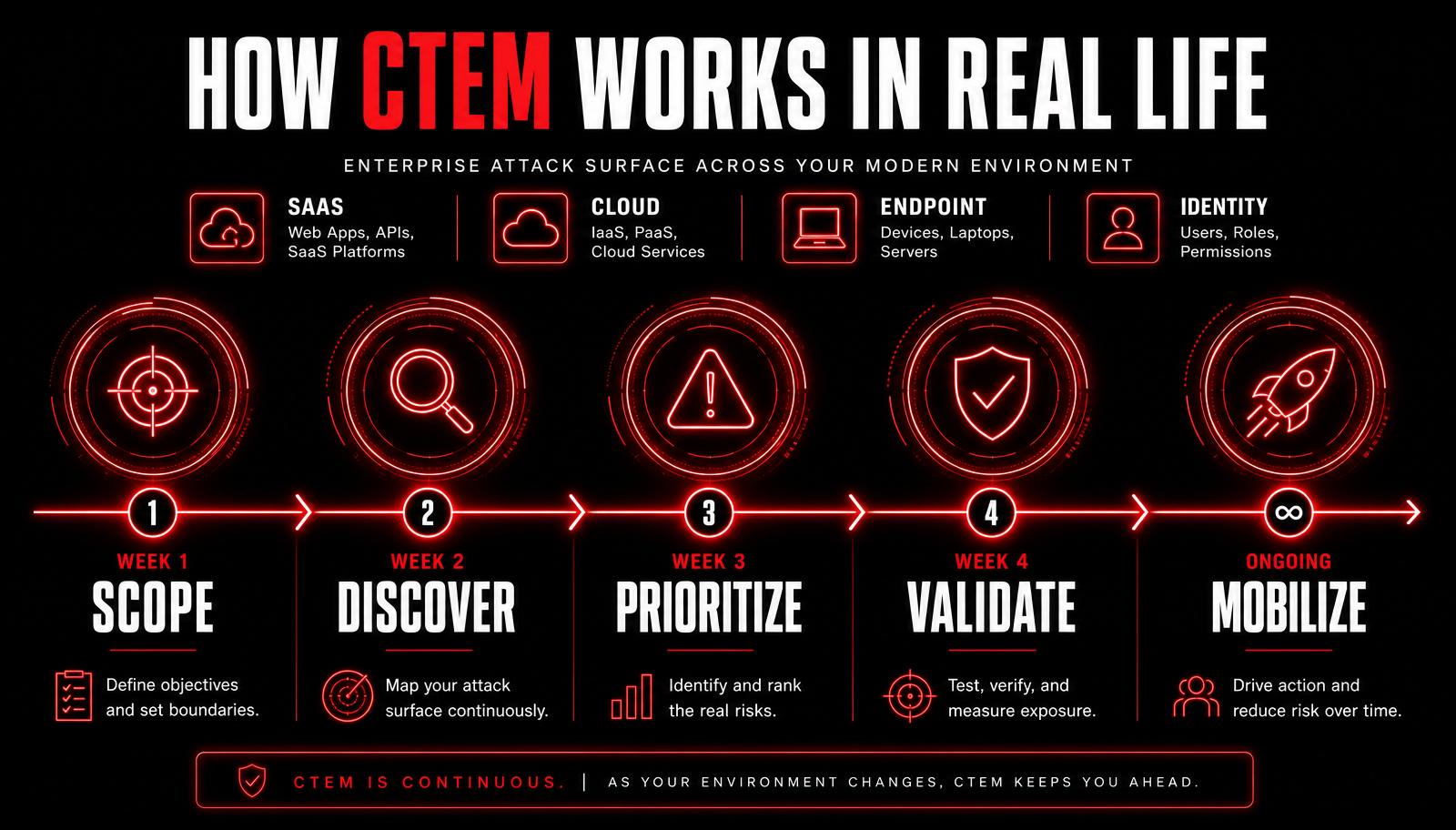
Day 1 to Day 3: Scope
The program manager meets the head of e-commerce and the checkout service owner. They agree the checkout service is the first cycle's scope because it handles card data and is customer-facing. The team writes a one-page scope brief listing the checkout web application, its API, its primary database, a payments integration, the storage bucket used for receipts, the deployment pipeline, and the on-call team.
Output: Scope brief signed by security leadership and the service owner.
Day 3 to Day 8: Discover
Security engineering pulls data from the vulnerability scanner, cloud posture tool, identity governance tool, external attack surface tool, and secrets scanner. Everything found in scope lands in a single exposure register. Duplicate findings are merged. Each row records source, asset, exposure category, and initial context.
What they find. Sixteen exposures across the seven scoped assets: two unpatched CVEs on the checkout web app, one public storage bucket, three excess-privilege service accounts, one leaked API key in an old commit, two exposed staging endpoints, one third-party library with a known issue, one microservice with no listed owner, and five lower-severity misconfigurations.
Output: Exposure register with sixteen rows.
Day 8 to Day 11: Prioritize
The exposure analyst applies business impact, reachability, exploitability, and threat context. Severity score is one input, not the ranking. The register is filtered to a short ranked list.
| Rank | Exposure | Reason |
|---|---|---|
| 1 | Public storage bucket | Internet-reachable, contains customer receipts including PII |
| 2 | Leaked API key in old commit | Grants payments API access; still valid |
| 3 | Excess-privilege service account | Can reach production database from a low-trust zone |
| 4 | Unpatched CVE on checkout web app | Public exploit exists; targeted by active ransomware campaigns |
| 5 | Third-party library with known issue | Used in payment flow; vendor patch available |
Output: Ranked short list with reasoning.
Day 11 to Day 14: Validate
Each top-five exposure is validated. The bucket is confirmed world readable through a safe read-only request. The leaked API key is proven still valid against a sandboxed endpoint. The excess-privilege account is walked from its trust zone to a database read, documented with screenshots. The CVE is confirmed present at the reported version. The third-party library is confirmed loaded in the payment path via dependency graph.
Result. Four of the five are confirmed real and exploitable. One is downgraded because a WAF rule blocks the CVE payload in production; that context is captured in the register.
Output: Validation evidence per item.
Day 14 to Day 21: Mobilize
The program manager routes each validated exposure to its owner with an SLA based on severity. Progress is tracked in the ticket system linked to the exposure register.
| Exposure | Owner | SLA | Closure evidence |
|---|---|---|---|
| Public storage bucket | Cloud engineering | 24 hours | Bucket ACL diff, retest confirms private |
| Leaked API key | Platform engineering | 24 hours | Key rotated, sandbox test fails, commit history redacted |
| Excess-privilege service account | Identity team | 5 days | Role scope reduced, walkthrough no longer reaches database |
| Unpatched CVE | Application team | 5 days | Patched build deployed, scanner clean, WAF rule kept as defense in depth |
| Third-party library | Application team | 7 days | Library upgraded, dependency check clean |
Output: Closed tickets with owner, timestamp, and evidence.
Day 21: Measure and report
The program manager writes a one-page report for the service owner and security leadership. It shows: exposures found, exposures closed with evidence, current critical exposure count on the checkout service, mean age at closure, reopened exposure rate, exceptions taken with reasons, and top three improvements for the next cycle.
Improvements identified. Add automated bucket policy checks to the deployment pipeline, expand secrets scanning to all repositories in the organization, and assign an owner to the unowned microservice discovered during scope. All three go on the roadmap for the next cycle.
Where cycles usually get stuck
| Sticking point | Common cause | How to unblock |
|---|---|---|
| Scope creeps to whole platform | Pressure to be comprehensive | Publish scope brief and treat additions as next-cycle work |
| Discover produces overwhelming noise | Every finding is treated equally | Filter by asset importance before adding to register |
| Prioritization takes too long | Trying to score every finding | Rank the top ten and defer the rest to next cycle |
| Validation is skipped | Time pressure | Treat validation as gating; nothing goes to Mobilize without it |
| Mobilize stalls waiting on an owner | No escalation path defined | Agree escalation during Scope, use it when SLA is at risk |
How the second cycle differs
The second cycle is faster because the register exists, ownership is clearer, and the retrospective from the first cycle is baked into the process. A common pattern is that cycle two either takes half the calendar time, or covers twice the scope in the same time. Cycle three usually enables continuous overlapping cycles across several services.
To try this on your own environment, see How to Start a CTEM Program or work through The 5 Stages of CTEM.
How to apply this
- Copy this 21-day plan and adapt dates to your own calendar
- Pick a single business service that ranks highly for business impact
- Publish a scope brief before writing a single scanner query
- Cap the first ranked list at five exposures
- Insist on evidence for every closure, even when it feels slow
Common mistakes
- Scoping the whole company on the first cycle
- Copying scanner output into the register without merging duplicates
- Skipping validation because a scanner already said the finding exists
- Closing tickets before retest
- Skipping the retrospective and treating the cycle as a one-off project
Key takeaways
- A first CTEM cycle takes two to four weeks on one business service.
- Every stage produces a small, concrete artifact.
- Validation is the stage that keeps the program honest.
- Evidence-based closure is the difference between CTEM and vulnerability management.
- The retrospective is what turns cycles into a program.
Frequently asked questions
Related pages
5 Stages of CTEM
The 5 Stages of CTEM Explained for Beginners
A beginner-friendly walkthrough of the five CTEM stages, scoping, discovery, prioritization, validation, and mobilization, using one running example.
How to Start a CTEM Program
How to Start a CTEM Program: A 30/60/90-Day Roadmap
A practical 30/60/90-day roadmap for starting a CTEM program: what to do first, what to avoid, how to choose scope, and how to show early progress.
CTEM Roles and Responsibilities
CTEM Roles and Responsibilities: Who Does What in the Program
A simple RACI-style view of CTEM roles across security, IT, cloud, application, identity, risk, and leadership teams.
CTEM Metrics and KPIs
CTEM Metrics and KPIs: What to Measure and How to Report
Practical CTEM metrics and KPIs with what each one means, why it matters, and how each one can be misused if reported without context.
Next step
Next: CTEM roles and responsibilities
See who does what in a real cycle.
Earn your free CTEM certification.
Study the lifecycle, take a free certification exam and earn a publicly verifiable certificate.
Beginner / Practitioner / Program Leader
Explore certificationsAuthor
LearnCTEM Editorial Team
Practitioners and educators writing plain-English guides on Continuous Threat Exposure Management.
Reviewed by
Senior CTEM Practitioner Panel
Reviewed for accuracy against public CTEM guidance and real-world program experience.
Sources and further reading
- ▸Gartner, Implement a Continuous Threat Exposure Management (CTEM) Program (2022). Defines the five-stage cycle used in this scenario.
- ▸NIST SP 800-40, Guide to Enterprise Patch Management Planning. Public guidance on SLA-based remediation aligned with CTEM Mobilize.