
Quick answer
CTEM in one paragraph
CTEM is not a tool you install. It is a way of working that connects the security team, IT, cloud, application, identity, and business owners around a single, repeatable rhythm. Every cycle asks four practical questions: what is exposed, what actually matters, what is truly exploitable, and did the fix land.
What you will learn
- What CTEM means in plain English
- Why CTEM exists and what problem it solves
- How CTEM differs from traditional vulnerability management
- How the five CTEM stages work
- How prioritization and validation actually work
- Who owns CTEM work across security, IT, cloud, application, and identity teams
- Which metrics show whether CTEM is really working
- How a small team can start CTEM with one business service
Why CTEM exists
Most security teams do not have a data problem. Scanners, cloud posture tools, identity tools, and external attack surface tools already produce thousands of findings every week. The problem is signal. CTEM exists because the noise around exposure keeps growing, and traditional programs cannot keep up.
- Security teams receive too many disconnected findings from too many tools
- Vulnerability severity alone does not show business risk or exploitability
- Assets, identities, cloud services, and applications change faster than quarterly scans
- Ownership of assets and findings is often unclear or contested
- Fixes stall when security cannot mobilize IT, cloud, application, and identity teams
- Leaders need proof that exposure is actually being reduced, not just that tickets are being opened
CTEM in one sentence
Memorable definition
CTEM is an operating model, not a product
A useful way to think about CTEM is that it sits on top of the tools you already own. It gives those tools a shared language, a shared cadence, and a shared definition of done. Any team that only buys a new product and calls it CTEM will end up with a slightly better dashboard and the same unfixed exposures.
- CTEM is not a scanner
- CTEM is not a dashboard
- CTEM is not a one-time report
- CTEM is not only vulnerability management
- CTEM is a repeatable way of working across teams, tied to the assets that matter to the business
CTEM lifecycle
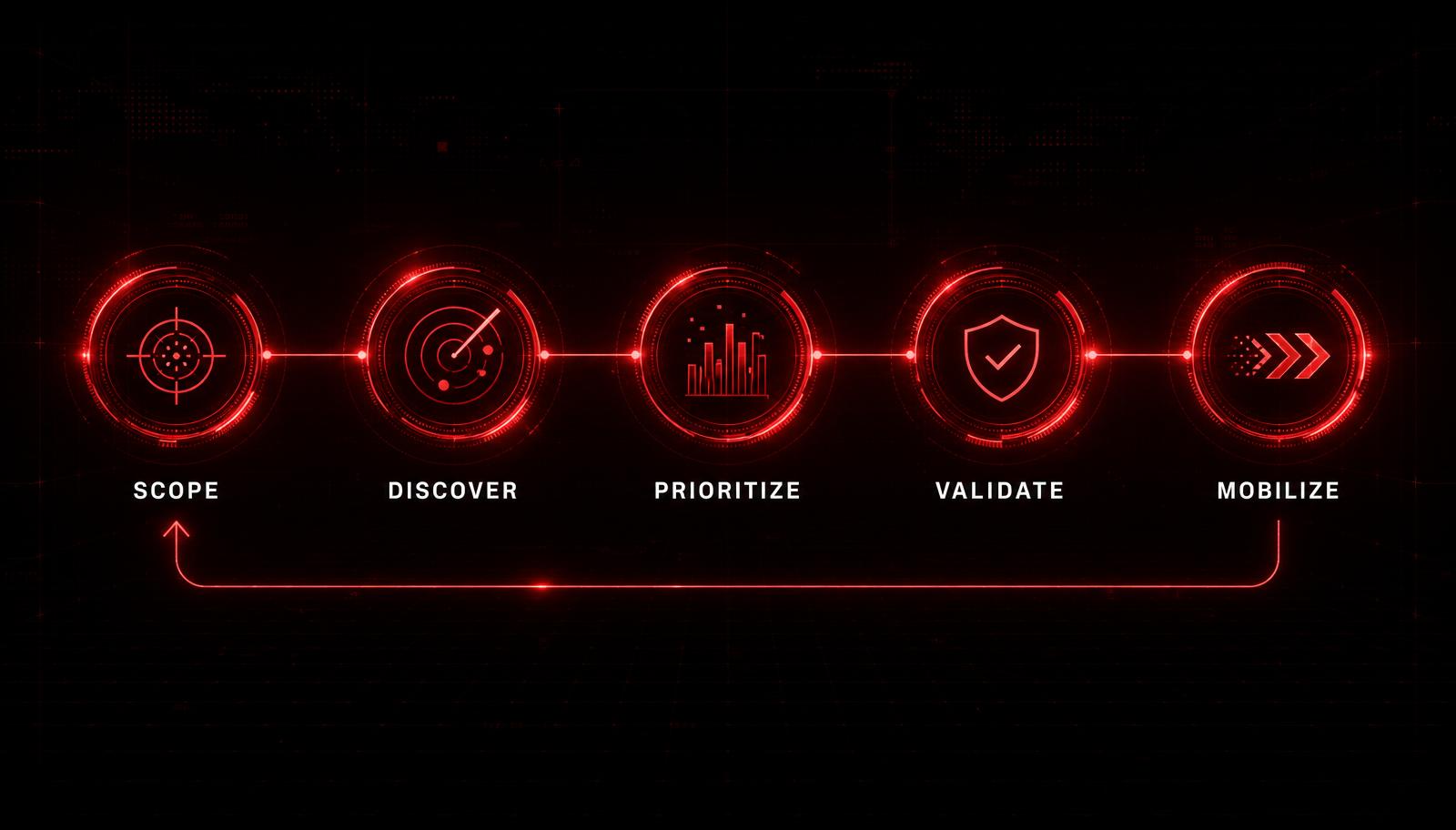
The CTEM lifecycle is a loop, not a project. Each pass covers a scope you have chosen, produces evidence that exposure was reduced, and feeds the next cycle with better information. The diagram below shows the flow.
The CTEM loop
- 01ScopeWhat matters
- 02DiscoverWhat exists
- 03PrioritizeWhat matters most
- 04ValidateWhat is real
- 05MobilizeWho fixes it
- 06MeasureWhat improved
Loop back to Scope. CTEM is a rhythm, not a one-time project.
The five CTEM stages explained
Every CTEM cycle moves through five practical stages. The point of naming them is not bureaucracy. It is to make sure every exposure has a clear stage owner and a clear next action.
| Stage | Plain-English meaning | Main question | Example output |
|---|---|---|---|
| Scope | Decide which business services and assets this cycle will focus on. | What are we protecting this cycle and why? | A one-page scope brief listing the service, its assets, and its business owner. |
| Discover | Find the assets, identities, weaknesses, and misconfigurations inside that scope. | What actually exists in scope, including things we forgot about? | A live exposure register with each finding, its source, and the affected asset. |
| Prioritize | Rank exposures by business impact and how attackable they are today. | Which of these should we fix first and why? | A ranked short list of the top exposures with reasoning attached. |
| Validate | Confirm that the top exposures are real, reachable, and exploitable. | If an attacker tried this today, would it work? | Validation notes and evidence for each high-priority exposure. |
| Mobilize | Assign a fix, confirm closure, and capture evidence before closing the ticket. | Who owns the fix, by when, and how do we know it worked? | Closed tickets with owner, timestamp, and proof of remediation. |
Beginner example
A company runs an online store. The service includes a public website, a payment workflow, a customer database, a cloud storage bucket used by the payment service, several admin accounts, and a deployment pipeline. The security team decides to run one full CTEM cycle on this service.
- Scope. The online store is chosen because it handles customer and payment data, and any incident here is visible to customers and regulators.
- Discover. The team finds a public storage bucket linked to the payment service, an admin account with unused but powerful access, an outdated library on the website, and an internal service with no listed owner.
- Prioritize. The public bucket ranks first because it is reachable from the internet and holds customer data. The admin account ranks second because compromise would allow lateral movement.
- Validate. Safe checks confirm the bucket is world readable, and a controlled test shows the admin account can reach the customer database.
- Mobilize. The cloud owner locks the bucket within one day, the identity team removes the excess access within the week, and the library is patched in the next release. Each closure has evidence attached.
- Measure. The team records closure times, notes what improved between the first and second cycle, and adds the missing owner to the asset inventory so it never gets lost again.
CTEM vs traditional vulnerability management
CTEM does not replace vulnerability management. It absorbs it and adds business context, validation, ownership, and continuous cadence. The table shows the practical differences.
| Area | Traditional vulnerability management | CTEM |
|---|---|---|
| Main focus | Software vulnerabilities on known assets | All exposures across assets, identities, cloud, and applications |
| Cadence | Scheduled scans, often monthly or quarterly | Continuous cycle with weekly and daily inputs |
| Prioritization | Mostly severity scores | Business impact, reachability, exploitability, and asset importance |
| Business context | Minimal or added after the fact | Built in from the Scope stage |
| Validation | Rarely, and often not repeated after remediation | Explicit stage, with evidence attached to closures |
| Ownership | Often unclear once findings leave security | Named owner per asset, per exposure, per fix |
| Output | Long finding lists | Short lists of validated, owned, closed exposures |
| Success metric | Tickets closed | Risk reduced on critical services, with evidence |
CTEM inputs and outputs
Each stage consumes generic inputs and produces specific outputs. The point is not to name a tool for each input, but to make sure the data actually reaches the next stage.
| CTEM stage | Common inputs | Expected outputs |
|---|---|---|
| Scope | Business service list, asset inventory, business criticality ratings | A written scope with services, assets, and owners |
| Discover | Vulnerability findings, cloud configuration data, identity data, application context, external surface data | An exposure register with source, asset, and initial context per finding |
| Prioritize | Exposure register, asset importance, threat activity, reachability, control coverage | A ranked short list with reasoning per exposure |
| Validate | Ranked exposures, test environment access, safe validation methods | Validation evidence for each priority exposure, including retest results |
| Mobilize | Validated exposures, ownership map, remediation SLAs | Closed tickets with owner, timestamp, evidence, and exceptions where needed |
How CTEM prioritization works
CTEM prioritization is not a single score. It is a small set of questions applied to every candidate exposure. When the answers stack up, the exposure moves to the top of the list.
- How important is the affected asset to the business
- Is the exposure reachable from where an attacker would actually start
- Is the asset exposed to the internet
- Is a working exploit or a known technique available
- Does an attacker path lead from this exposure to sensitive data or systems
- How sensitive is the data or process behind the exposure
- What level of privilege would an attacker gain
- What is the business impact if the exposure is used
- Do existing controls detect or block the technique
- How large is the remediation effort and how disruptive is it
- Is a named owner ready to act on it
Prioritization checklist
How CTEM validation works
Validation means confirming that an exposure is real, reachable, exploitable, relevant to the environment, and still present after remediation. It is the check that keeps the program honest. Without validation, a program prioritizes based on theory and closes based on trust.
- Confirming that an exposed service is actually reachable from the intended attacker position
- Verifying that a misconfiguration exists exactly as reported
- Checking whether excessive access can reach sensitive data by walking the path
- Confirming that a control blocks the attack path the exposure would enable
- Retesting after remediation to confirm the fix worked and did not regress
- Attaching evidence, such as a screenshot or a test note, before an item is closed
Roles and ownership
CTEM only works when the fix owners sit outside security. The table below shows the practical split. It is intentionally simple. A more detailed RACI lives on the dedicated roles page.
| Role or team | What they own in CTEM |
|---|---|
| Security team | Runs the program, sets scope with the business, ranks exposures, validates the top ones, and reports outcomes |
| IT operations | Owns patching and configuration on managed systems, and coordinates change windows |
| Cloud team | Owns cloud configuration, identity boundaries, and public exposure of cloud resources |
| Application team | Owns application code, dependencies, and secure release practices |
| Identity team | Owns accounts, roles, entitlements, and privileged access review |
| Asset owner | Confirms business impact, signs off on scope, and accepts exceptions |
| Risk or compliance team | Aligns CTEM outputs to policy, exceptions, and audit needs |
| Leadership | Sets tolerance, unblocks resources, and reviews the risk reduction trend |
Metrics that show CTEM is working
Ticket counts are a poor signal on their own. The following metrics tell you whether CTEM is actually reducing risk on the assets that matter.
| Metric | What it means | Why it matters |
|---|---|---|
| Total exposure backlog | All open exposures across in-scope assets | Shows the size of the problem you are actually working |
| Critical exposure count | Open exposures rated critical after prioritization | Focuses attention on the small set that could hurt the business |
| Exposure age | Time an exposure has been open since discovery | Shows whether the program is closing items or letting them age |
| Validated exposure rate | Share of high-priority exposures that were validated | Shows discipline around proving what is real before fixing |
| Remediation SLA performance | Share of exposures closed within their target time | Shows whether owners can actually deliver fixes |
| Reopened exposure rate | Exposures that returned after being closed | Shows quality of remediation and root-cause work |
| Exception count | Approved exposures kept open with a plan | Keeps risk decisions visible instead of buried |
| Critical asset exposure trend | Exposure count over time on critical assets | Shows whether the most important surface is improving |
| Risk reduction trend | Weighted view of open exposures over time | Shows whether the program is actually reducing risk |
| Time from discovery to closure | End-to-end time per closed exposure | Shows how fast the full loop can run in practice |
Benefits
- Reduces noise from long finding lists by focusing on exposures that matter
- Focuses teams on exposures that can actually hurt the business
- Improves remediation ownership across security, IT, cloud, application, and identity
- Connects technical findings to business context that leadership understands
- Helps leaders track risk reduction, not just ticket volume
- Makes validation part of normal security work instead of a special project
- Improves collaboration between security and operational teams
Common challenges
- Incomplete or stale asset inventory that hides real exposure
- Disconnected findings from different sources with no common view
- Unclear ownership of assets or of specific fixes
- Prioritization based only on severity scores
- Validation skipped due to time pressure or unclear responsibility
- Remediation tracked only by ticket closure, not by evidence
- Trying to scope the entire company in the first cycle instead of one service
Best practices
- Start with one important business service, not the whole company
- Define what exposure means for your organization and share the definition
- Agree on ownership before findings pile up in the register
- Prioritize by business impact and exploitability, not severity alone
- Validate only the highest-priority exposures first and expand from there
- Require evidence for closure, not just a status change on a ticket
- Review progress weekly and share a short exposure update with leadership
- Improve the cycle before you expand the scope
What CTEM is not
- Not a scanner
- Not a one-time report
- Not a product category by itself
- Not a compliance checkbox
- Not only for large enterprises
- Not a replacement for the security team
- Not useful without ownership and follow-through
How to apply this
- Write a one-page CTEM definition for your team
- Choose one important business service to run through the cycle
- Map the assets, identities, applications, and data involved
- Collect existing findings from your current security processes for that service
- Prioritize the top ten exposures using the questions on this page
- Validate the top three safely and attach evidence
- Assign owners and due dates for each validated exposure
- Track evidence of closure, not just ticket status
- Review what changed after 30 days and adjust the cycle for the next run
Key takeaways
- CTEM is a continuous operating model, not a product.
- The five stages, Scope, Discover, Prioritize, Validate, and Mobilize, run as a loop and always end with evidence.
- Prioritization stacks business impact, reachability, and exploitability, not severity alone.
- Validation is what separates a real closure from a hopeful one.
- Ownership sits outside security. Security runs the program; asset owners fix things.
- Good metrics measure risk reduction on critical assets, not ticket volume.
- Small teams can start CTEM by picking one service and running one full cycle.
Frequently asked questions
Related pages
What is a Cyber Exposure?
What is a Cyber Exposure? Meaning, Examples, and Types
A cyber exposure is any weakness, misconfiguration, excessive access, or condition an attacker could use to cause harm. Clear examples and beginner definitions.
CTEM Definition Explained
CTEM Definition Explained: Continuous, Threat, Exposure, Management
Break the phrase Continuous Threat Exposure Management into simple parts and understand what CTEM really means for security teams and leaders.
Exposure vs Vulnerability vs Threat vs Risk
Exposure vs Vulnerability vs Threat vs Risk: Clear Comparison
The clearest comparison of exposure, vulnerability, threat, and risk with a definition table and one scenario that follows all four terms end to end.
CTEM vs Vulnerability Management
CTEM vs Vulnerability Management: What's Actually Different
Side-by-side comparison of CTEM and traditional vulnerability management: scope, prioritization, validation, ownership, and continuous risk reduction.
CTEM Framework
CTEM Framework: The Complete Operating Model Explained
The full CTEM framework: five stages, inputs, outputs, roles, cadence, and how scope, discovery, prioritization, validation, and mobilization connect.
5 Stages of CTEM
The 5 Stages of CTEM Explained for Beginners
A beginner-friendly walkthrough of the five CTEM stages, scoping, discovery, prioritization, validation, and mobilization, using one running example.
CTEM Metrics and KPIs
CTEM Metrics and KPIs: What to Measure and How to Report
Practical CTEM metrics and KPIs with what each one means, why it matters, and how each one can be misused if reported without context.
How to Start a CTEM Program
How to Start a CTEM Program: A 30/60/90-Day Roadmap
A practical 30/60/90-day roadmap for starting a CTEM program: what to do first, what to avoid, how to choose scope, and how to show early progress.
Next step
Next: Learn what a cyber exposure is
Build the vocabulary you will use in every CTEM stage.
Earn your free CTEM certification.
Study the lifecycle, take a free certification exam and earn a publicly verifiable certificate.
Beginner / Practitioner / Program Leader
Explore certificationsAuthor
LearnCTEM Editorial Team
Practitioners and educators writing plain-English guides on Continuous Threat Exposure Management.
Reviewed by
Senior CTEM Practitioner Panel
Reviewed for accuracy against public CTEM guidance and real-world program experience.
Continuous Threat Exposure Management is often written as CTEM. This page uses both terms interchangeably. See the related pages above for a full glossary and stage-by-stage guides.