
What you will learn
- Why severity alone produces an unworkable queue
- What each prioritization signal really tells you
- A worked example of four findings ranked correctly
- How to build a weighting model and publish it
- How reachability and validation change the ranking
- How to keep the model honest over time
Explanation
Why severity alone produces an unworkable queue
If you sort by CVSS, a large enterprise queue will contain tens of thousands of critical and high items, most of which no attacker will ever touch. Severity describes what a flaw could do under ideal conditions for the attacker. It says nothing about whether anyone is exploiting it, whether the affected service is reachable, or whether the asset matters to the business.
The practical consequence is credibility loss. Engineering teams receive a list they cannot finish, notice that yesterday's critical item is unchanged today, and start treating the entire queue as advisory. Prioritization exists to prevent that outcome.
What each signal actually tells you
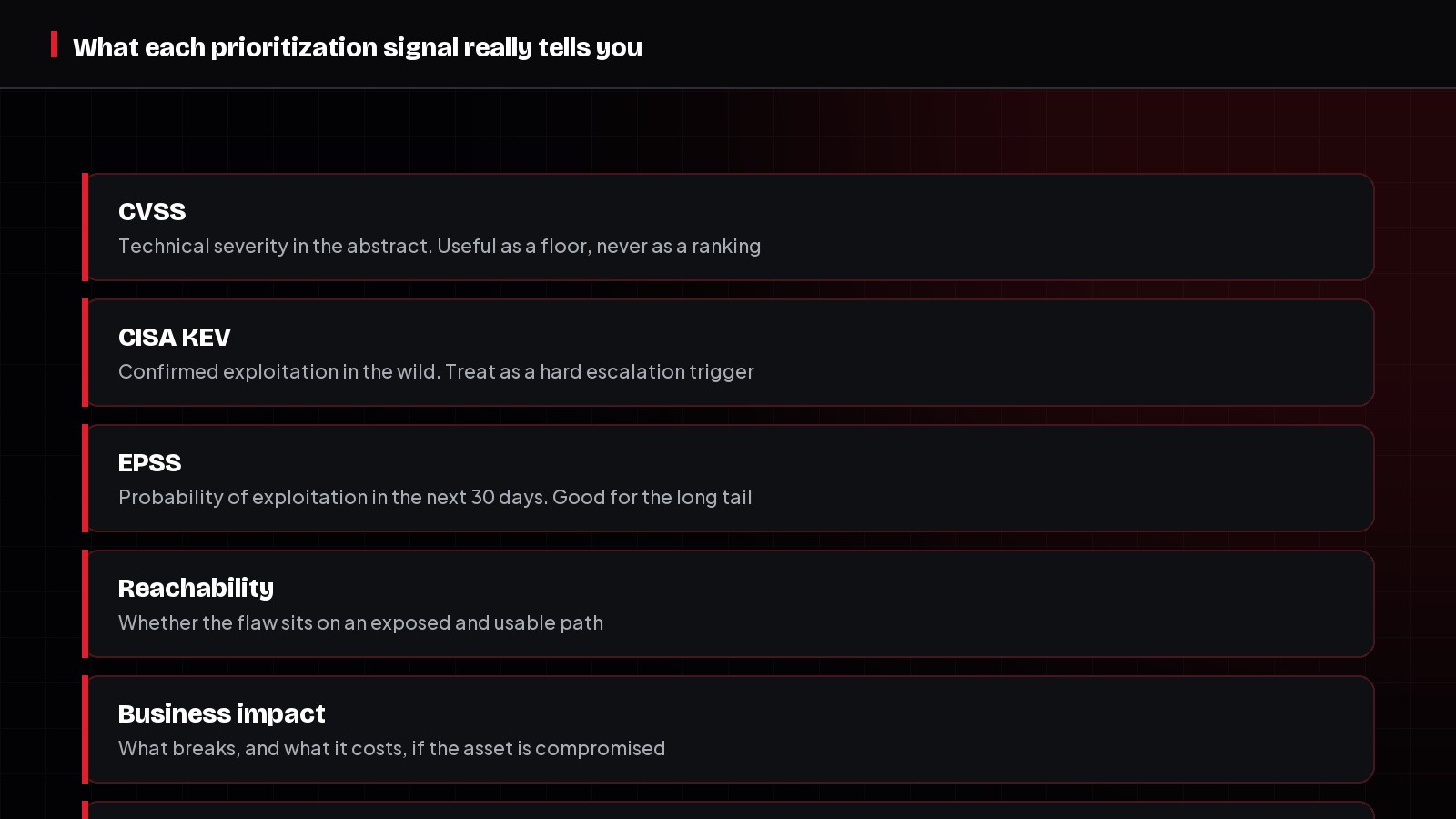
| Signal | Question it answers | Failure mode when used alone |
|---|---|---|
| CVSS | How bad is this flaw in theory | Thousands of equal criticals with no ordering |
| CISA KEV | Is this being exploited in the wild | Only covers what has been observed and catalogued |
| EPSS | How likely is exploitation in the next 30 days | Probabilistic, so it needs a threshold and review |
| Reachability | Can an attacker touch this at all | Requires accurate topology and identity data |
| Asset criticality | What breaks if this asset falls | Depends on business input that must be kept current |
| Validation | Does it actually work here today | Expensive, so it can only cover the top tier |
A worked example
Four findings arrive in the same cycle. Sorted by CVSS, the ordering would be A, B, C, D. Sorted by the CTEM model, the ordering changes completely, and the change is defensible to both the CISO and the platform team.
| Finding | CVSS | KEV | EPSS | Reachable | Asset tier | CTEM rank |
|---|---|---|---|---|---|---|
| A. Kernel flaw on isolated build agent | 9.8 | No | 0.02 | No | Low | 4 |
| B. Auth bypass on internet facing portal | 9.1 | Yes | 0.71 | Yes | Revenue critical | 1 |
| C. Misconfigured storage bucket with customer data | 6.5 | No | n/a | Yes | Regulated data | 2 |
| D. Privilege escalation on standard laptop image | 7.8 | Yes | 0.34 | Partially | Medium | 3 |
Notice that C outranks D despite a much lower CVSS score. A publicly readable bucket holding regulated records needs no exploit chain at all, which is a case where severity scoring is structurally misleading because there is no software vulnerability to score.
Building a weighting model you can defend
- 1Start with hard triggers. Known exploited plus reachable plus critical asset always enters the top tier, regardless of any score.
- 2Use EPSS with a threshold, for example 0.1 or higher, rather than as a fine grained ranking number.
- 3Apply asset tier as a multiplier that the business owns and reviews quarterly.
- 4Use CVSS as a floor to filter noise, not as the primary sort key.
- 5Downgrade only on validated control effectiveness, never on an assumption.
- 6Publish the model in one page and review it after every major incident or near miss.
Reachability is the cheapest large win
Most teams can cut their actionable queue substantially by asking one question consistently: can an attacker reach this from anywhere they can plausibly stand. Internet exposure, identity reachability and network path data all contribute. Reachability is also easier to automate than validation, so it is the right filter to add first if your programme is early.
Keeping the model honest
- Sample the queue monthly and ask whether the top ten items still feel right to a senior analyst
- Track how often validation overturns a ranking, which tells you where the model is weak
- Re-collect asset criticality from business owners on a fixed schedule
- Watch for score inflation, where teams request a tier upgrade to get work scheduled
- Record every exception with an expiry so accepted risk stays visible
How this fits the CTEM lifecycle
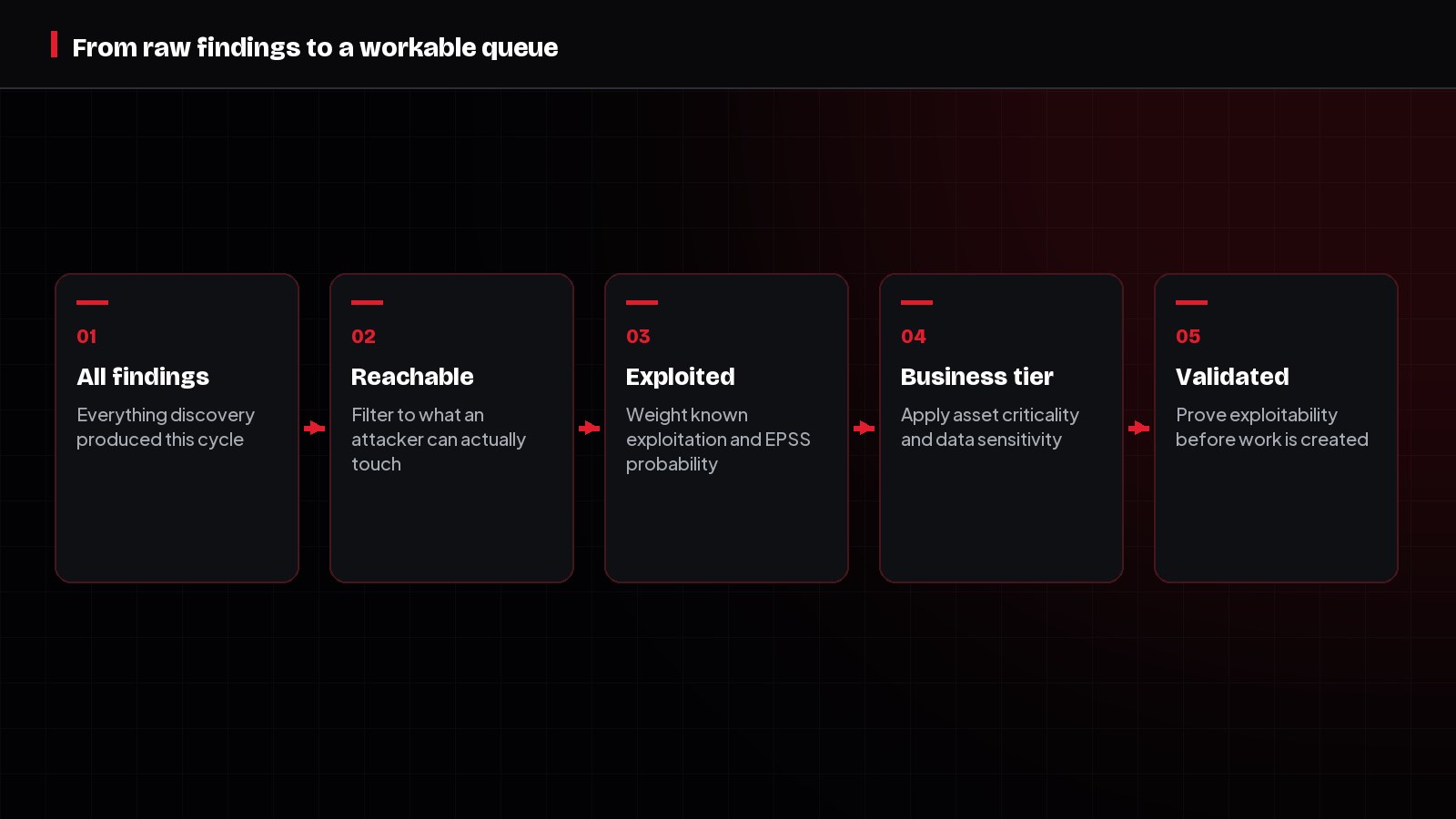
Prioritization sits between discovery and validation. It receives everything discovery found and produces a short ranked queue that validation can realistically test. If prioritization is weak, validation wastes its budget and mobilization loses the trust of engineering teams. If it is strong, the rest of the loop becomes much cheaper.
How to measure success
| Metric | Definition | Healthy direction |
|---|---|---|
| Top tier size | Items ranked as must fix this cycle | Stable and within remediation capacity |
| Ranking overturn rate | Top tier items downgraded after validation | Falling as the model improves |
| KEV exposure time | Days a known exploited item stays open on a reachable asset | Falling towards single digits |
| Queue acceptance | Share of ranked work engineering schedules without dispute | Rising towards near total acceptance |
How to apply this
- Write your prioritization model on one page and circulate it to engineering leadership.
- Add hard triggers for known exploited vulnerabilities on reachable critical assets.
- Introduce a reachability filter before investing in heavier validation tooling.
- Collect asset criticality from business owners and refresh it quarterly.
- Track how often validation overturns the ranking and tune the weights accordingly.
- Cap the top tier at what your teams can actually remediate in one cycle.
Common mistakes
- Sorting by CVSS and calling it risk based prioritization.
- Using EPSS as a precise ranking number rather than a threshold.
- Treating the KEV catalog as complete rather than as a floor of confirmed exploitation.
- Letting asset criticality be assigned by the security team without business input.
- Producing a top tier larger than remediation capacity, which restores the original problem.
- Hiding the model, which guarantees the queue gets renegotiated in every meeting.
Frequently asked questions
Related pages
CTEM Prioritize Stage
CTEM Prioritization Stage: Rank Exposures That Matter
How to prioritize exposures using business impact, exploitability, threat activity, asset criticality, control gaps, and attack paths.
Exposure Validation Checklist
Exposure Validation Checklist for CTEM Teams
A practical exposure validation checklist for CTEM: what to test, how to scope safely, what evidence to capture, and how to prove a fix actually held.
Attack Path Analysis
Attack Path Analysis for CTEM: Scoring Real Paths
How to analyse and score attack paths in CTEM: path anatomy, feasibility versus impact scoring, choke points, and turning graphs into prioritized work.
Vulnerability Management Learning Path
Free Vulnerability Management Training Path | LearnCTEM
Follow a free vulnerability management learning path covering CVSS, KEV, EPSS, prioritization, remediation, practical labs and CTEM certification.
CTEM Beginner Certification
CTEM Beginner Certification: Free Beginner Certification
The free CTEM Beginner certification for beginners. Syllabus, lessons, quiz format, sample questions, and how to earn the certificate.
Earn your free CTEM certification.
Ready to prove your CTEM knowledge? Start with the free LearnCTEM Beginner Certification, continue with the Practitioner Certification, and build toward Program Leader. Every LearnCTEM certificate is free, vendor-neutral, and publicly verifiable at LearnCTEM.com.
Beginner / Practitioner / Program Leader
Explore certificationsAuthor
LearnCTEM Editorial Team
Practitioners and educators writing plain-English guides on Continuous Threat Exposure Management.
Reviewed by
Senior CTEM Practitioner Panel
Reviewed for accuracy against public CTEM guidance and real-world program experience.