
What you will learn
- Why SaaS breaks traditional vulnerability management
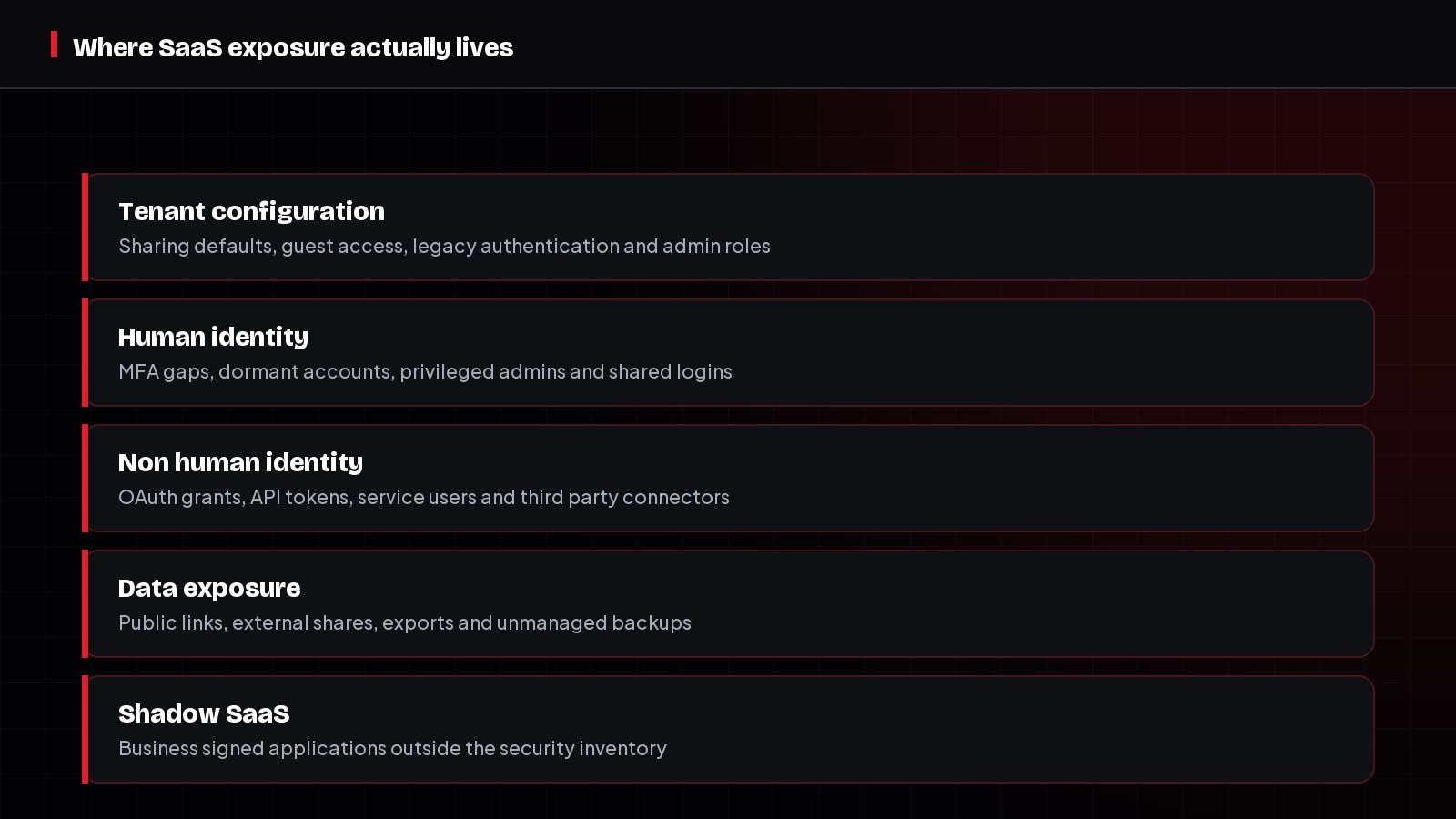
- Where SaaS exposure actually lives
- How to discover shadow SaaS without an agent
- How to baseline tenant configuration
- How to score OAuth grants and non human identities
- How to validate SaaS exposure safely
- How to mobilize business application owners
Explanation
There is nothing to patch, so the exposure moves
When the vendor runs the software, you inherit their patching and lose most of the vulnerability surface. What you keep is everything you control: who can log in, how strongly, what they can reach, which third party applications you granted access to, and how easily data leaves the tenant. Those controls are configured by business teams, change without security review, and are rarely inventoried. That is where SaaS incidents come from.
Discovering shadow SaaS without agents
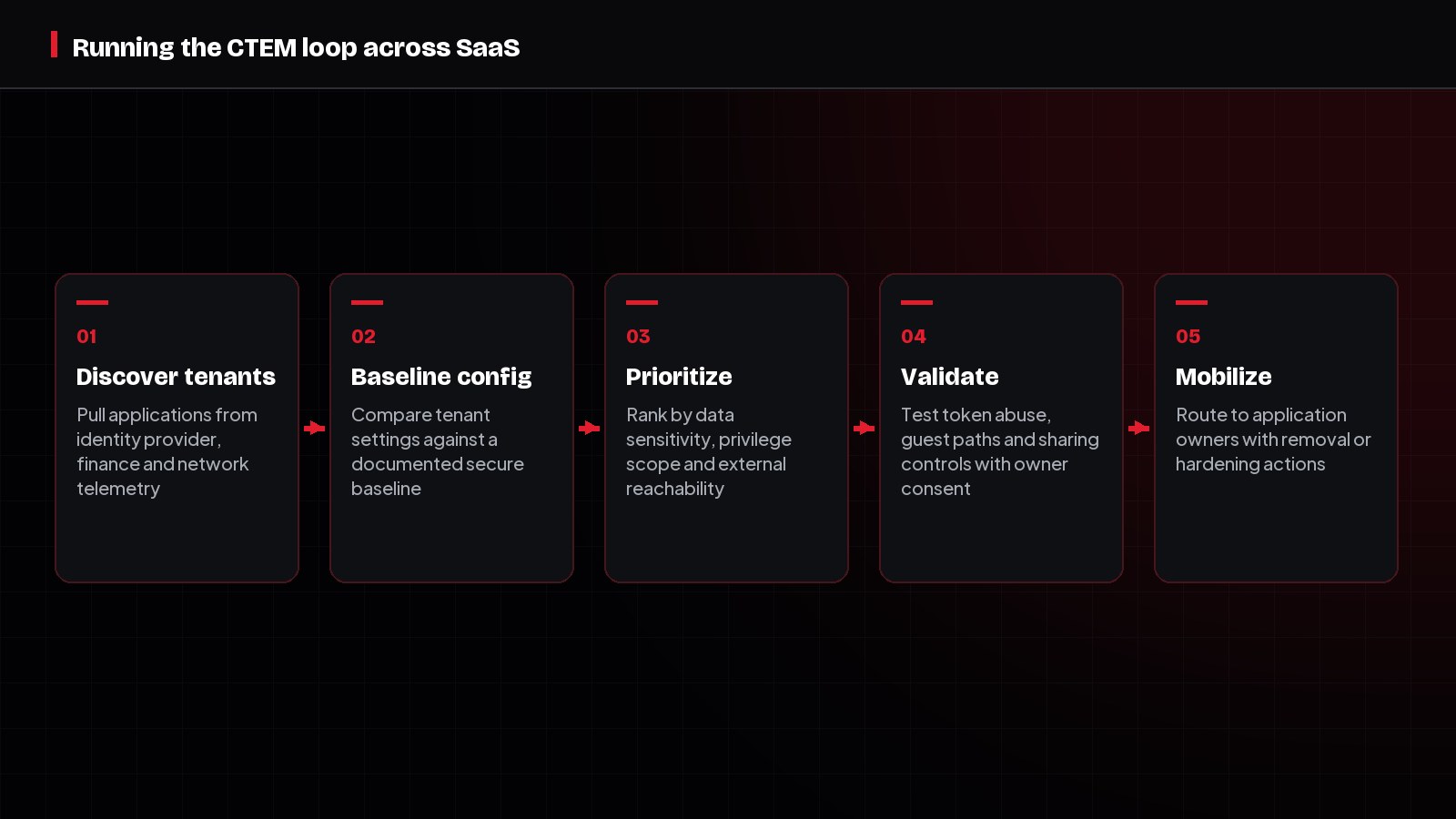
You cannot secure applications you do not know about, and the business signs up for applications faster than security can track them. Combine several imperfect data sources; each one alone is incomplete, but together they produce a credible list.
- 1Identity provider logs: every application using single sign on, plus the ones users authenticate to with corporate email.
- 2Expense and procurement data: subscriptions paid by business units without a security review.
- 3OAuth grant logs in your major tenants: third party applications that already hold API access to your data.
- 4Network and secure web gateway telemetry: applications used without single sign on at all.
- 5Direct interviews with business teams for anything holding regulated data.
Baseline tenant configuration, then measure drift
Write a documented secure baseline for each major tenant, covering authentication strength, external sharing defaults, guest access, legacy protocol availability, admin role counts, audit log retention and export controls. Then measure drift continuously. Most SaaS incidents trace back to a setting that was correct at go live and quietly changed later.
| Setting area | Common weak default | Baseline target |
|---|---|---|
| Authentication | Legacy protocols still enabled | Modern authentication only, phishing resistant MFA for admins |
| External sharing | Anyone with the link can view | Named recipients, expiry on external links |
| Guest access | Guests can invite other guests | Sponsored guests with review and expiry |
| Admin roles | Many permanent global admins | Small named set, just in time elevation |
| Logging | Short retention, no export | Extended retention exported into the security data platform |
OAuth grants and non human identity are the underrated risk
A third party application granted broad, refreshable access to mailboxes or files is a persistent credential outside your control. Unlike a user account it has no MFA, no session expiry a helpdesk can trigger, and often no owner. Inventory every grant, score it by scope and data reach, and remove anything unowned or unused.
- Record every OAuth application, its scopes, its consenting user and the date of consent
- Flag grants with tenant wide scopes, especially read of all mail, all files or all sites
- Disable user consent for high privilege scopes and require an admin review
- Expire and re certify integrations annually with a named business owner
- Revoke grants for applications with no login activity in the last 90 days
Validating SaaS exposure safely
SaaS validation is mostly confirmation rather than exploitation, and the vendor's terms of service usually forbid active testing against their platform. Focus on tests you can run against your own tenant and your own data with the application owner's consent.
- Confirm whether an external link is actually reachable from an unauthenticated browser
- Test whether a guest account can reach content it should not
- Verify that a revoked token really stops working, rather than assuming
- Check that admin actions produce alerts in your monitoring, not only in the vendor log
- Test the offboarding process end to end with a controlled test account
Mobilizing owners who are not engineers
The person who can fix a SaaS exposure is usually a business administrator, not an infrastructure engineer. Write the request in their language: which setting, where, what changes for their users, and what happens if it is not done. Give them a rollback path and a named contact. Technical severity language does not motivate an application owner; user impact and business risk do.
How to apply this
- Build a SaaS inventory from identity, finance, OAuth and network data this quarter.
- Write and publish a secure baseline for your three largest tenants.
- Inventory every OAuth grant and revoke anything unowned or dormant.
- Run consent based validation on external sharing and guest access.
- Assign a named business owner to every tenant and route work to them directly.
Common mistakes
- Treating SaaS as out of scope because there is nothing to patch.
- Discovering applications once and never repeating it.
- Ignoring OAuth grants, which are credentials without expiry or MFA.
- Sending configuration findings to infrastructure teams who cannot change them.
- Running active tests against a vendor platform without checking the terms of service.
Frequently asked questions
Related pages
Identity Exposure in CTEM
Identity Exposure in CTEM: Practical Guide
Learn how credentials, secrets, privileges, and service accounts fit into CTEM discovery, prioritization, validation, and remediation.
Cloud CTEM
Cloud CTEM: AWS, Azure, Kubernetes, SaaS and CIEM
How to run CTEM in cloud environments: the five exposure planes, cloud attack paths, CIEM entitlement risk, Kubernetes exposure and safe validation in production.
Complete CTEM Guide 2026
Complete CTEM Guide 2026: Framework and Lifecycle
A complete CTEM guide for 2026: the framework, five lifecycle stages, worked examples, tool categories, metrics and a practical rollout sequence.
Earn your free CTEM certification.
Ready to prove your CTEM knowledge? Start with the free LearnCTEM Beginner Certification, continue with the Practitioner Certification, and build toward Program Leader. Every LearnCTEM certificate is free, vendor-neutral, and publicly verifiable at LearnCTEM.com.
Beginner / Practitioner / Program Leader
Explore certificationsAuthor
LearnCTEM Editorial Team
Practitioners and educators writing plain-English guides on Continuous Threat Exposure Management.
Reviewed by
Senior CTEM Practitioner Panel
Reviewed for accuracy against public CTEM guidance and real-world program experience.