
What you will learn
- What CTEM is and what it is not
- The five stages of the CTEM lifecycle in operational detail
- A worked example that follows one exposure end to end
- How the CTEM operating loop runs week to week
- Which tool categories support each stage
- The metrics that show whether the program is working
- A realistic maturity ladder from first scope to enterprise coverage
Explanation
What is CTEM in one paragraph?
Continuous Threat Exposure Management, usually shortened to CTEM, is a program discipline rather than a product. It gives security teams a repeatable way to answer four questions on a fixed cadence: what parts of the business are we responsible for protecting, what exposures exist there, which of those exposures are genuinely dangerous, and did anyone actually fix them. CTEM is deliberately continuous because attack surfaces change daily and because a point in time assessment answers those questions only for the day it was run.
The word exposure matters. A vulnerability is a software weakness. An exposure is anything that gives an attacker a usable foothold or a usable step toward something valuable, which includes unpatched software but also misconfigurations, over privileged identities, exposed management interfaces, leaked credentials, forgotten cloud storage, unmanaged assets and weak segmentation. A CTEM program is scoped around exposures because attackers do not restrict themselves to items that have a CVE identifier.
The five stages of the CTEM lifecycle
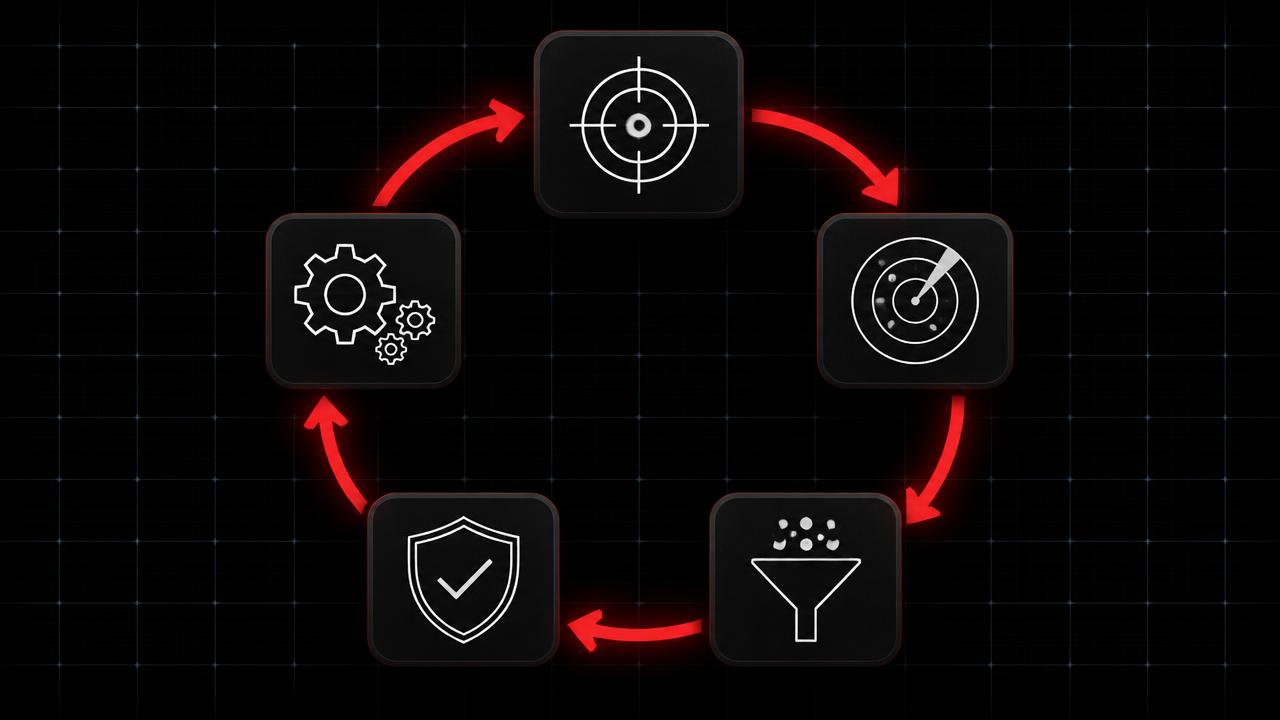
Every credible CTEM implementation moves through the same five stages. The order matters, because each stage removes noise that would otherwise overwhelm the next one.
| Stage | Core question | Primary output |
|---|---|---|
| Scoping | What business systems are in scope this cycle? | A named scope with owners and crown jewel assets |
| Discovery | What assets and exposures exist inside that scope? | An exposure register with asset context |
| Prioritization | Which exposures matter most right now? | A ranked, defensible remediation queue |
| Validation | Could an attacker actually use this? | Evidence of exploitability and control effectiveness |
| Mobilization | Who fixes it, by when, and how do we prove it? | Owned tickets, SLAs and verified closure |
Stage one: scoping that reflects the business
Scoping is where most programs quietly fail. A scope defined as everything produces a backlog nobody can act on. A useful scope is defined in business language first and technical language second. Start with a revenue generating or regulated process, for example customer payments, patient records or the production build pipeline, then enumerate the systems and identities that process supports.
- Name the business process and its accountable executive owner.
- List the crown jewel assets that process depends on, including data stores and the identities that can reach them.
- Record the technical boundary: cloud accounts, subscriptions, domains, IP ranges, code repositories, SaaS tenants and third party connections.
- Agree what is explicitly out of scope for this cycle so the team can defend the boundary later.
A first scope should be small enough that the whole loop completes inside one quarter. A program that proves the loop on one business process earns the credibility to expand. A program that tries to scope the entire estate on day one usually stalls at discovery.
Stage two: discovery beyond the vulnerability scanner
Discovery answers what exists and what is weak inside the agreed scope. Traditional vulnerability management contributes one input here. A CTEM discovery layer pulls from several sources and reconciles them into a single asset and exposure inventory.
- External attack surface data for internet facing hosts, certificates, subdomains and exposed services.
- Internal asset inventory from endpoint, cloud and configuration management systems.
- Cloud posture findings covering misconfiguration, public exposure and workload weaknesses.
- Identity data covering privileged accounts, stale accounts, service principals and standing access.
- Application and code findings, including exposed secrets and dependency risk.
- Third party and supply chain connections that reach into the scope.
The output is not a list of findings. It is an exposure register where every entry carries the asset, the owner, the business process it supports, the exposure type and where the evidence came from. Without ownership recorded at discovery time, prioritization produces work nobody can accept.
Stage three: prioritization that survives challenge
Severity alone is a poor ranking signal because it describes theoretical damage, not likelihood or context. A defensible CTEM prioritization model combines four inputs.
| Input | What it tells you | Example source |
|---|---|---|
| Known exploitation | Attackers are using this today | CISA Known Exploited Vulnerabilities Catalog |
| Exploit probability | How likely exploitation is in the near term | FIRST EPSS scoring |
| Technical severity | How bad the outcome could be | CVSS base and environmental scores |
| Business context | What breaks if this is used | Crown jewel mapping and data classification |
Weighting is a program decision, not a universal formula. A workable starting point is to treat known exploited items inside the scope as automatic top tier, then rank the remainder by exploit probability multiplied by business impact, with technical severity as a tie breaker. Publish the model so engineering teams can predict what will land in their queue.
Stage four: validation that replaces assumption with evidence
Validation asks a narrow question: if an attacker attempted this, would our controls stop it. Validation is what separates CTEM from a better sorted vulnerability list. It can be delivered through safe exploitation testing, breach and attack simulation, control configuration review, attack path analysis or targeted penetration testing, and the technique should match the exposure.
- Validate the top of the queue first. Validating everything is neither possible nor useful.
- Record the outcome in three states: exploitable, blocked by a named control, or inconclusive.
- Capture the evidence artefact, because that artefact is what convinces an engineering owner and an auditor.
- Feed blocked results back into prioritization so the queue reflects reality rather than raw findings.
Stage five: mobilization, where risk actually falls
Mobilization converts validated exposures into work inside the systems engineering teams already use. Security teams that build a parallel remediation tracker generally lose, because the work never enters sprint planning or change control. Route findings into the existing ticketing system with the owner, the evidence, the specific action and the deadline attached.
| Tier | Trigger | Target remediation |
|---|---|---|
| Tier 1 | Validated exploitable path to a crown jewel asset | 72 hours or documented compensating control |
| Tier 2 | Known exploited exposure on an in scope asset | 7 days |
| Tier 3 | High probability exposure, no validated path | 30 days |
| Tier 4 | Everything else in the register | Next maintenance window or backlog |
A worked example: one exposure through all five stages
A retailer scopes its customer payment journey. Discovery finds 41,000 findings across the scope, which is unhelpful on its own. One entry is an internet facing reporting appliance running an outdated component, owned by the finance platform team.
- 1Scoping places the appliance in scope because it holds a database credential used by the payment reporting job.
- 2Discovery records the asset, its owner, the exposed component and the credential relationship.
- 3Prioritization ranks it top tier because the component appears in the known exploited catalogue and the asset touches cardholder data.
- 4Validation proves that the exposed component can be reached from the internet and that the stored credential grants read access to the reporting database, while also proving that lateral movement to the core payment processor is blocked by segmentation.
- 5Mobilization issues a 72 hour ticket to patch the component and a 7 day ticket to rotate and vault the credential, then reruns the validation test before closing.
The value is not that a patch was applied. It is that the team can state, with evidence, that a specific path to cardholder data existed on Monday and no longer existed on Friday. That is the sentence a board understands.
How the CTEM operating loop runs in practice
| Cadence | Activity | Owner |
|---|---|---|
| Daily | Ingest new discovery data, triage known exploited items | Exposure analyst |
| Weekly | Prioritization review and validation queue planning | CTEM lead with asset owners |
| Fortnightly | Mobilization stand up with IT, cloud and application owners | Remediation owners |
| Monthly | Metrics pack, exception review, scope adjustment | Security leadership |
| Quarterly | Scope expansion, maturity assessment, board reporting | CISO |
Which tools support CTEM?
No single product delivers CTEM, and any claim otherwise deserves scrutiny. Map the categories to the stages instead, then decide what you already own.
| Stage | Supporting categories |
|---|---|
| Scoping | CMDB, business service mapping, data classification |
| Discovery | EASM, CAASM, vulnerability assessment, CNAPP, code and secrets scanning, identity discovery |
| Prioritization | Threat intelligence, exploit intelligence feeds, risk scoring and exposure analytics |
| Validation | Breach and attack simulation, automated penetration testing, attack path analysis, control assurance |
| Mobilization | ITSM and issue tracking, automation and orchestration, patch and configuration management |
How this fits the CTEM lifecycle
This guide is the map for the entire lifecycle. Each stage described here has its own operational depth, and the practical failure modes differ per stage: scoping fails through over ambition, discovery fails through unreconciled data, prioritization fails through unpublished logic, validation fails through unrepeatable tests, and mobilization fails through missing ownership. Programs improve fastest when they diagnose which single stage is currently the bottleneck rather than trying to improve all five at once.

How to measure success
Measure the loop, not the inventory. Finding counts rise as coverage improves, which makes them useless as a progress signal.
| Metric | Definition | Healthy direction |
|---|---|---|
| Validated exposure reduction | Exploitable paths to crown jewels closed per cycle | Rising then plateauing |
| Time to remediate validated exposures | Median days from validation to verified fix | Falling |
| Scope coverage | Percentage of in scope assets with current discovery data | Rising toward full coverage |
| Exposure half life | Time for half of a cohort of exposures to be closed | Falling |
| Repeat exposure rate | Share of exposures that reappear after closure | Falling |
| Exception debt | Count and age of accepted risks | Stable and reviewed |
Common mistakes to avoid
The failure patterns are consistent across industries and program sizes, and almost all of them are organisational rather than technical.
A realistic first year
| Period | Focus | Proof point |
|---|---|---|
| Days 1 to 30 | Scope one business process, agree owners | Signed scope document |
| Days 31 to 60 | Build the exposure register, publish the prioritization model | Ranked queue accepted by engineering |
| Days 61 to 90 | Validate the top tier, run the first mobilization cycle | First verified exposure closures |
| Months 4 to 6 | Automate discovery ingestion, set SLAs, start metrics reporting | Monthly metrics pack |
| Months 7 to 12 | Expand to a second and third scope, formalise exceptions and governance | Board level exposure report |
How to apply this
- Pick one revenue generating or regulated business process and write a one page scope with a named executive owner.
- Build a single exposure register that reconciles external, internal, cloud, identity and application discovery sources.
- Publish your prioritization model, including how known exploitation and business impact are weighted.
- Validate only the top tier of the queue and record every result as exploitable, blocked or inconclusive.
- Route validated work into the ticketing system engineering already uses, with evidence and a deadline attached.
- Report validated exposure reduction and time to remediate monthly, and expand scope only after one full loop completes.
Common mistakes
- Scoping the entire estate at once, which guarantees the first loop never finishes.
- Treating CTEM as a product purchase rather than an operating model.
- Ranking by severity alone and ignoring known exploitation and business context.
- Skipping validation, which leaves the team defending a longer list rather than a smaller risk.
- Building a separate remediation tracker that engineering teams never open.
- Reporting finding counts to executives instead of validated risk reduction.
- Leaving exceptions undocumented, so accepted risk quietly becomes invisible risk.
Frequently asked questions
Related pages
What is CTEM?
What is CTEM? Continuous Threat Exposure Management Explained
CTEM (Continuous Threat Exposure Management) explained in plain English: definition, why it exists, and how it works as an operating model, not a tool.
CTEM Framework
CTEM Framework: The Complete Operating Model Explained
The full CTEM framework: five stages, inputs, outputs, roles, cadence, and how scope, discovery, prioritization, validation, and mobilization connect.
5 Stages of CTEM
The 5 Stages of CTEM Explained for Beginners
A beginner-friendly walkthrough of the five CTEM stages, scoping, discovery, prioritization, validation, and mobilization, using one running example.
Maturity Model
CTEM Maturity Model: From Ad Hoc to Optimized
A CTEM maturity model with levels, evidence, metrics, and improvement actions to move from ad hoc to optimized.
CTEM Proving Ground Labs
CTEM Proving Ground Labs: Assessed Hands-On CTEM Labs
Free assessed CTEM labs. Run the five CTEM stages on realistic enterprise scenarios, pass every stage, and earn a verifiable credential.
CTEM Beginner Certification
CTEM Beginner Certification: Free Beginner Certification
The free CTEM Beginner certification for beginners. Syllabus, lessons, quiz format, sample questions, and how to earn the certificate.
Earn your free CTEM certification.
Ready to prove your CTEM knowledge? Start with the free LearnCTEM Beginner Certification, continue with the Practitioner Certification, and build toward Program Leader. Every LearnCTEM certificate is free, vendor-neutral, and publicly verifiable at LearnCTEM.com.
Beginner / Practitioner / Program Leader
Explore certificationsAuthor
LearnCTEM Editorial Team
Practitioners and educators writing plain-English guides on Continuous Threat Exposure Management.
Reviewed by
Senior CTEM Practitioner Panel
Reviewed for accuracy against public CTEM guidance and real-world program experience.