

What you will learn
- Why cloud exposure is mostly identity and configuration
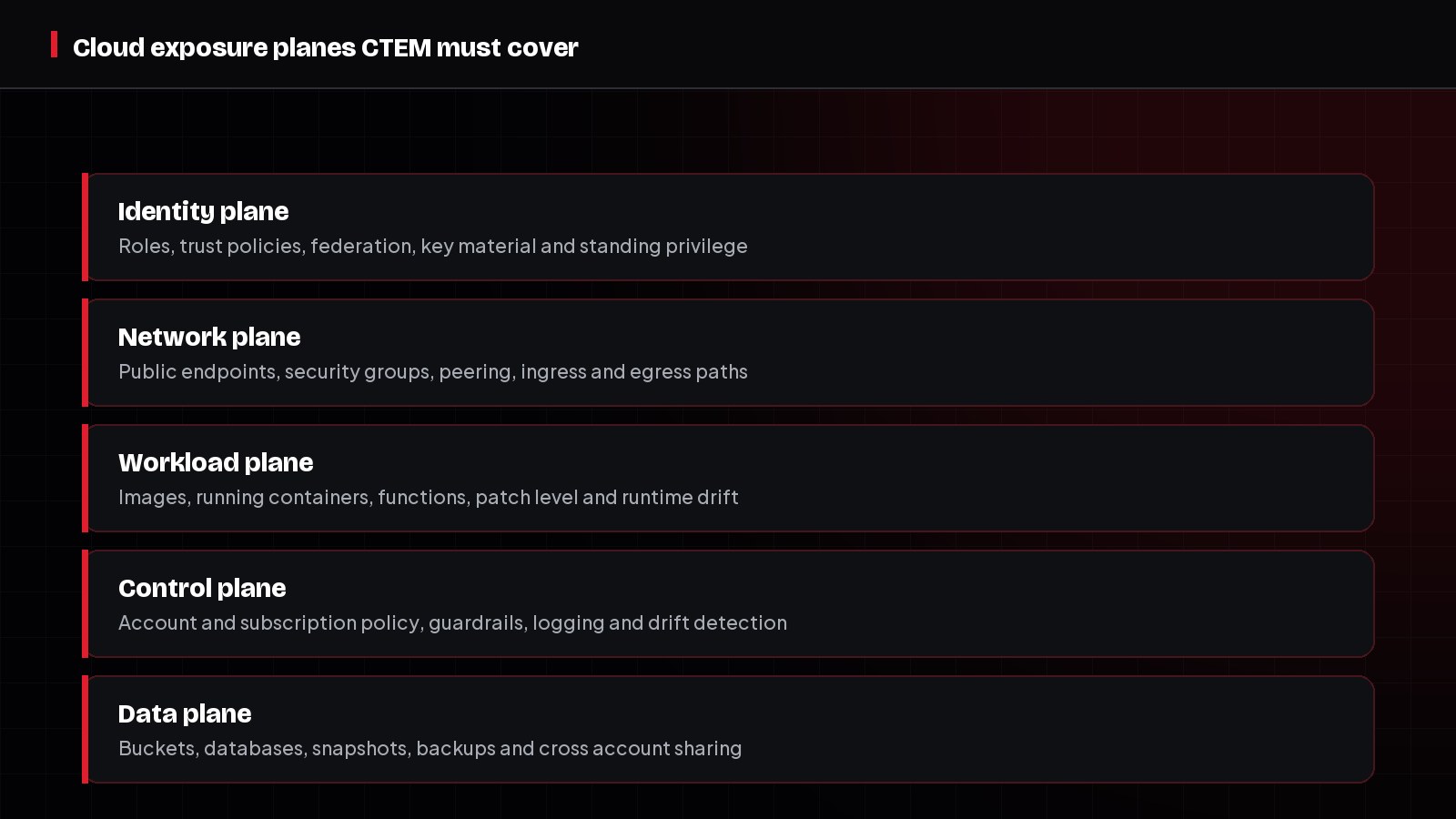
- The five cloud planes CTEM has to cover
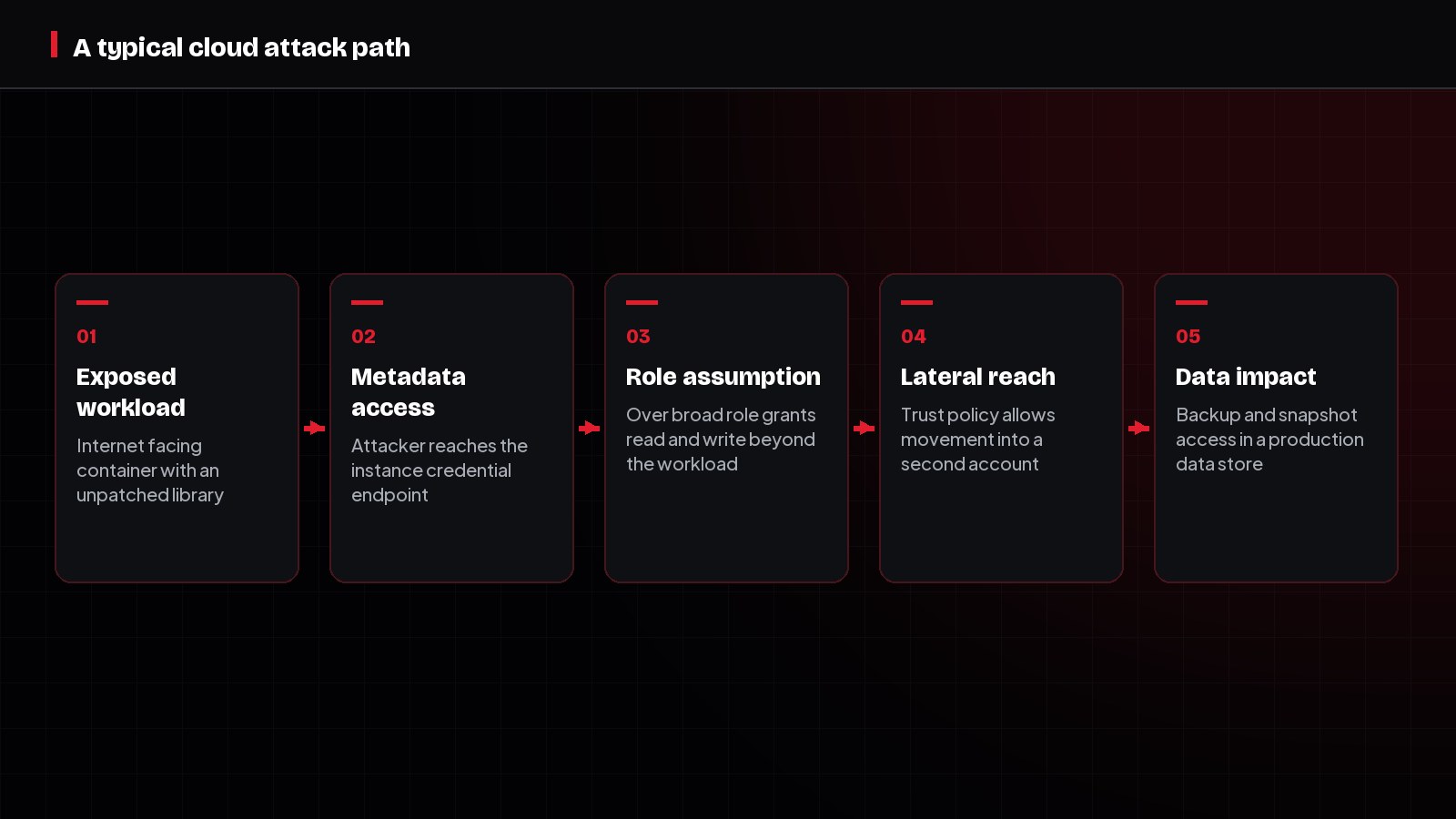
- How a realistic cloud attack path forms
- What CIEM adds to prioritization
- Kubernetes specific exposure that scanners miss
- How to validate safely in a live cloud account
- Cloud specific metrics worth reporting
Explanation
In cloud, the exposure is usually a permission, not a patch
Traditional vulnerability management assumes the risk is a flawed piece of software. In cloud environments the more common story is a correctly patched workload with an over broad role, a storage bucket shared beyond its intended audience, or a trust policy that lets one account act inside another. Those are configuration and entitlement problems. They never appear in a CVE feed, so a CTEM programme that only ingests vulnerability data will miss most of what actually gets exploited.
Discovery has to be continuous and API driven
Cloud inventories change hourly. A quarterly snapshot describes an environment that no longer exists. Connect directly to cloud provider APIs, read the control plane rather than guessing from network scans, and treat every account, subscription and project as in scope until someone documents why it is not. Untracked accounts created by project teams are a recurring source of surprise exposure.
- Enumerate every account, subscription, project and organisational unit, including sandbox and legacy ones
- Read identity configuration: roles, trust policies, federation and long lived keys
- Capture network reachability from the control plane, not only from external scans
- Track workload images and runtime drift, including containers and serverless functions
- Classify data stores and the backups and snapshots attached to them
How a cloud attack path actually forms
Cloud incidents rarely come from a single dramatic flaw. They come from an ordinary chain: something reachable, a credential available to it, a permission wider than it needed, and a data store at the end. Attack path analysis is what makes this visible; individual findings scored in isolation are not.
CIEM: entitlements as a first class exposure
Cloud infrastructure entitlement management looks at what identities can do versus what they actually do. The gap between granted and used permissions is one of the highest value inputs to cloud prioritization, because it directly measures blast radius. An identity that has never used its write permissions to a production data store is an exposure you can remove with low operational risk.
| Entitlement signal | What it tells you | Typical action |
|---|---|---|
| Granted but unused permissions | Blast radius larger than the job requires | Right size the policy and re measure after 30 days |
| Standing privileged access | Persistent high value target | Move to just in time elevation with approval |
| Long lived access keys | Credential likely to leak and never expire | Rotate to short lived federated credentials |
| Cross account trust | Movement between blast radii | Constrain the trust condition and log every assumption |
| Unused service principals | Forgotten non human identity | Disable, monitor, then delete |
Kubernetes exposure that image scanning does not cover
Container image scanning is necessary and insufficient. Most Kubernetes exposure sits in the cluster configuration: permissive role bindings, service accounts mounted into pods that do not need them, workloads running privileged, missing network policy so any pod can talk to any pod, and secrets stored unencrypted. Include the cluster control plane in discovery and treat role bindings with the same seriousness as cloud roles.
- Cluster role bindings that grant broad verbs across all namespaces
- Default service account tokens auto mounted into workloads
- Privileged or host network pods that break the container boundary
- Absent network policy, so lateral movement inside the cluster is unrestricted
- Exposed dashboards, kubelet endpoints and unauthenticated metrics services
Validating safely in a live cloud account
Cloud validation is safer than most teams assume when it is scoped properly. Read only checks, permission simulation and identity path evaluation cause no change at all. Where an active test is needed, run it against a clone of the workload, use a purpose built test identity, and agree a rollback and a communication channel with the cloud owner beforehand. Always record what the detection stack saw, because a cloud test that produces no alert is itself a finding.
Metrics that mean something in cloud
Cloud reporting should track blast radius and reachability, not just how many misconfigurations were closed. Percentage of accounts with no standing privileged access, number of internet reachable paths into production data, and mean time to revoke an over broad entitlement are all better indicators than a raw configuration compliance score.
How to apply this
- Connect every cloud account to discovery, including sandbox and legacy accounts.
- Add entitlement data to prioritization so blast radius is scored, not assumed.
- Model at least one full attack path per production business service.
- Bring Kubernetes role bindings and network policy into scope alongside image scanning.
- Validate with read only checks first, then scoped active tests with the cloud owner present.
Common mistakes
- Treating cloud exposure as a patching problem and missing identity risk entirely.
- Scanning only from outside and never reading the control plane.
- Leaving sandbox and legacy accounts out of scope because nobody claims them.
- Scanning container images while ignoring cluster role bindings.
- Reporting configuration compliance percentages that hide reachable attack paths.
Frequently asked questions
Related pages
Attack Path Analysis
Attack Path Analysis for CTEM: Scoring Real Paths
How to analyse and score attack paths in CTEM: path anatomy, feasibility versus impact scoring, choke points, and turning graphs into prioritized work.
Identity Exposure in CTEM
Identity Exposure in CTEM: Practical Guide
Learn how credentials, secrets, privileges, and service accounts fit into CTEM discovery, prioritization, validation, and remediation.
CTEM for SaaS Security
CTEM for SaaS Security: Apps, Identities and Integrations
Bring SaaS into CTEM: discover shadow SaaS, baseline tenant configuration, score OAuth and token risk, validate safely and mobilize business application owners.
Earn your free CTEM certification.
Ready to prove your CTEM knowledge? Start with the free LearnCTEM Beginner Certification, continue with the Practitioner Certification, and build toward Program Leader. Every LearnCTEM certificate is free, vendor-neutral, and publicly verifiable at LearnCTEM.com.
Beginner / Practitioner / Program Leader
Explore certificationsAuthor
LearnCTEM Editorial Team
Practitioners and educators writing plain-English guides on Continuous Threat Exposure Management.
Reviewed by
Senior CTEM Practitioner Panel
Reviewed for accuracy against public CTEM guidance and real-world program experience.