
What you will learn
- Which CTEM stages benefit from AI and which do not
- Why asset reconciliation is the best first use case
- How AI assists prioritization without owning it
- Why validation evidence must stay deterministic
- The guardrails that keep AI output auditable
- How attackers are using AI, and what that changes
- How to measure whether AI is actually saving effort
Explanation
Match the tool to the problem shape
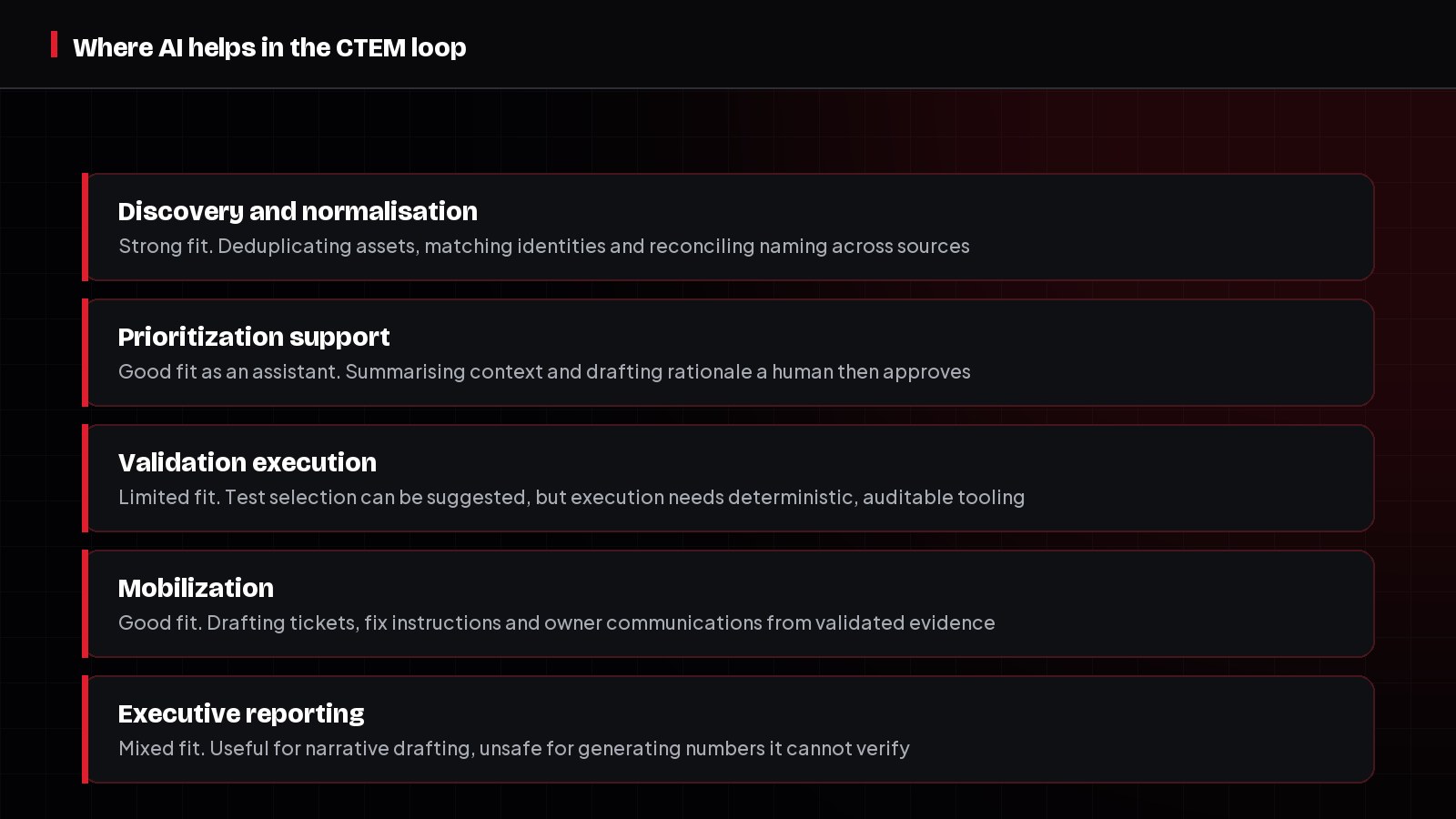
AI is strong at language, pattern matching and reconciliation across messy inputs. Exposure management contains a lot of that: five tools describing the same host with four different names, findings written in inconsistent language, and tickets that need a clear explanation for an engineer who has never read a security advisory. AI is weak where the requirement is proof, reproducibility and an audit trail. Most disappointment with AI in security comes from applying it to the second category.
Best first use case: making the inventory agree with itself
Almost every organisation running CTEM has an asset reconciliation problem. The cloud tool, the endpoint tool, the CMDB and the identity provider each hold a partial and differently named view. Resolving those into one asset record is tedious, high volume and forgiving of occasional error, because a human reviews the merge rules. That makes it an ideal starting point, and it removes a bottleneck every later stage depends on.
Prioritization: assistant, not decision maker
AI can gather the context an analyst would otherwise assemble by hand: what the asset does, which business service it supports, what the advisory says, whether exploitation has been reported and what changed recently. Presenting that summary alongside a draft rationale saves real time. Letting the model set the priority itself removes the accountability that makes prioritization defensible, and produces rankings nobody can explain in a governance meeting.
| Task | AI role | Human role |
|---|---|---|
| Asset deduplication | Propose merges across sources | Approve merge rules and review exceptions |
| Finding summarisation | Write a plain language explanation | Confirm technical accuracy |
| Priority ranking | Draft rationale from gathered context | Own the decision and defend it |
| Validation execution | Suggest which technique to test | Run deterministic tooling and record evidence |
| Executive reporting | Draft narrative around measured numbers | Produce the numbers from system data |
Validation is where AI output must stop
The entire value of the validation stage is that it produces evidence somebody else can check. A generated statement that an exposure is exploitable has no evidential weight, no matter how confident it sounds. Keep validation execution in deterministic, logged tooling, and let AI help only with the surrounding work: choosing candidates, writing the test plan and turning the raw log into a readable summary that still links to the raw log.
Guardrails that keep AI usable in a regulated programme
Auditors and executives do not object to AI. They object to claims with no traceable source. Build the guardrails into the workflow rather than the policy document.
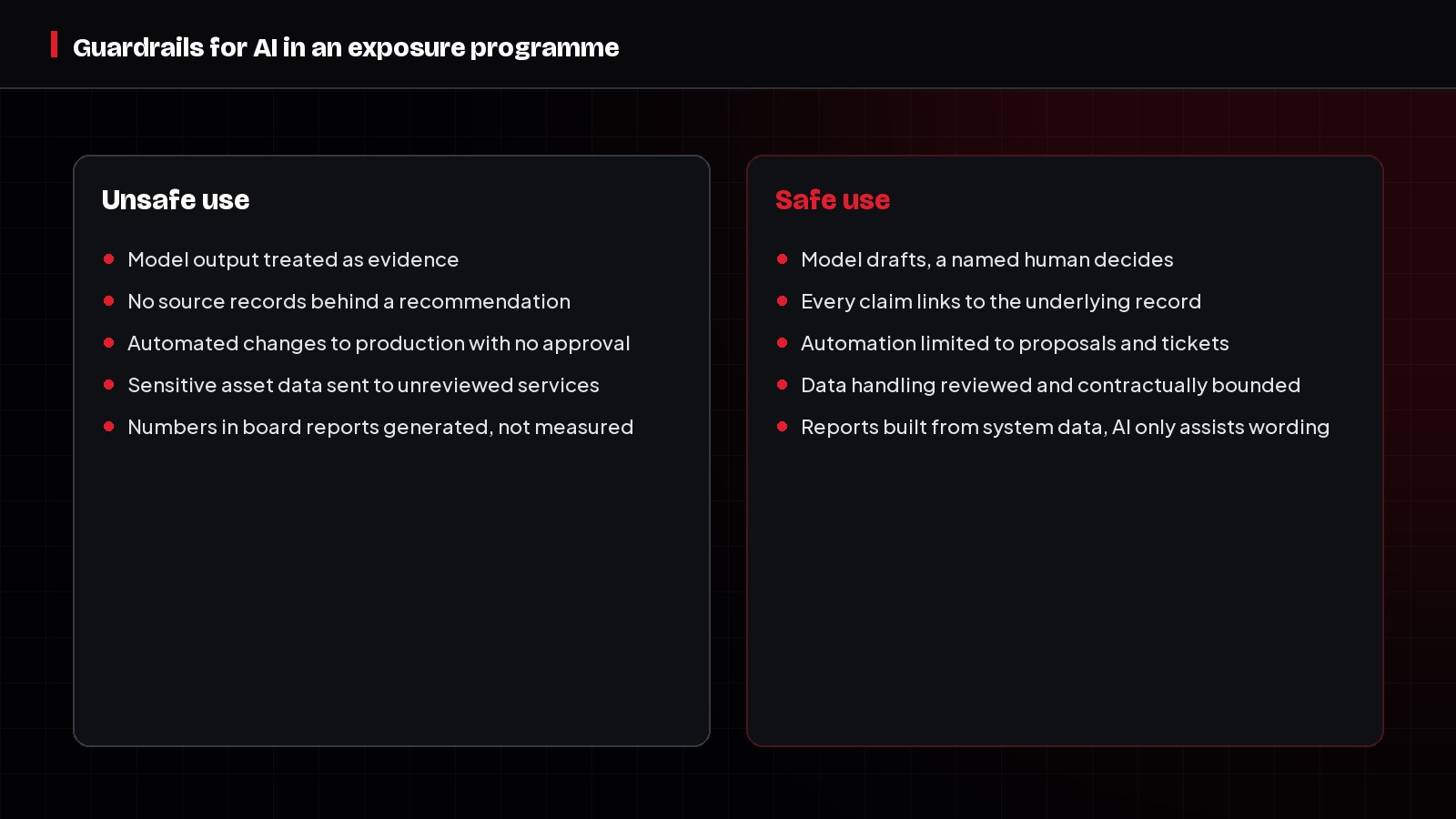
- Every AI generated statement links to the underlying record it came from
- A named human approves anything that changes priority, ownership or production state
- Model output is stored with the prompt and the source data for later review
- Sensitive asset and identity data flows only to reviewed, contractually bounded services
- Board numbers come from the system of record; AI may draft wording but never values
What AI changes on the attacker side
The practical effect of AI on attackers so far is speed and scale rather than novel technique: faster reconnaissance, better written phishing, quicker triage of stolen data and faster adaptation of public exploit code. That shortens the window between disclosure and exploitation attempts, which argues for exactly the behaviours CTEM already promotes: continuous discovery, fast exposure queries and validated mitigation rather than long patch cycles.
Measure whether it is actually helping
Adopt AI the same way you would any other capability, with a before and after measurement. Analyst hours spent on reconciliation, time from finding to decision ready work item, and the proportion of tickets returned by engineers as unclear are three concrete indicators. If none of them move after a quarter, the tool is decoration.
How to apply this
- Start with asset reconciliation, where volume is high and errors are recoverable.
- Require every AI generated claim to link to its source record.
- Keep validation execution in deterministic tooling with stored evidence.
- Never let generated values enter an executive report.
- Measure analyst hours saved and ticket clarity before and after adoption.
Common mistakes
- Treating model output as evidence that an exposure is or is not exploitable.
- Letting AI set priorities that no human can explain in a governance review.
- Sending sensitive asset and identity data to unreviewed services.
- Automating production changes without an approval step.
- Adopting AI without any before and after measurement of effort saved.
Frequently asked questions
Related pages
CTEM Validation
CTEM Validation Explained: Proving Real Exploitability
How CTEM validation works: proving exploitability, testing control effectiveness, choosing techniques, and turning evidence into faster remediation.
CTEM Operating Model
The CTEM Operating Model: Roles, Rhythm, Governance
How to structure a CTEM programme that runs without heroics: six roles, a daily to quarterly rhythm, decision rights, escalation paths and governance evidence.
Complete CTEM Guide 2026
Complete CTEM Guide 2026: Framework and Lifecycle
A complete CTEM guide for 2026: the framework, five lifecycle stages, worked examples, tool categories, metrics and a practical rollout sequence.
Earn your free CTEM certification.
Ready to prove your CTEM knowledge? Start with the free LearnCTEM Beginner Certification, continue with the Practitioner Certification, and build toward Program Leader. Every LearnCTEM certificate is free, vendor-neutral, and publicly verifiable at LearnCTEM.com.
Beginner / Practitioner / Program Leader
Explore certificationsAuthor
LearnCTEM Editorial Team
Practitioners and educators writing plain-English guides on Continuous Threat Exposure Management.
Reviewed by
Senior CTEM Practitioner Panel
Reviewed for accuracy against public CTEM guidance and real-world program experience.