
What you will learn
- Why validation is the stage most programs skip
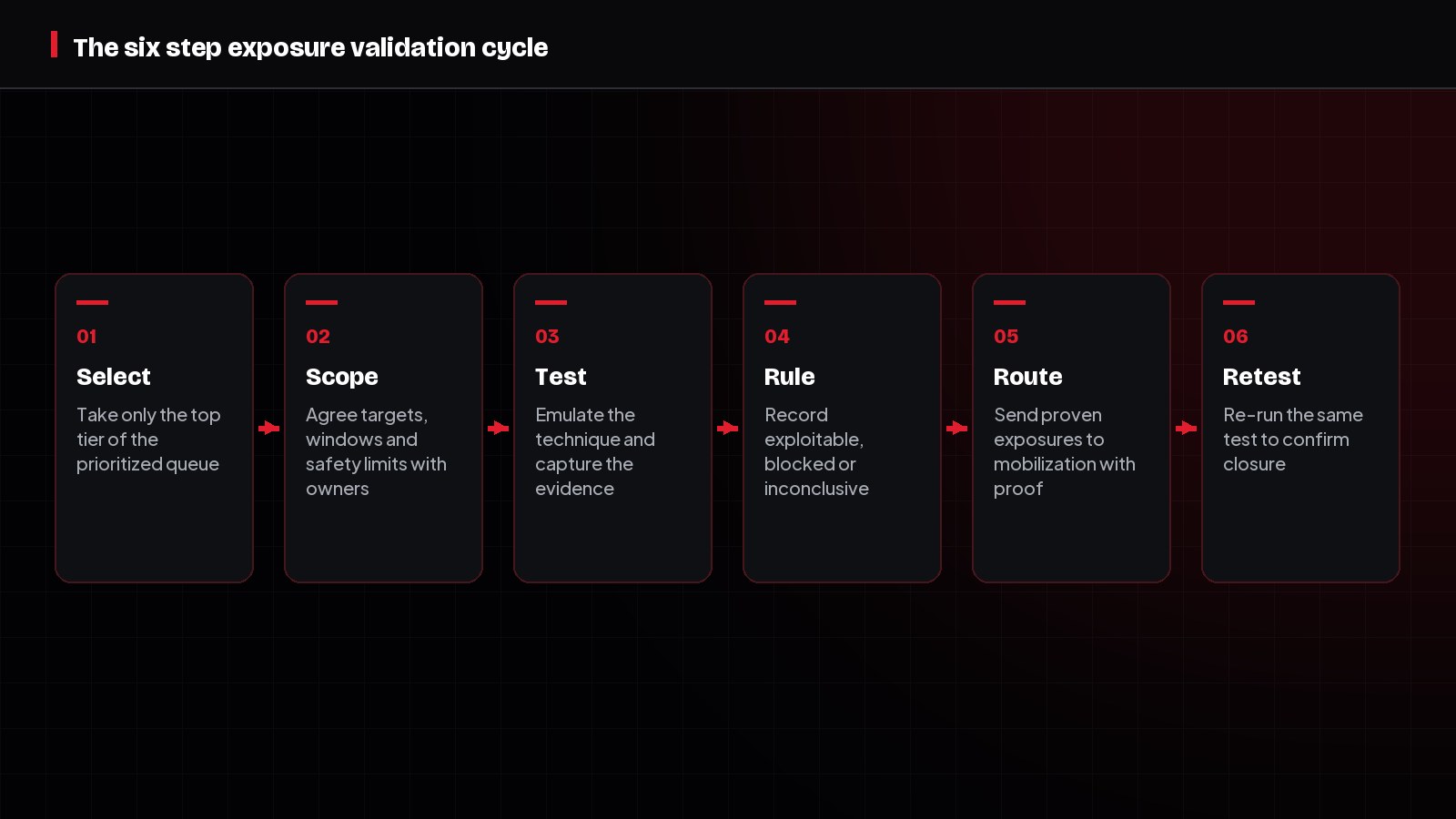
- The six step validation cycle
- How to select validation candidates without wasting effort
- How to scope a test safely in production
- The evidence record every validation should produce
- How to rule an outcome, including inconclusive results
- How retesting turns closure into proof
- The metrics that show validation is working
Explanation
Why validation is the stage most programs skip
Most security teams can produce a long list of findings within a week of buying a scanner. Very few can say which of those findings an attacker could actually use tomorrow morning. Validation closes that gap. It is the difference between reporting that a service is running a vulnerable version and demonstrating that the service is reachable, the exploit path is intact, and no compensating control stops it.
Validation gets skipped because it feels expensive. In practice it is the cheapest way to protect remediation capacity. Every hour of testing that removes a false urgency saves days of engineering effort somewhere else in the organisation, and every proven exposure gets fixed faster because nobody has to argue about whether it matters.
Step 1: select candidates from the prioritized queue
Validation is not a scan of everything. It is a targeted test of the small set of exposures that would change your decisions. Pull candidates from the top of the prioritized queue and add anything that meets an automatic trigger, such as appearing in the CISA Known Exploited Vulnerabilities catalog on an internet facing asset.
- Any exposure on a path that reaches a crown jewel asset
- Anything in the KEV catalog that sits on a reachable service
- High EPSS probability findings on assets tied to revenue or regulated data
- Findings where an owner has disputed the severity or requested an exception
- Any control the organisation believes is protecting a large group of assets
Step 2: scope the test safely
A validation programme that causes an outage will not survive to its second cycle. Scope every test explicitly and agree it with the asset owner before it runs. Safety limits are not bureaucracy, they are what allows testing to happen continuously rather than once with heavy approvals.
| Scope element | What to agree before testing | Why it matters |
|---|---|---|
| Targets | Exact hosts, identities, applications or accounts in scope | Prevents drift into systems nobody agreed to test |
| Techniques | Which attacker behaviours are permitted | Keeps destructive actions out of production |
| Window | Time period and change freeze awareness | Avoids clashing with releases and peak trading |
| Abort criteria | Conditions that stop the test immediately | Gives the owner confidence to say yes |
| Notification | Who is told before, during and after | Stops the SOC treating the test as a live incident |
Step 3: emulate the technique, not the scanner signature
The point of validation is to reproduce what an attacker would do. That may mean confirming that an exposed management interface accepts a default credential, that an over permissive role can read a production bucket, or that a phishing payload executes because an application control policy has an exception. Map each test to a MITRE ATT&CK technique so results aggregate into coverage reporting rather than staying anecdotal.
- 1Reproduce the initial access or entry condition first, because most claimed exposures fail here.
- 2Confirm the follow on action the exposure enables, such as code execution, data read or privilege gain.
- 3Record whether prevention controls blocked the action.
- 4Record whether detection controls produced an alert, and how long it took to appear.
- 5Stop at the point where impact is proven. Validation does not need to complete the attack.
Step 4: rule the outcome honestly
Every validation ends in one of three rulings. Teams that only allow exploitable or not exploitable end up recording guesses, which corrupts the queue. Inconclusive is a legitimate outcome and should trigger a follow up rather than a silent downgrade.
| Ruling | Meaning | What happens next |
|---|---|---|
| Exploitable | The technique worked and impact was demonstrated | Escalate to mobilization with evidence and an SLA |
| Blocked | A control prevented the technique | Record which control, keep the finding at a lower tier |
| Inconclusive | The test could not run properly or results were ambiguous | Requeue with a better scope or a different technique |
Step 5: capture evidence a reviewer can check
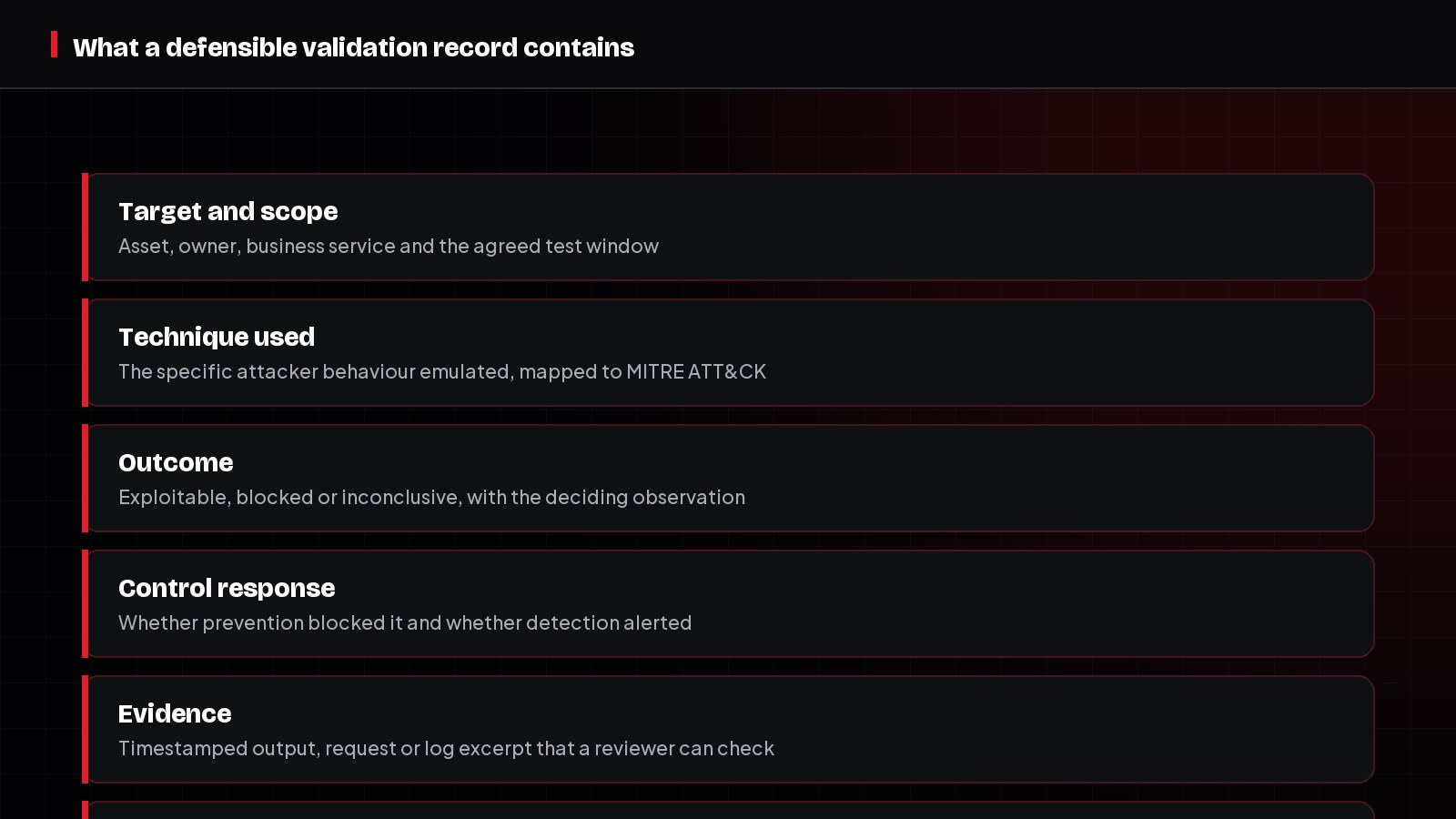
Evidence is what makes validation useful beyond the moment. Auditors, incident responders and future analysts all read validation records. Keep them short but concrete: the technique, the observation that decided the ruling, the timestamp, and the control response. Screenshots without context age badly, so always include what was expected and what actually happened.
Step 6: retest before you accept closure
Closure should be earned. When the owner reports a fix, re-run the exact same test. A surprising proportion of fixes address a symptom rather than the path: a patch is applied to a staging instance, a firewall rule is added but shadowed by a broader allow rule, or a role is edited while an inherited policy keeps the same permission alive.
- Re-run the identical technique against the same target
- Confirm the ruling has changed from exploitable to blocked
- Check that the fix did not simply move the exposure to another asset
- Record the retest date so the closure has an evidence trail
- Feed the result back into the metric that reports validated exposure reduction
How this fits the CTEM lifecycle
Validation sits between prioritization and mobilization. It receives a ranked queue and returns a shorter, evidence backed queue, plus a set of control findings that improve future prioritization. Over time the validation record also becomes a map of which controls reliably work, which is one of the most valuable artefacts a security programme can hold.
How to measure success
| Metric | Definition | Healthy direction |
|---|---|---|
| Validation coverage | Share of top tier exposures validated in a cycle | Rising towards full coverage of the top tier |
| False urgency removed | Findings downgraded after a blocked ruling | Meaningful and stable, proving the queue is being cleaned |
| Control effectiveness rate | Share of tests blocked by an existing control | Rising as control gaps get fixed |
| Retest failure rate | Fixes that fail their first retest | Falling, showing remediation quality is improving |
| Time to validate | Days from prioritization to a ruling | Falling towards days rather than weeks |
How to apply this
- Write a one page validation scope template and use it for every test.
- Agree the three rulings with engineering leadership so results are not renegotiated later.
- Automate the repeatable tests and reserve manual effort for business logic and chained paths.
- Attach the evidence record to the remediation ticket rather than storing it in a separate tool.
- Make retesting a required step before any exposure can be marked closed.
- Report control effectiveness alongside exposure counts so validation improves defences, not just the backlog.
Common mistakes
- Validating everything, which turns the stage into a second scanning programme.
- Testing without an agreed scope, which ends the programme after the first outage.
- Removing the inconclusive ruling, which pushes analysts into recording guesses.
- Keeping evidence in a chat thread instead of the exposure record.
- Closing exposures on the owner's word rather than on a retest.
- Measuring number of tests run rather than risk removed.
Frequently asked questions
Related pages
CTEM Validation
CTEM Validation Explained: Proving Real Exploitability
How CTEM validation works: proving exploitability, testing control effectiveness, choosing techniques, and turning evidence into faster remediation.
Adversarial Exposure Validation
Adversarial Exposure Validation (AEV) Explained
Adversarial exposure validation explained: how AEV combines BAS, automated pentesting and red teaming to prove exposures and test control effectiveness.
CTEM Validate Stage
CTEM Validate Stage: Prove Exposures Are Real
How to run the Validate stage of CTEM: prove reachability and exploitability, test control effectiveness, and record evidence that drives fixes.
CTEM Proving Ground Labs
CTEM Proving Ground Labs: Assessed Hands-On CTEM Labs
Free assessed CTEM labs. Run the five CTEM stages on realistic enterprise scenarios, pass every stage, and earn a verifiable credential.
CTEM Practitioner Certification
CTEM Practitioner Certification: For Analysts and Consultants
The free CTEM Practitioner certification with a scenario exam, exposure register lab, prioritization worksheet, and validation exercise.
Earn your free CTEM certification.
Ready to prove your CTEM knowledge? Start with the free LearnCTEM Beginner Certification, continue with the Practitioner Certification, and build toward Program Leader. Every LearnCTEM certificate is free, vendor-neutral, and publicly verifiable at LearnCTEM.com.
Beginner / Practitioner / Program Leader
Explore certificationsAuthor
LearnCTEM Editorial Team
Practitioners and educators writing plain-English guides on Continuous Threat Exposure Management.
Reviewed by
Senior CTEM Practitioner Panel
Reviewed for accuracy against public CTEM guidance and real-world program experience.