
What you will learn
- What mobilization means and why it is not just ticketing
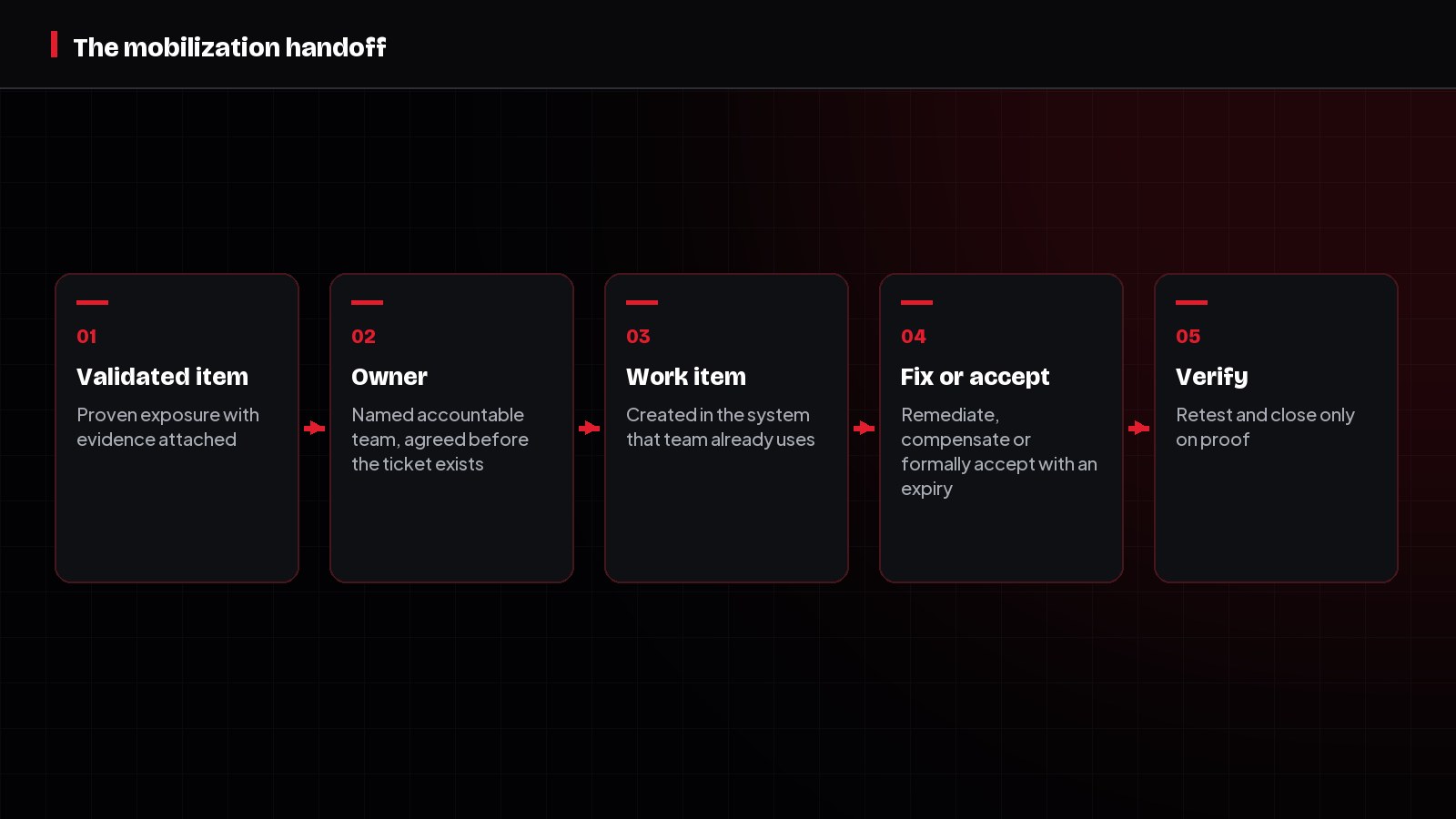
- The handoff that decides whether CTEM works
- How to assign ownership before the ticket exists
- How to set risk based service levels
- How to handle exceptions and accepted risk
- Why closure must depend on verification
- The operating rhythm that keeps mobilization moving
Explanation
Mobilization is an organisational stage, not a technical one
Every earlier CTEM stage happens largely inside the security function. Mobilization does not. It depends on infrastructure, cloud, application, identity and business teams agreeing to change something in production. That is why mobilization is where most programmes stall, and why the fixes are almost always about clarity and process rather than tooling.
Assign ownership before the ticket exists
The single most common failure is creating a ticket and then trying to find someone to accept it. Ownership must be a property of the asset, agreed during scoping, so mobilization is a routing exercise rather than a negotiation. When ownership is unclear, escalate it as a governance issue, not as a security finding.
- Every asset in scope has a named accountable team recorded in the inventory
- Every accountable team has a route into their existing work management system
- Shared platforms have a designated owner even where many teams consume them
- Unowned assets are escalated to the executive sponsor within the same cycle
- Ownership is reviewed whenever a service moves team or platform
Route work where the work already happens
Security teams frequently build a remediation tracker that only security opens. Engineering teams work in their own backlog systems, so anything outside those systems is invisible to sprint planning. Integrate into Jira, ServiceNow, Azure DevOps or whatever the team already uses, and accept that the security view will be a report built on top of those systems rather than a separate queue.
| Ticket element | What good looks like | What causes rejection |
|---|---|---|
| Title | The specific change on the specific asset | A CVE identifier with no context |
| Evidence | Validation result showing it works today | A scanner export |
| Action | Exact remediation or configuration change | Investigate and remediate |
| Impact | What the exposure allows in business terms | Severity label only |
| Deadline | Risk based date with the rule that set it | Immediately |
| Verification | How the fix will be retested | Close when done |
Risk based service levels
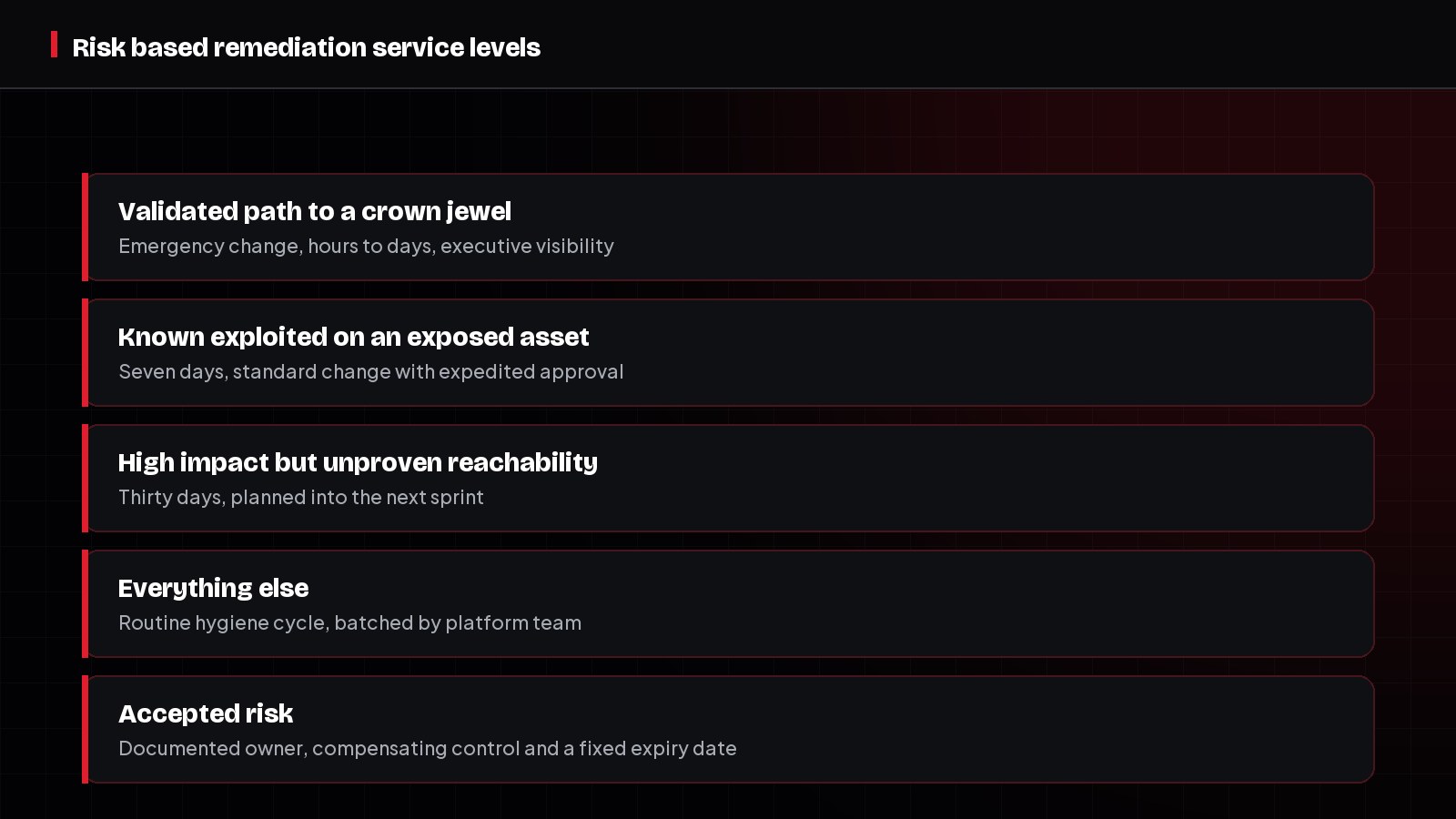
Uniform SLAs fail in both directions: they are too slow for a validated path to a payments database and too aggressive for a low impact issue on an isolated system. Tie the deadline to what validation proved and to the tier of the asset, and write the rule down so nobody has to argue the date.
Exceptions and accepted risk
Some exposures will not be fixed within the SLA, and pretending otherwise pushes teams into quietly ignoring the queue. A working exception process keeps accepted risk visible and time bound, which is also what regulators and auditors expect to see.
- 1The accountable owner requests the exception, not the security team.
- 2The request states the business reason and the compensating control in place.
- 3Security records the residual risk in plain language, not as a score.
- 4An expiry date is set. Permanent exceptions are not permitted.
- 5Exceptions above a defined threshold are approved by the executive risk owner.
- 6Expiring exceptions reappear in the queue automatically for review.
Closure requires verification
An exposure is closed when a retest shows the technique no longer works, not when a ticket is marked done. This single rule changes the behaviour of the whole programme, because it removes the incentive to close items optimistically and it surfaces fixes that were applied to the wrong environment.
The operating rhythm
| Cadence | Meeting | Decision made |
|---|---|---|
| Weekly | Exposure standup with platform leads | Unblock stalled items and confirm this week's work |
| Monthly | Cycle review with security and engineering leadership | Accept the new top tier and review SLA breaches |
| Quarterly | Risk committee | Review accepted risk, expiring exceptions and scope expansion |
| Per change | Emergency change board | Approve fixes for validated paths to critical assets |
How this fits the CTEM lifecycle
Mobilization consumes the validated queue and returns two things: verified closures and honest data about what the organisation can actually deliver. That second output should feed back into scoping and prioritization, because a top tier that consistently exceeds delivery capacity is a prioritization problem disguised as a remediation problem.
How to measure success
- Mean time to remediate validated exposures, segmented by asset tier
- Share of exposures closed with a passing retest rather than on assertion
- SLA breach rate by owning team, used to find capacity problems not to punish
- Number of active exceptions and the volume of risk they represent
- Percentage of assets with a named accountable owner
How to apply this
- Record an accountable owner for every asset in scope before the first cycle starts.
- Integrate remediation work into the systems engineering already uses.
- Publish risk based SLAs with the rule that sets each deadline.
- Require evidence, action and verification method in every ticket.
- Give every exception an owner, a compensating control and an expiry date.
- Close exposures only after a retest confirms the technique fails.
Common mistakes
- Creating tickets before ownership is agreed.
- Running a separate security backlog engineering never opens.
- Applying one uniform SLA to every severity level.
- Allowing permanent exceptions, which converts accepted risk into invisible risk.
- Closing on assertion rather than on a retest.
- Treating SLA breaches as a compliance failure rather than a capacity signal.
Frequently asked questions
Related pages
CTEM Mobilize Stage
CTEM Mobilize Stage: Turn Findings Into Fixes
How to run the Mobilize stage of CTEM: route exposures to named owners, set SLAs from validated risk, unblock work, and prove closure.
CTEM Remediation Playbook
CTEM Remediation Playbook
A practical CTEM mobilization playbook for assigning owners, creating tickets, setting SLAs, handling exceptions, and validating fixes.
Choke Point Remediation
Choke Point Remediation in CTEM Programs
Choke point remediation in CTEM: how to find the few nodes that carry most attack paths, fix them safely, and report risk reduction instead of ticket counts.
CTEM Governance and Risk Acceptance
CTEM Governance and Risk Acceptance
Map CTEM governance to board oversight, audit evidence, NIST CSF, DORA, NIS2, and SEC cybersecurity disclosure expectations.
CTEM Program Leader Certification
CTEM Program Leader Certification: For CISOs and Managers
The free CTEM Program Leader certification covering operating model, metrics, reporting, governance, and a program capstone.
Earn your free CTEM certification.
Ready to prove your CTEM knowledge? Start with the free LearnCTEM Beginner Certification, continue with the Practitioner Certification, and build toward Program Leader. Every LearnCTEM certificate is free, vendor-neutral, and publicly verifiable at LearnCTEM.com.
Beginner / Practitioner / Program Leader
Explore certificationsAuthor
LearnCTEM Editorial Team
Practitioners and educators writing plain-English guides on Continuous Threat Exposure Management.
Reviewed by
Senior CTEM Practitioner Panel
Reviewed for accuracy against public CTEM guidance and real-world program experience.