
What you will learn
- What a choke point is in exposure management
- Why finding by finding remediation never catches up
- The five common choke point types
- How to identify choke points from your own data
- How to change a choke point without breaking production
- How to report choke point work to executives
Explanation
The arithmetic that breaks traditional remediation
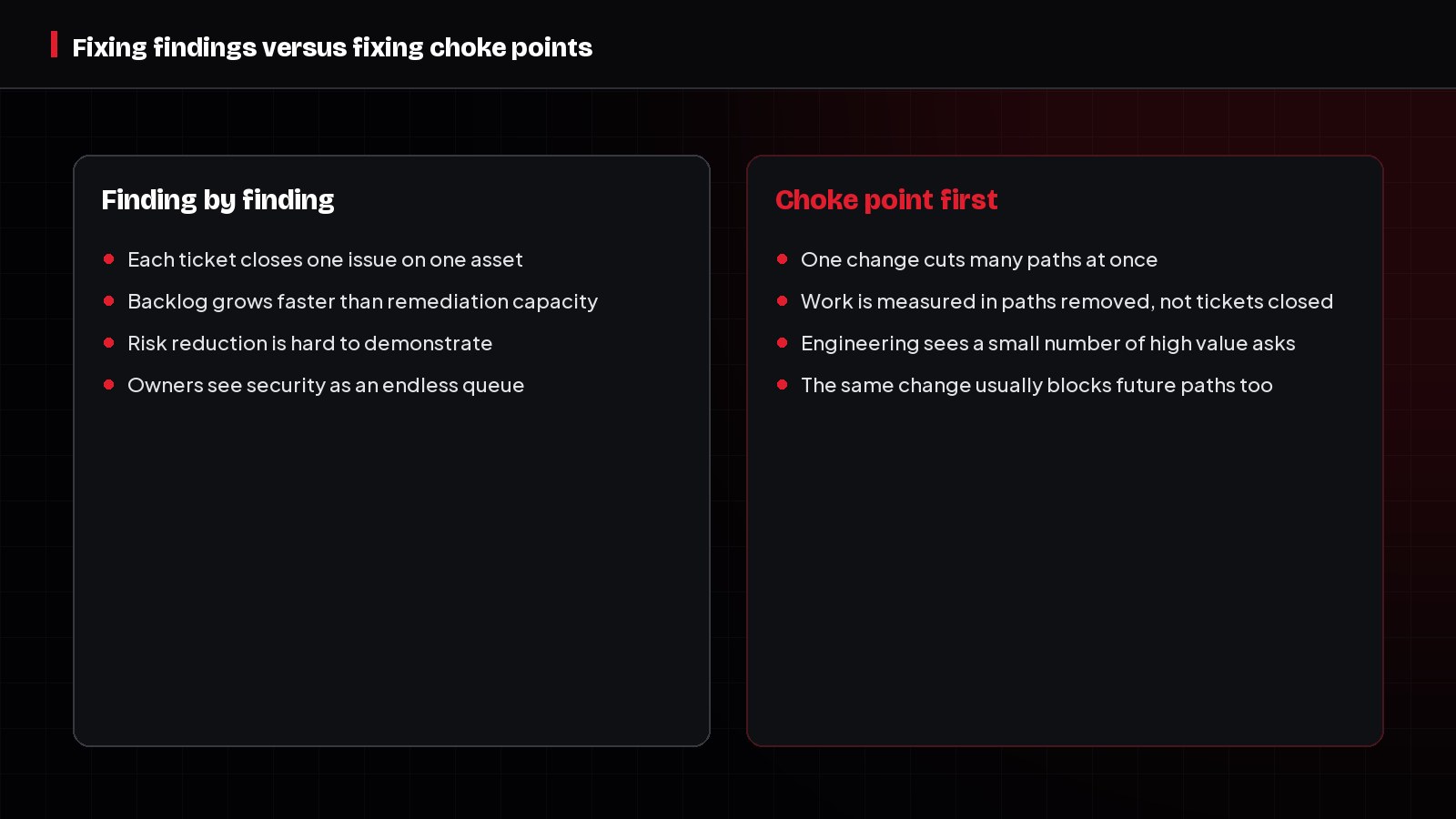
A mid sized enterprise typically discovers tens of thousands of findings and can remediate a few hundred a month. No amount of prioritization fixes that ratio if every ticket closes one issue on one asset. Choke point remediation changes the unit of work: instead of asking how many findings were closed, it asks how many attack paths stopped existing.
What counts as a choke point
A choke point is any node that a large share of critical attack paths must pass through. It is usually not the most vulnerable asset in the estate. It is normally something convenient that was built years ago and never revisited, which is exactly why it accumulates so much reachability.
| Choke point type | Typical example | Structural fix |
|---|---|---|
| Over privileged service account | A backup or monitoring account with domain wide rights | Scope rights per host group, rotate and vault the credential |
| Shared local administrator | One local admin password reused across a fleet | Unique per host passwords managed automatically |
| Flat management network | A jump host reachable from every user segment | Restrict access to a bastion with brokered sessions |
| Broad cloud role | A role attached to every workload in a cluster | Split into per workload roles with least privilege |
| Federated trust | A partner or subsidiary trust with unrestricted scope | Constrain the trust, scope claims, add conditional access |
How to identify choke points from your own data
You do not need a full graph platform to start. Identity and access data alone reveals most choke points, because permissions are what let an attacker convert one foothold into many.
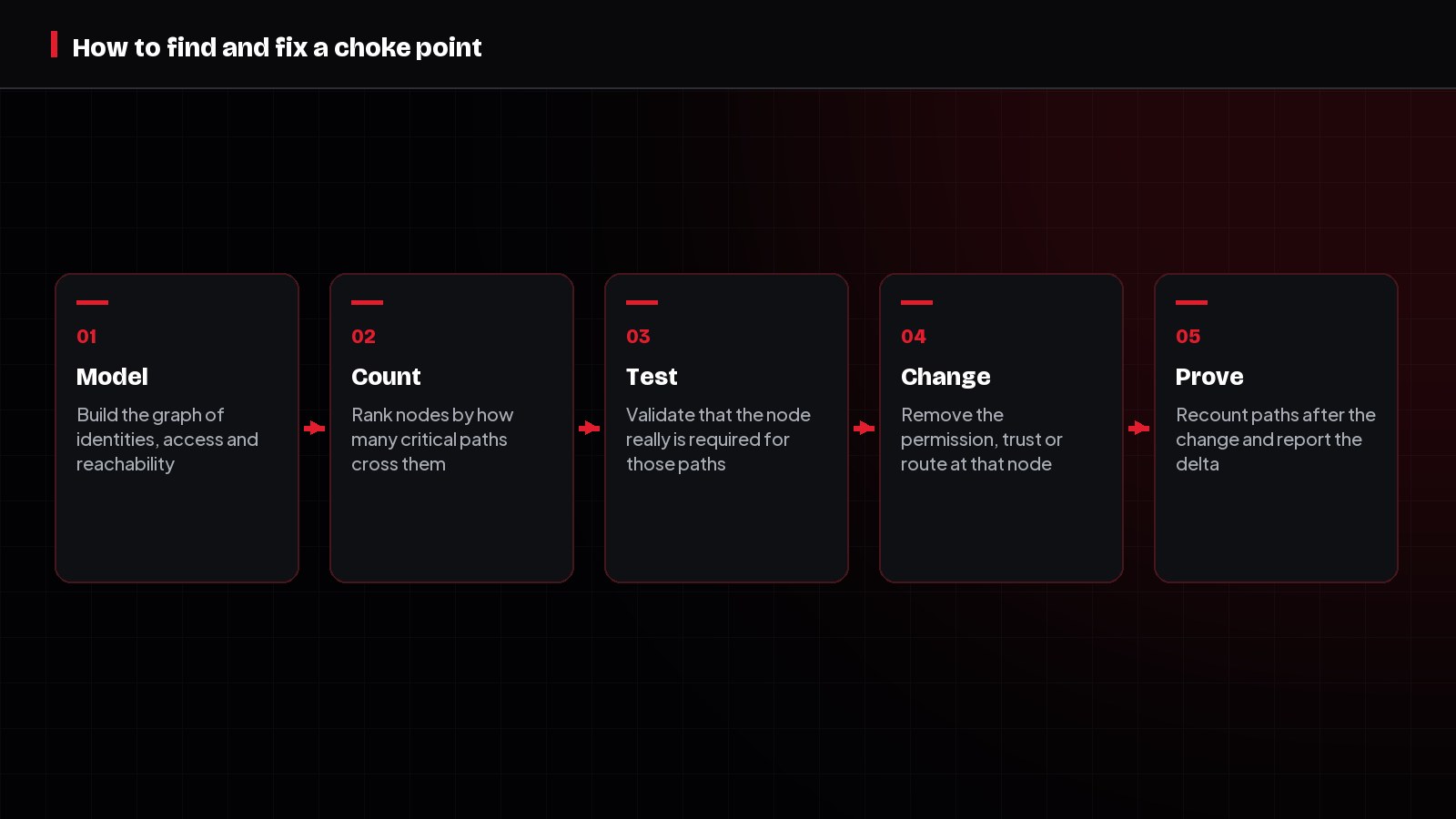
- 1Build the list of critical assets and the systems that grant access to them.
- 2Enumerate which identities, hosts and network routes can reach each critical asset.
- 3Count how many distinct paths pass through each node and rank the top twenty.
- 4Validate that those hops actually work today rather than trusting configuration alone.
- 5Choose the change that removes capability with the least operational disruption.
- 6Recount paths afterwards and record the difference as the delivered outcome.
Changing a choke point without breaking production
Choke points are load bearing. That is what makes them choke points. The change must be planned like an infrastructure change rather than a security fix, and the security team should expect to do most of the analysis work rather than handing engineering an instruction.
- Collect usage telemetry first, so you know which permissions are actually exercised
- Introduce the replacement path before removing the old one, then cut over
- Stage the change by environment and by host group, never estate wide in one step
- Agree a rollback that can be executed by the on call team without security involvement
- Monitor for failed jobs and denied API calls for a full business cycle after the change
- Only close the item after a retest confirms the paths are gone
Reporting choke point work to executives
Choke point work produces few tickets and large outcomes, which is the opposite shape of the metrics most security programmes report. Change the report before you change the work, otherwise the programme looks less productive while it is delivering more risk reduction.
| Old metric | Replacement | Why it is better |
|---|---|---|
| Findings closed | Attack paths removed | Reflects consequence rather than volume |
| Patch compliance percentage | Critical assets with no validated path | Answers the question the board actually asks |
| Mean time to remediate | Mean time to close a validated path | Focuses effort on what carries risk |
| Open critical count | Choke points remaining in the top twenty | Turns an endless list into a finite programme of work |
How this fits the CTEM lifecycle
Choke point remediation is a mobilization pattern that depends on good prioritization and validation upstream. Discovery supplies the nodes, path analysis identifies the concentration, validation proves the hops are real, and mobilization delivers a small number of structural changes. The next cycle then measures how many paths disappeared.
How to measure success
- Number of validated paths removed per structural change
- Reduction in identities that can reach a crown jewel asset
- Share of the top twenty choke points remediated or compensated
- Rate at which removed paths reappear through alternative routes
- Engineering hours spent per path removed, which should fall sharply over time
How to apply this
- Rank your top twenty nodes by the number of critical paths passing through them.
- Pick the single highest leverage node and treat it as a project, not a ticket.
- Gather permission usage telemetry before proposing any removal.
- Stage the change with a tested rollback and a monitoring window.
- Retest the paths after the change and publish the count that disappeared.
- Replace ticket volume metrics with path reduction metrics in your monthly report.
Common mistakes
- Removing a permission without usage data, which causes an outage and stalls the programme.
- Treating the choke point as a security ticket instead of an infrastructure change.
- Fixing the asset instead of the capability, so the path returns in another form.
- Skipping the recount, which leaves the team unable to prove the value of the work.
- Choosing the easiest node rather than the highest leverage one.
Frequently asked questions
Related pages
Attack Path Analysis
Attack Path Analysis for CTEM: Scoring Real Paths
How to analyse and score attack paths in CTEM: path anatomy, feasibility versus impact scoring, choke points, and turning graphs into prioritized work.
CTEM Remediation Playbook
CTEM Remediation Playbook
A practical CTEM mobilization playbook for assigning owners, creating tickets, setting SLAs, handling exceptions, and validating fixes.
Identity Exposure in CTEM
Identity Exposure in CTEM: Practical Guide
Learn how credentials, secrets, privileges, and service accounts fit into CTEM discovery, prioritization, validation, and remediation.
CTEM Mobilize Stage
CTEM Mobilize Stage: Turn Findings Into Fixes
How to run the Mobilize stage of CTEM: route exposures to named owners, set SLAs from validated risk, unblock work, and prove closure.
CTEM Practitioner Certification
CTEM Practitioner Certification: For Analysts and Consultants
The free CTEM Practitioner certification with a scenario exam, exposure register lab, prioritization worksheet, and validation exercise.
Earn your free CTEM certification.
Ready to prove your CTEM knowledge? Start with the free LearnCTEM Beginner Certification, continue with the Practitioner Certification, and build toward Program Leader. Every LearnCTEM certificate is free, vendor-neutral, and publicly verifiable at LearnCTEM.com.
Beginner / Practitioner / Program Leader
Explore certificationsAuthor
LearnCTEM Editorial Team
Practitioners and educators writing plain-English guides on Continuous Threat Exposure Management.
Reviewed by
Senior CTEM Practitioner Panel
Reviewed for accuracy against public CTEM guidance and real-world program experience.